Australian Dollar remains steady after recovering losses, US ISM Manufacturing PMI eyed
- The Australian Dollar rebounds due to improved market sentiment following news of the US scaling back its goals for tariff deal negotiations.
- China's Caixin Manufacturing PMI climbed to 50.4 in June from 48.3 in May.
- The US Dollar extends its losing streak due to growing Fed uncertainty and fiscal concerns.

The Australian Dollar (AUD) recovers its daily losses against the US Dollar (USD) on Tuesday amid improved risk appetite, driven by the news that the US may scale back its goals for comprehensive reciprocal agreements with trading partners. US President Donald Trump’s top trade officials were seeking phased deals with the most engaged countries as they hurried to reach an agreement by the July 9 deadline, when Trump had vowed to reimpose his harshest levies, per the Financial Times.
However, the AUD/USD pair faced challenges as Australia’s S&P Global Manufacturing Purchasing Managers’ Index (PMI) fell to 50.6 in June from the previous 51.0. The output declined to its lowest reading since February due to adequate client inventories and weaker market conditions, data showed on Tuesday.
China's Caixin Manufacturing Purchasing Managers' Index improved to 50.4 in June from 48.3 in May, according to the latest data released on Tuesday. The reading surpassed the market forecast of 49.0. This is important to note that any economic change in China could impact AUD as both countries are close trade partners.
The AUD/USD pair may regain its ground as the US Dollar continues to face challenges amid growing uncertainty over the Federal Reserve (Fed) policy outlook and a rising fiscal concern in the United States (US). Additionally, traders adopt caution over a sweeping tax and spending bill currently under consideration in the Senate, which could add $3.3 trillion to the national debt.
Australian Dollar advances as US Dollar weakens amid improved risk appetite
- The US Dollar Index (DXY), which measures the value of the US Dollar against six major currencies, is continuing its losing streak that began on June 19 and is trading at around 96.70 at the time of writing. Traders await the US June ISM Manufacturing Purchasing Managers Index (PMI) data due later on Tuesday.
- The US Personal Consumption Expenditures (PCE) Price Index climbed by 2.3% year-over-year in May, up from the 2.2% rise in April (revised from 2.1%). This reading came in line with market expectations. Meanwhile, the core PCE Price Index, which excludes volatile food and energy prices, rose 2.7%, following the previous 2.6% increase (revised from 2.5%).
- The President of the Federal Reserve Bank of Minneapolis, Neel Kashkari, noted on Friday that he was sticking to his view that cooling inflation would allow the Fed to cut its policy rate twice that year, beginning in September.
- US President Donald Trump could weaken Fed Chair Jerome Powell’s authority by announcing his preferred candidate to lead the central bank next year. Trump said that he has a list of potential Powell successors down to “three or four people,” without naming the finalists. Chicago Fed President Austan Goolsbee said on Thursday that political waves are not a factor in decision-making, nor would the naming of a shadow chair, per CNBC.
- Fed Chair Jerome Powell noted on Wednesday that Trump's tariff policies may cause a one-time price hike, but they could also lead to more persistent inflation. The Fed should be careful in considering further rate cuts.
- A US intelligence report indicated that US strikes on Iranian nuclear sites have set back Tehran's program by only a matter of months, per Reuters. Iranian Foreign Minister Abbas Araghchi noted that Tehran has no intention of resuming nuclear negotiations with the United States, per CNN.
- China’s NBS Manufacturing Purchasing Managers' Index (PMI) advanced to 49.7 in June, compared with 49.5 in May. The data came in line with the market consensus in the reported month. The NBS Non-Manufacturing PMI rose to 50.5 in June versus May’s 50.3 and the expected 50.3 reading.
- TD-MI Inflation Gauge edged up 0.1% month-over-month in June, reversing a 0.4% previous decline. The rise came even as both headline and underlying inflation continued to ease within the Reserve Bank of Australia’s (RBA) 2–3% target range.
- Australia's Private Sector Credit climbed to 0.5% month-over-month in May, against the market expectations and the prior month's 0.7% rise. The slowdown was primarily due to a deceleration in business loans, which eased to 0.8% from 1% in April.
Australian Dollar trades near 0.6560 after pulling back from eight-month highs
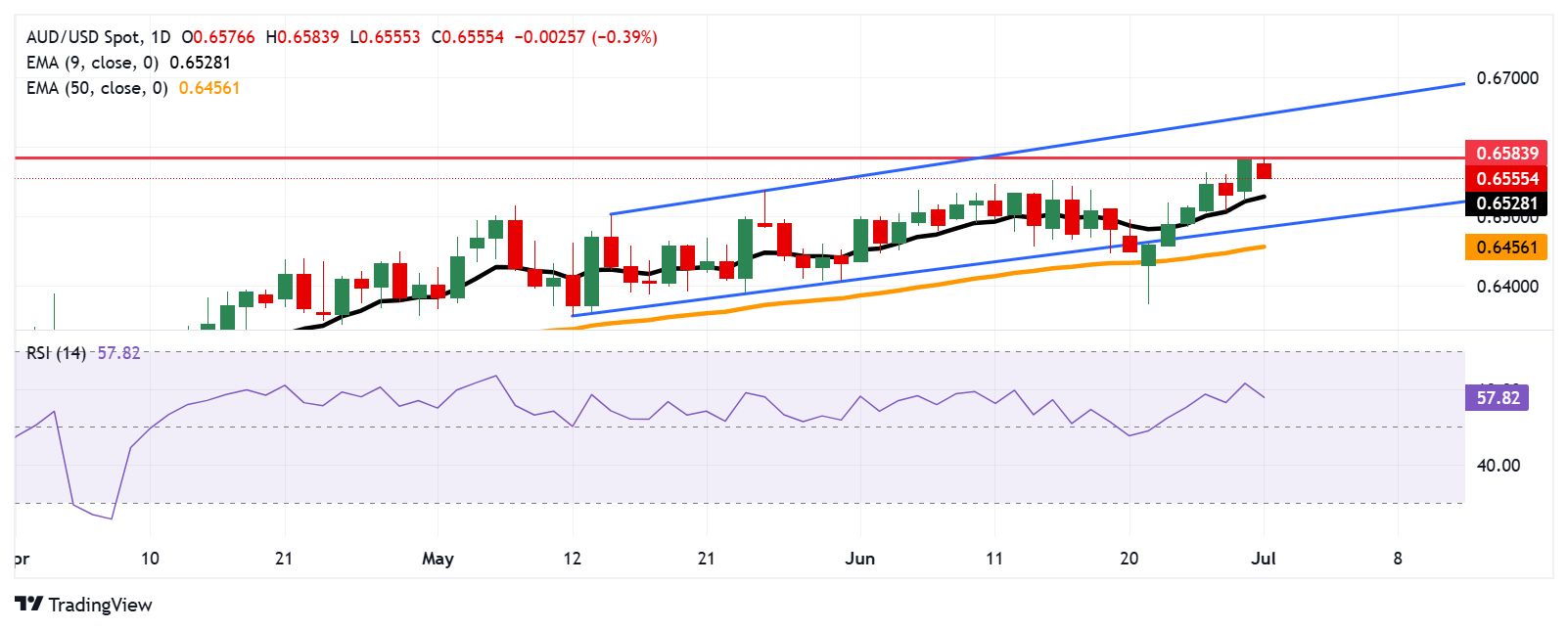
The AUD/USD pair is trading around 0.6560 on Tuesday. The daily technical analysis indicates a persistent bullish bias as the pair remains within the ascending channel pattern. The 14-day Relative Strength Index (RSI) is positioned above the 50 mark. Additionally, the pair rises above the nine-day Exponential Moving Average (EMA), indicating that short-term price momentum is stronger.
On the upside, the AUD/USD pair could rebound to the fresh eight-month high of 0.6583, which was recorded on July 1, followed by the upper boundary of the ascending channel around 0.6650.
The nine-day EMA at 0.6529 appears as the primary support. A break below this level would weaken the short-term price momentum and put downward pressure on the AUD/USD pair to test the lower boundary of the ascending channel around 0.6490, aligned with the 50-day EMA at 0.6456.
AUD/USD: Daily Chart
Australian Dollar PRICE Today
The table below shows the percentage change of Australian Dollar (AUD) against listed major currencies today. Australian Dollar was the strongest against the Canadian Dollar.
| USD | EUR | GBP | JPY | CAD | AUD | NZD | CHF | |
|---|---|---|---|---|---|---|---|---|
| USD | 0.04% | -0.10% | -0.26% | -0.01% | 0.00% | -0.09% | -0.12% | |
| EUR | -0.04% | -0.13% | -0.39% | -0.05% | 0.05% | -0.15% | -0.15% | |
| GBP | 0.10% | 0.13% | -0.16% | 0.11% | 0.19% | -0.01% | -0.02% | |
| JPY | 0.26% | 0.39% | 0.16% | 0.30% | 0.27% | 0.15% | 0.15% | |
| CAD | 0.00% | 0.05% | -0.11% | -0.30% | -0.00% | -0.12% | -0.13% | |
| AUD | -0.01% | -0.05% | -0.19% | -0.27% | 0.00% | -0.20% | -0.21% | |
| NZD | 0.09% | 0.15% | 0.01% | -0.15% | 0.12% | 0.20% | -0.01% | |
| CHF | 0.12% | 0.15% | 0.02% | -0.15% | 0.13% | 0.21% | 0.01% |
The heat map shows percentage changes of major currencies against each other. The base currency is picked from the left column, while the quote currency is picked from the top row. For example, if you pick the Australian Dollar from the left column and move along the horizontal line to the US Dollar, the percentage change displayed in the box will represent AUD (base)/USD (quote).
Australian Dollar FAQs
One of the most significant factors for the Australian Dollar (AUD) is the level of interest rates set by the Reserve Bank of Australia (RBA). Because Australia is a resource-rich country another key driver is the price of its biggest export, Iron Ore. The health of the Chinese economy, its largest trading partner, is a factor, as well as inflation in Australia, its growth rate and Trade Balance. Market sentiment – whether investors are taking on more risky assets (risk-on) or seeking safe-havens (risk-off) – is also a factor, with risk-on positive for AUD.
The Reserve Bank of Australia (RBA) influences the Australian Dollar (AUD) by setting the level of interest rates that Australian banks can lend to each other. This influences the level of interest rates in the economy as a whole. The main goal of the RBA is to maintain a stable inflation rate of 2-3% by adjusting interest rates up or down. Relatively high interest rates compared to other major central banks support the AUD, and the opposite for relatively low. The RBA can also use quantitative easing and tightening to influence credit conditions, with the former AUD-negative and the latter AUD-positive.
China is Australia’s largest trading partner so the health of the Chinese economy is a major influence on the value of the Australian Dollar (AUD). When the Chinese economy is doing well it purchases more raw materials, goods and services from Australia, lifting demand for the AUD, and pushing up its value. The opposite is the case when the Chinese economy is not growing as fast as expected. Positive or negative surprises in Chinese growth data, therefore, often have a direct impact on the Australian Dollar and its pairs.
Iron Ore is Australia’s largest export, accounting for $118 billion a year according to data from 2021, with China as its primary destination. The price of Iron Ore, therefore, can be a driver of the Australian Dollar. Generally, if the price of Iron Ore rises, AUD also goes up, as aggregate demand for the currency increases. The opposite is the case if the price of Iron Ore falls. Higher Iron Ore prices also tend to result in a greater likelihood of a positive Trade Balance for Australia, which is also positive of the AUD.
The Trade Balance, which is the difference between what a country earns from its exports versus what it pays for its imports, is another factor that can influence the value of the Australian Dollar. If Australia produces highly sought after exports, then its currency will gain in value purely from the surplus demand created from foreign buyers seeking to purchase its exports versus what it spends to purchase imports. Therefore, a positive net Trade Balance strengthens the AUD, with the opposite effect if the Trade Balance is negative.
Author

Akhtar Faruqui
FXStreet
Akhtar Faruqui is a Forex Analyst based in New Delhi, India. With a keen eye for market trends and a passion for dissecting complex financial dynamics, he is dedicated to delivering accurate and insightful Forex news and analysis.

















