Australian Dollar maintains its position post intraday gains, focus on US data
- Australian Dollar extends its gains despite downbeat Retail Sales data from the country.
- Australia’s Retail Sales declined by 0.2% against the expected growth of 0.1%.
- RBA Governor Bullock mentioned the need for caution in employing high interest rates to curb inflation.
- US Dollar extends its losses as US Treasury yields decline.

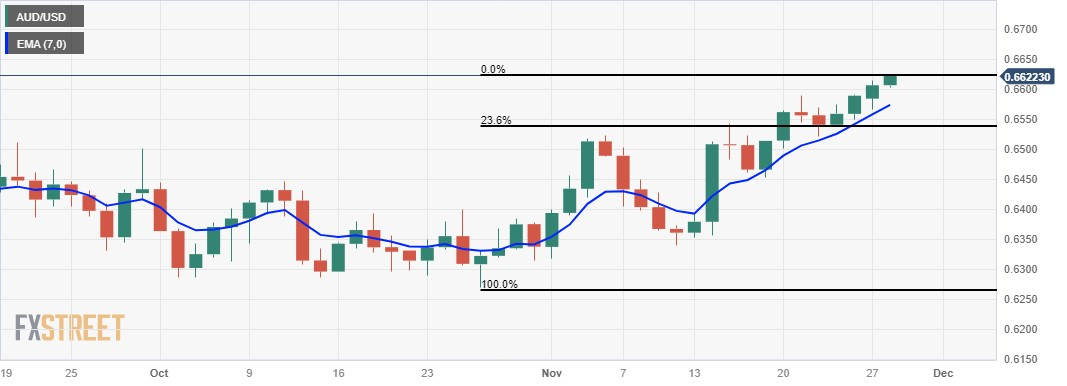
The Australian Dollar (AUD) continues its winning streak for the fourth successive session despite downbeat seasonally adjusted Retail Sales data from Australia on Tuesday. The AUD/USD pair hovers near its peak from early August near the 0.6625 level, benefiting from a downward bias that has left the Greenback appearing susceptible.
Australia’s primary gauge of consumer spending is released by the Australian Bureau of Statistics (ABS), which showed monthly readings for October declined by 0.2% against the market expectations of a 0.1% rise and 0.9% prior.
Australia's Dollar (AUD) received a lift from positive market sentiment and the unveiling of the Chinese stimulus plan. Additionally, Reserve Bank of Australia (RBA) Governor Michele Bullock added her insights to a panel discussion titled "Inflation, Financial Stability, and Employment" on Tuesday. She highlighted that the current monetary policy is on the restrictive side, with rate hikes putting a damper on demand, particularly in the context of persistent services inflation.
Governor Bullock emphasized the need for caution in employing high interest rates to combat inflation without inadvertently raising the unemployment rate. Her expectation is for inflation to decrease to just under 3.0% in 2025, acknowledging the uncertainty surrounding the path of inflation. Subsequently, on Wednesday, traders will closely observe the Monthly Consumer Price Index (YoY) for further market insights.
US Dollar Index (DXY) marks its lowest since late August on Tuesday. The prevailing trend continues to lean towards the downside, fueled by a dip in US Treasury yields, notably with the 2 and 10-year bond yields slipping to 4.86% and 4.39%, respectively, by the press time.
United States (US) is slated to release key data on Tuesday, including the Housing Price Index and CB Consumer Confidence. Additionally, market participants will be tuning in to several speeches from Federal Reserve (Fed) officials, providing insights into the central bank's perspective on the economic landscape.
Daily Digest Market Movers: Australian Dollar continues to move on an upward trajectory on hawkish RBA
- RBA's meeting minutes revealed that the board acknowledged a "credible case" against an immediate rate hike but considered the case for tightening stronger due to increased inflation risks. The decision on further tightening would hinge on data and risk assessment.
- National Australia Bank (NAB) anticipates another RBA rate hike, expecting it to occur at the February 2024 meeting.
- The People's Bank of China (PBoC) has issued a notice to strengthen financial support for private firms. This comprehensive support encompasses assistance for private enterprises in listing and financing, mergers and acquisitions, as well as restructuring.
- China's Industrial Profit Year-to-Date (YTD) data narrowed to a decline of 7.8%, an improvement from the previous drop of 9.0%. In the month of October, there was a positive shift, with industrial enterprises' profits showing a 2.7% increase, contrasting with the 11.9% decrease observed earlier.
- The Federal Open Market Committee (FOMC) meeting minutes revealed that members would further entertain the idea of tightening monetary policy if incoming information suggests insufficient progress toward the Committee's inflation objective.
- FOMC members unanimously agree that policy should stay restrictive for some time until there is clear and sustainable evidence of inflation moving down toward the Committee's target.
- US New Home Sales fell by 5.6% to 679K compared to the market consensus of 725K.
Technical Analysis: Australian Dollar moves above the psychological level of 0.6600
The Australian Dollar hovers around the 0.6620 level on Tuesday. The next key resistance is at 0.6650. A breakthrough above the level could support the AUD/USD pair to approach the psychological resistance region around 0.6700 level followed by August’s high at 0.6723. On the downside, the psychological level of 0.6600 could be the key support before with the seven-day Exponential Moving Average (EMA) at 0.6573. A decisive break below the latter could push the pair to test support near the 23.6% Fibonacci retracement at 0.6537.
AUD/USD: Daily Chart
Australian Dollar price today
The table below shows the percentage change of Australian Dollar (AUD) against listed major currencies today. Australian Dollar was the strongest against the Pound Sterling.
| USD | EUR | GBP | CAD | AUD | JPY | NZD | CHF | |
| USD | 0.08% | 0.06% | -0.05% | -0.07% | -0.11% | 0.02% | 0.02% | |
| EUR | -0.07% | -0.01% | -0.12% | -0.14% | -0.17% | -0.04% | -0.05% | |
| GBP | -0.06% | 0.01% | -0.10% | -0.13% | -0.17% | -0.04% | -0.03% | |
| CAD | 0.05% | 0.12% | 0.10% | -0.02% | -0.06% | 0.08% | 0.07% | |
| AUD | 0.08% | 0.13% | 0.14% | 0.03% | -0.03% | 0.10% | 0.13% | |
| JPY | 0.10% | 0.18% | 0.17% | 0.06% | 0.03% | 0.12% | 0.14% | |
| NZD | -0.03% | 0.05% | 0.03% | -0.09% | -0.10% | -0.14% | 0.01% | |
| CHF | -0.04% | 0.05% | 0.03% | -0.07% | -0.09% | -0.14% | 0.01% |
The heat map shows percentage changes of major currencies against each other. The base currency is picked from the left column, while the quote currency is picked from the top row. For example, if you pick the Euro from the left column and move along the horizontal line to the Japanese Yen, the percentage change displayed in the box will represent EUR (base)/JPY (quote).
Australian Dollar FAQs
What key factors drive the Australian Dollar?
One of the most significant factors for the Australian Dollar (AUD) is the level of interest rates set by the Reserve Bank of Australia (RBA). Because Australia is a resource-rich country another key driver is the price of its biggest export, Iron Ore. The health of the Chinese economy, its largest trading partner, is a factor, as well as inflation in Australia, its growth rate and Trade Balance. Market sentiment – whether investors are taking on more risky assets (risk-on) or seeking safe-havens (risk-off) – is also a factor, with risk-on positive for AUD.
How do the decisions of the Reserve Bank of Australia impact the Australian Dollar?
The Reserve Bank of Australia (RBA) influences the Australian Dollar (AUD) by setting the level of interest rates that Australian banks can lend to each other. This influences the level of interest rates in the economy as a whole. The main goal of the RBA is to maintain a stable inflation rate of 2-3% by adjusting interest rates up or down. Relatively high interest rates compared to other major central banks support the AUD, and the opposite for relatively low. The RBA can also use quantitative easing and tightening to influence credit conditions, with the former AUD-negative and the latter AUD-positive.
How does the health of the Chinese Economy impact the Australian Dollar?
China is Australia’s largest trading partner so the health of the Chinese economy is a major influence on the value of the Australian Dollar (AUD). When the Chinese economy is doing well it purchases more raw materials, goods and services from Australia, lifting demand for the AUD, and pushing up its value. The opposite is the case when the Chinese economy is not growing as fast as expected. Positive or negative surprises in Chinese growth data, therefore, often have a direct impact on the Australian Dollar and its pairs.
How does the price of Iron Ore impact the Australian Dollar?
Iron Ore is Australia’s largest export, accounting for $118 billion a year according to data from 2021, with China as its primary destination. The price of Iron Ore, therefore, can be a driver of the Australian Dollar. Generally, if the price of Iron Ore rises, AUD also goes up, as aggregate demand for the currency increases. The opposite is the case if the price of Iron Ore falls. Higher Iron Ore prices also tend to result in a greater likelihood of a positive Trade Balance for Australia, which is also positive of the AUD.
How does the Trade Balance impact the Australian Dollar?
The Trade Balance, which is the difference between what a country earns from its exports versus what it pays for its imports, is another factor that can influence the value of the Australian Dollar. If Australia produces highly sought after exports, then its currency will gain in value purely from the surplus demand created from foreign buyers seeking to purchase its exports versus what it spends to purchase imports. Therefore, a positive net Trade Balance strengthens the AUD, with the opposite effect if the Trade Balance is negative.
Author

Akhtar Faruqui
FXStreet
Akhtar Faruqui is a Forex Analyst based in New Delhi, India. With a keen eye for market trends and a passion for dissecting complex financial dynamics, he is dedicated to delivering accurate and insightful Forex news and analysis.

















