Australian Dollar outperforms as RBA looks set to hike interest rates on Tuesday
- The Australian Dollar gains against its major currency peers amid hawkish RBA bets.
- The RBA is expected to hike its OCR by 25 bps to 4.6% on Tuesday.
- ING sees RBA Governor Bullock leaving the door open for more interest rate hikes.

The Australian Dollar (AUD) trades higher against its major currency peers, except the US Dollar (USD), during the European trading session on Monday. The antipodean gains are on expectations that the Reserve Bank of Australia (RBA) will hike interest rates at its policy meeting on Tuesday.
RBA seen hiking as inflation risks remain elevated
Analysts at ING note that the RBA will announce its policy decision at 05:30am BST tomorrow (04:30 GMT on Tuesday), with the bank expecting “a 25bp rate hike to 4.60%.”
ING highlights that with markets fully pricing in the 25-bps rate hike move, the Australian Dollar’s immediate reaction will hinge on the policy tone rather than the headline decision. ING added that the currency’s response will be “heavily dependent on whether Governor Michele Bullock will leave the door open for more hikes.”
Strategists at ING believe that RBA’s Governor Bullock will "leave the door open.” The team cites “elevated” inflation concerns, noting that “even if crude prices decline, domestic fuel prices are set to remain sticky for longer,” while “core CPI measures have all remained hot, the labour market is tight, and growth has proven stronger than expected” — a backdrop that, in ING’s view, supports the case for further tightening and underpins their constructive stance on the Aussie.
If the RBA hikes its Official Cash Rate (OCR), it would be its fourth this year.
Against the US Dollar (USD), the Australian Dollar is down almost 0.1%to near 0.7017 at the time of writing. The US Dollar outperforms as United States (US) Treasury Yields remain elevated amid expectations that the Federal Reserve (Fed) will hike interest rates again this year.
In the September policy meeting, the Fed hiked its policy rates by 25 bps to the 3.75%-4.00% range and signaled at least one more hike this year.
AUD/USD Technical Analysis
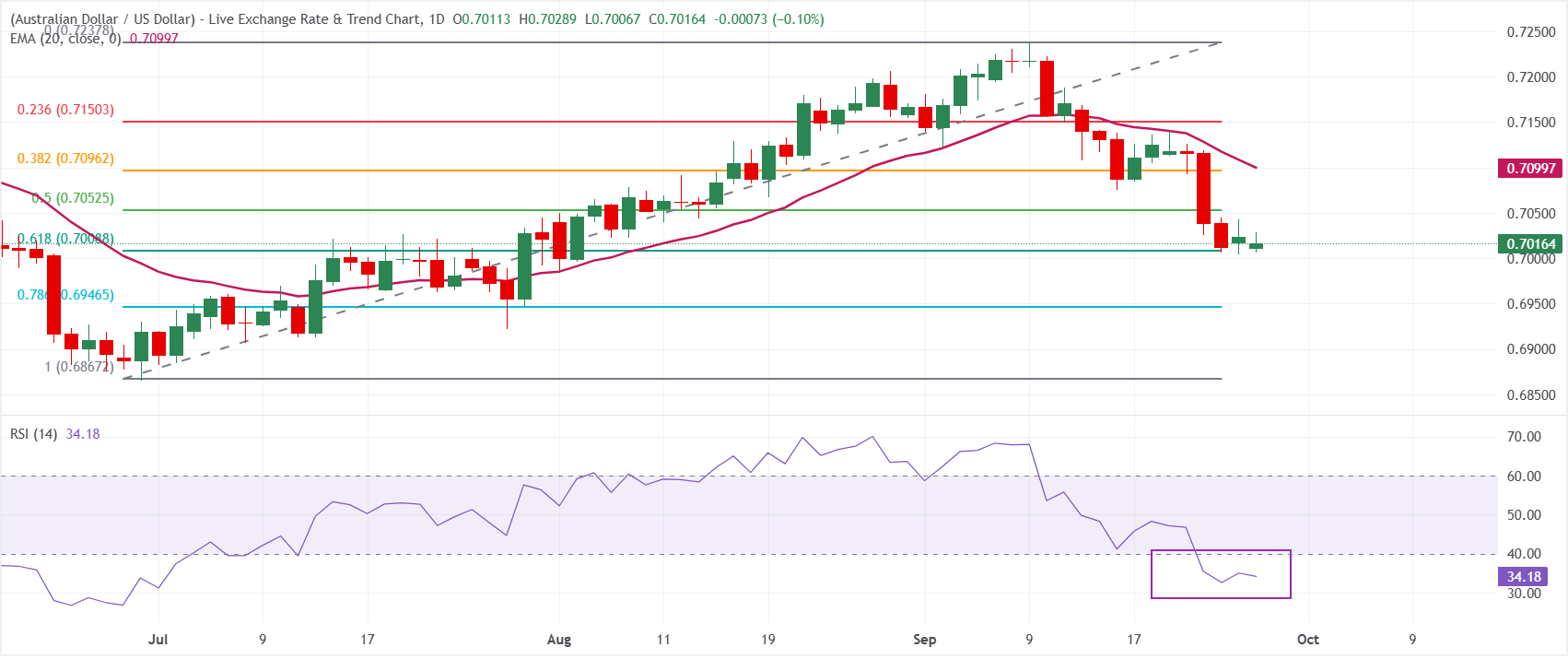
AUD/USD trades at 0.7016 at the time of writing, keeping a bearish near-term bias as price holds below the 20-day Exponential Moving Average (EMA) at 0.7100 and key Fibonacci retracements clustered overhead. The 14-day Relative Strength Index (RSI) at 34 hovers just above oversold territory, hinting at waning downside momentum but not yet signaling a convincing base while the pair remains capped beneath the 50% retracement at 0.7053 and the 38.2% Fibonacci level at 0.7096.
On the downside, immediate support emerges at the 61.8% Fibonacci retracement at 0.7009, ahead of a deeper structural zone defined by the 78.6% Fibonacci at 0.6947 and the cycle low at 0.6867. On the topside, resistance is first seen at 0.7053, followed by the 38.2% Fibonacci retracement at 0.7096 and the 20-day EMA at 0.7100, with stronger supply expected near the 23.6% Fibonacci retracement at 0.7150 and the cycle high around 0.7238.
(The technical analysis of this story was written with the help of an AI tool. Know more.)
Economic Indicator
RBA Interest Rate Decision
The Reserve Bank of Australia (RBA) announces its interest rate decision at the end of its eight scheduled meetings per year. If the RBA is hawkish about the inflationary outlook of the economy and raises interest rates it is usually bullish for the Australian Dollar (AUD). Likewise, if the RBA has a dovish view on the Australian economy and keeps interest rates unchanged, or cuts them, it is seen as bearish for AUD.
Read more.Next release: Tue Sep 29, 2026 04:30
Frequency: Irregular
Consensus: 4.6%
Previous: 4.35%
Source: Reserve Bank of Australia
Author

Sagar Dua
FXStreet
Sagar Dua is associated with the financial markets from his college days. Along with pursuing post-graduation in Commerce in 2014, he started his markets training with chart analysis.