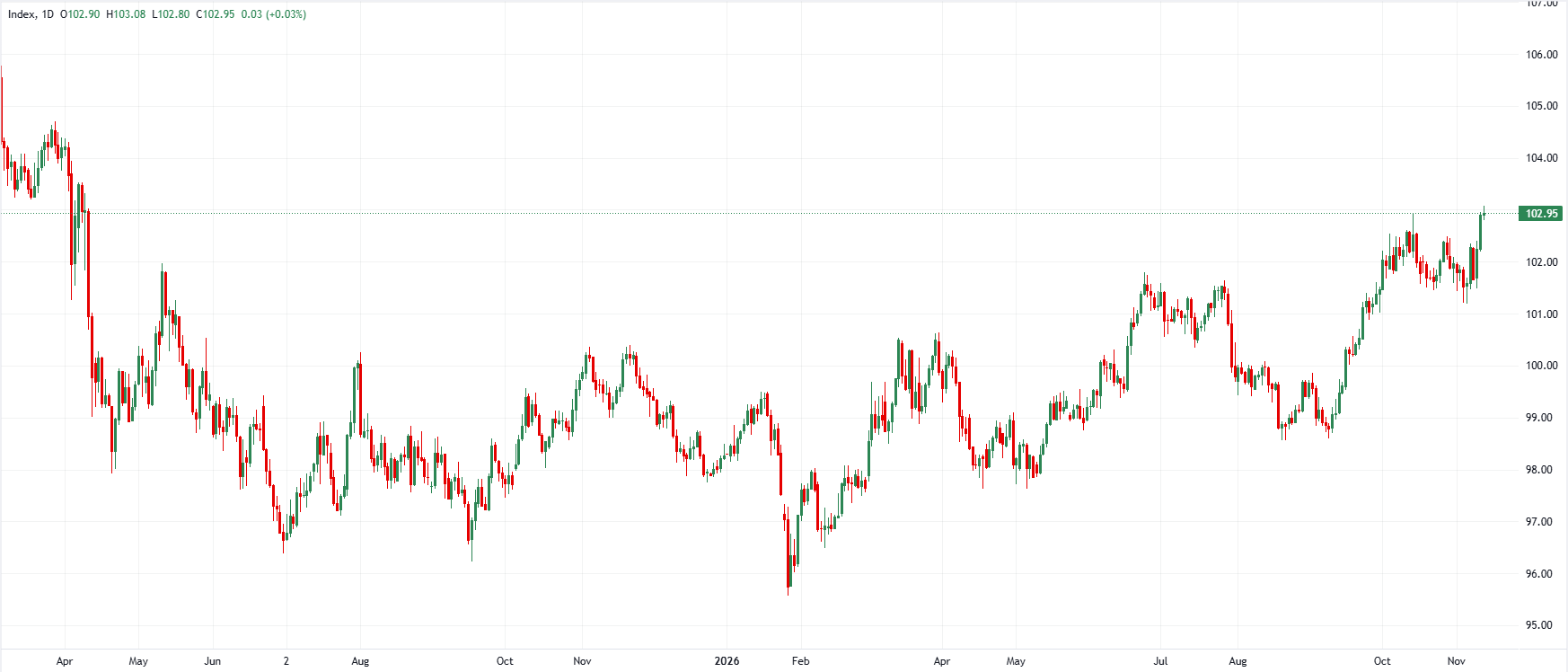
103.08: US Dollar Index hits a fresh year-to-date high as Fed hike bets build

The US Dollar (USD) has extended its upward trajectory across global foreign exchange markets, propelling the US Dollar Index (DXY) to a fresh year-to-date high of 103.08 and returning the currency to its April 2025 levels. This renewed rally is firmly anchored in real front-end rate differentials following stronger-than-expected US inflation data and hawkish Federal Reserve (Fed) rhetoric, which has prompted traders to price in a faster pace of monetary tightening. Alongside rate-driven momentum, reduced concerns over political interference at the Fed and resilient safe-haven inflows are reinforcing the Greenback’s valuation. Institutional strategists at MUFG, ING, and Rabobank assess that while near-term inflation prints and Fed communications point toward further upside, medium-term US fiscal deficit pressures remain a key variable for the US Dollar's broader outlook.
MUFG sees back-to-back December and January Fed hikes lifting the US Dollar
Lee Hardman at MUFG highlights that expectations for an accelerated Federal Reserve tightening cycle — spurred by recent strong US inflation readings — have driven the US Dollar Index DXY to a fresh year-to-date peak of 103.08. While Hardman does not anticipate a 50 bps hike in December, futures pricing points toward back-to-back 25 bps increases in December and January, making upcoming commentary from New York Fed President John Williams pivotal for confirming the rate path.
"The US dollar has continued to strengthen overnight resulting in the dollar index hitting a fresh year-to-date high of 103.08. The US dollar’s renewed upward momentum has been encouraged by expectations that the Fed is likely to speed up the pace of rate hikes in response to the recent run of stronger US inflation data... There are currently around 28bps of hikes priced by December, and 43bps of hikes priced by the following meeting in January indicating that even if the Fed hikes by 25bps in December it is now expected to quickly follow up with another 25bps hike at the start of next year... While we don’t expect a larger 50bps hike to be delivered in December, it is more likely now that the Fed could hike rates back-to-back in December and January."
ING expects front-end rate differentials and PPI data to fuel another US Dollar leg higher
Francesco Pesole and the FX strategy team at ING emphasize that the US Dollar's return to April 2025 levels is a fundamentally sound, rates-driven advance supported by real front-end yield differentials rather than excessive speculative stretching. With Fed Governor Chris Waller placing a 50 bps December rate hike on the table and market pricing still sitting at 28 bps, ING sees clear scope for hawkish repricing, identifying upcoming Producer Price Index (PPI) figures as a potential trigger for further USD gains.
"The combination of hawkish Fedspeak and a US CPI beat earlier this week continues to pay dividends for the dollar. DXY is now back at Liberation Day (April 2025) levels, with real front-end rate differentials continuing to fuel strong dollar momentum. Importantly, this remains a rates-driven move, with contained excessive USD strength relative to short-term fair value currently built in... We continue to see upside risks for the dollar in the coming days. The Fed's Chris Waller has put a 50bp December move on the radar, and that should keep markets biased towards hawkish interpretations of incoming data. December pricing remains at 28bp, leaving scope for further adjustment... Today’s home sales data are unlikely to matter, but tomorrow’s PPI will. That may be the catalyst for another USD leg higher."
Rabobank argues Fed credibility and safe-haven flows refute US Dollar debasement fears
The FX Strategy team at Rabobank contends that easing concerns over political interference at the Federal Reserve and resilient safe-haven inflows have restored Greenback credibility, allowing the currency to capitalize on robust US economic growth and upcoming Eurozone pressures. Although Rabobank warns that a US budget deficit above 6% of GDP and signs of slipping "exorbitant privilege" in the Treasury market could weigh on the USD over the medium term, the team concludes that previous US Dollar debasement fears were overstated.
"Diminished fears about political interference on the Fed is a supportive factor for the USD. In addition, at the start of the Gulf war, strong demand for the USD undermined last year’s claims that the USD’s had lost at least part of its safe haven value. In our view the USD’s safe haven appeal is linked to its embedded position in global payments systems, which could take decades to shake... Reduced concerns over the credibility of the greenback should allow it more opportunity to benefit from the US’s robust economic growth performance... There is still a risk that concerns related to the US’s unwieldly budget deficit could weigh on the USD over the medium-term. The US budget deficit at over 6% of GDP is wider than that of France... Either way, last year’s dollar debasement fears appear exaggerated."
Key Takeaway
The US Dollar's climb to a fresh year-to-date high of 103.08 reflects a powerful alignment of front-end interest rate repricing, institutional credibility, and structural safe-haven demand. While MUFG and ING highlight that sticky inflation and hawkish Fed commentary — including 28 bps to 43 bps of tightening priced across December and January alongside talk of a potential 50 bp move — leave near-term risks skewed toward further US Dollar gains on upcoming PPI data, Rabobank underscores that even with medium-term fiscal deficit risks above 6% of GDP, the Greenback's entrenched role in global financial markets keeps it firmly positioned to outperform major peers.
(This article was created with the help of an Artificial Intelligence tool and reviewed by an editor. Know more.)
Author

FXStreet Insights Team
FXStreet
The FXStreet Insights Team is a group of journalists that handpicks selected market observations published by renowned experts. The content includes notes by commercial as well as additional insights by internal and external analysts.