Why the US Dollar's rally isn't as strong as it looks
The US Dollar Index (DXY) is back at an 18-month high, but most of its climb since August is the Euro (EUR) falling. Against a wider group of trading partners, the Dollar has gained half as much, and the Federal Reserve (Fed) has raised rates once this year.
The US Dollar Index, which measures the Dollar against six other currencies, is trading near 103. That is level with its October 14 peak, the highest since April 2025, and about 4% above its late-August low. It reads like the whole world is paying more for Dollars, and it is mostly a record of what has gone wrong with the Euro.
The weights explain why. They were last changed in 1999, when the Euro was created, and the Euro is 57.6% of the index. The Yen is 13.6% and the Pound 11.9%, with the Canadian Dollar, Swedish Krona, and Swiss Franc sharing the rest. The Yuan and the Mexican Peso, the currencies of two of the largest US trading partners, aren't included, so Sweden is in the Dollar Index, and China isn't.
Most of the climb is one currency
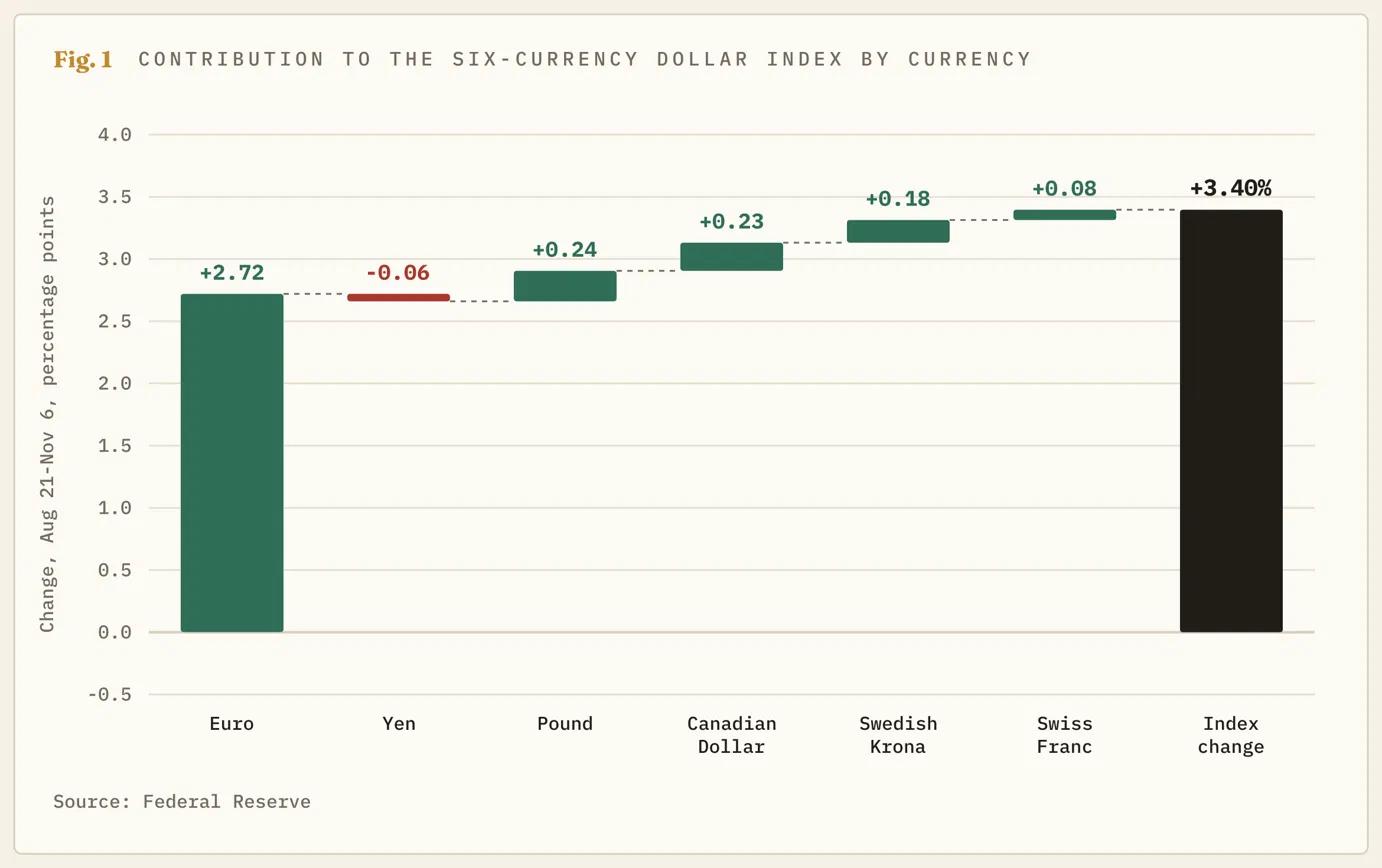
The Euro has lost about 5% against the US Dollar since late August and has dropped under 1.1100 for the first time since May 2025. Using the index's weights and Federal Reserve exchange-rate data, that fall accounts for about 2.7 of the 3.4 percentage points the index gained between its August low and November 6. If every member had moved by the same amount, the Euro's share would be about 2.
The reasons are European. The European Central Bank (ECB) left its deposit rate at 2.5% on October 29 after two rises earlier this year, and ECB President Christine Lagarde announced the same day that she will leave on February 7, 2027, about eight months before her term ends. France goes into a presidential election in April with its budget and its politics both unsettled. Those are reasons to sell Euros, and in the Dollar Index a sold Euro and a bought Dollar are the same number.
The second-largest weight is close to a limit
The Yen is the next biggest piece of the index, and it has added almost nothing. USD/JPY is trading just under 160.00, within 1% of where it was at the index's August low. Japan's Finance Ministry spent a record ¥11.73 trillion in April and May selling Dollars after the pair broke above 160.00, and each move toward that level since has brought the same threat.
For the index, that means the Yen can only add to the rally if Tokyo allows it. Between them, the Euro and the Yen make up 71% of the Dollar Index. One is falling for European reasons, and the other is being watched by a finance ministry with a record of selling Dollars at this price.
The wider world hasn't joined in
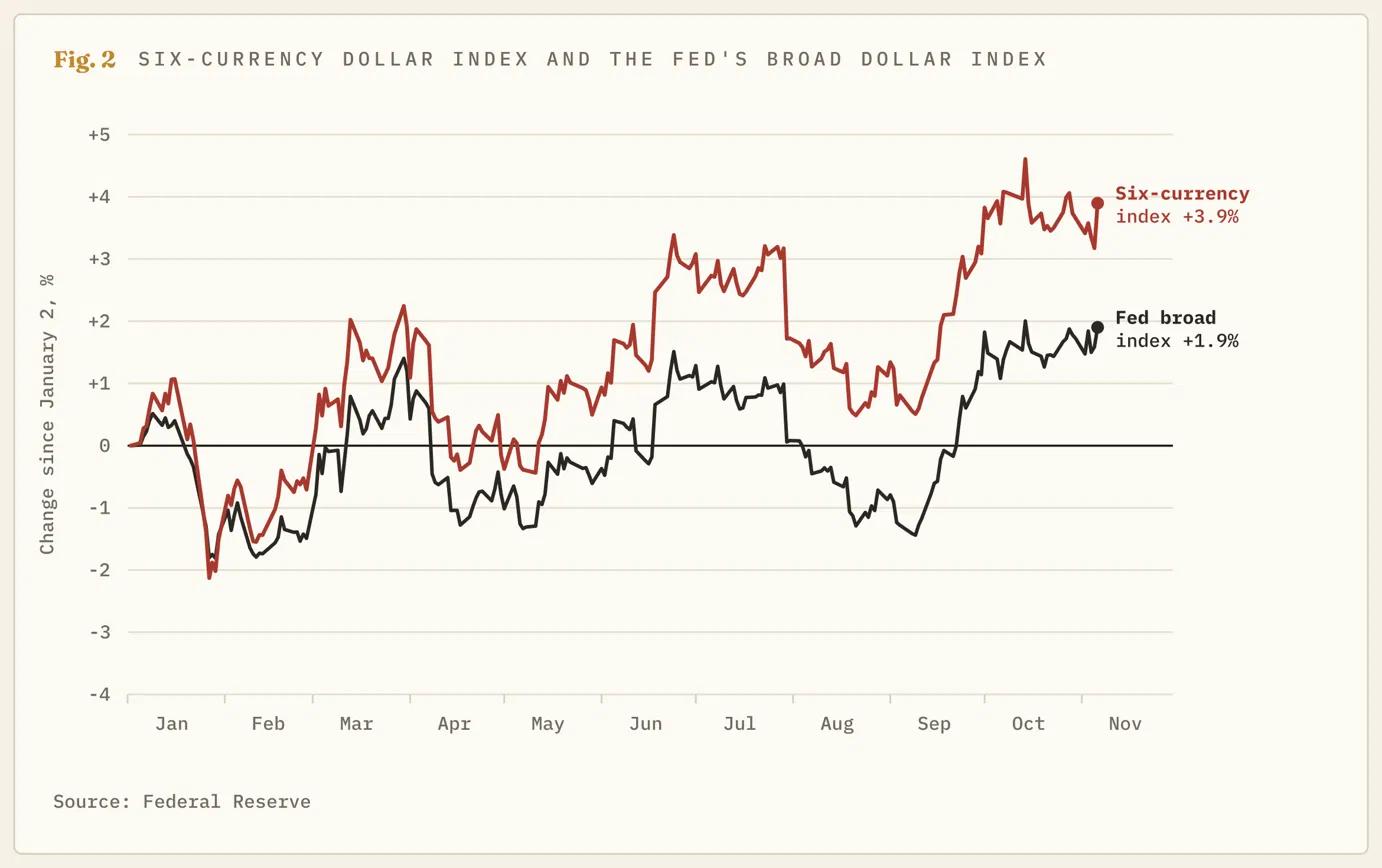
The Federal Reserve publishes its own broad Dollar index, which covers 26 currencies weighted by how much the US trades with each. Through November 6, it was up about 2% this year. The six-currency index was up about 4% over the same period, so the measure most people quote has gained twice as much as the measure that matches what the US buys and sells.
The Yuan is the clearest case. The Dollar has lost more than 4% against it this year and in early November was at its lowest of 2026. Among the index's members, the Pound, the Swiss Franc and the Swedish Krona were all stronger against the Dollar on Wednesday than at the October 14 peak. The index is back at its high and half of its members aren't back at their lows.
One Fed rise in a year of rises
The case for the Dollar is interest rates, and on the news alone it is a good one. The October jobs report showed 165K new jobs against a forecast of 65K. Tuesday's Consumer Price Index (CPI) showed prices outside food and energy up 0.3% for a third straight month. Fed Governor Christopher Waller said before the release that a number like that would mean a half-point rise should be considered. Futures now treat a quarter-point rise on December 9 as certain and put about a one-in-ten chance on a half-point.
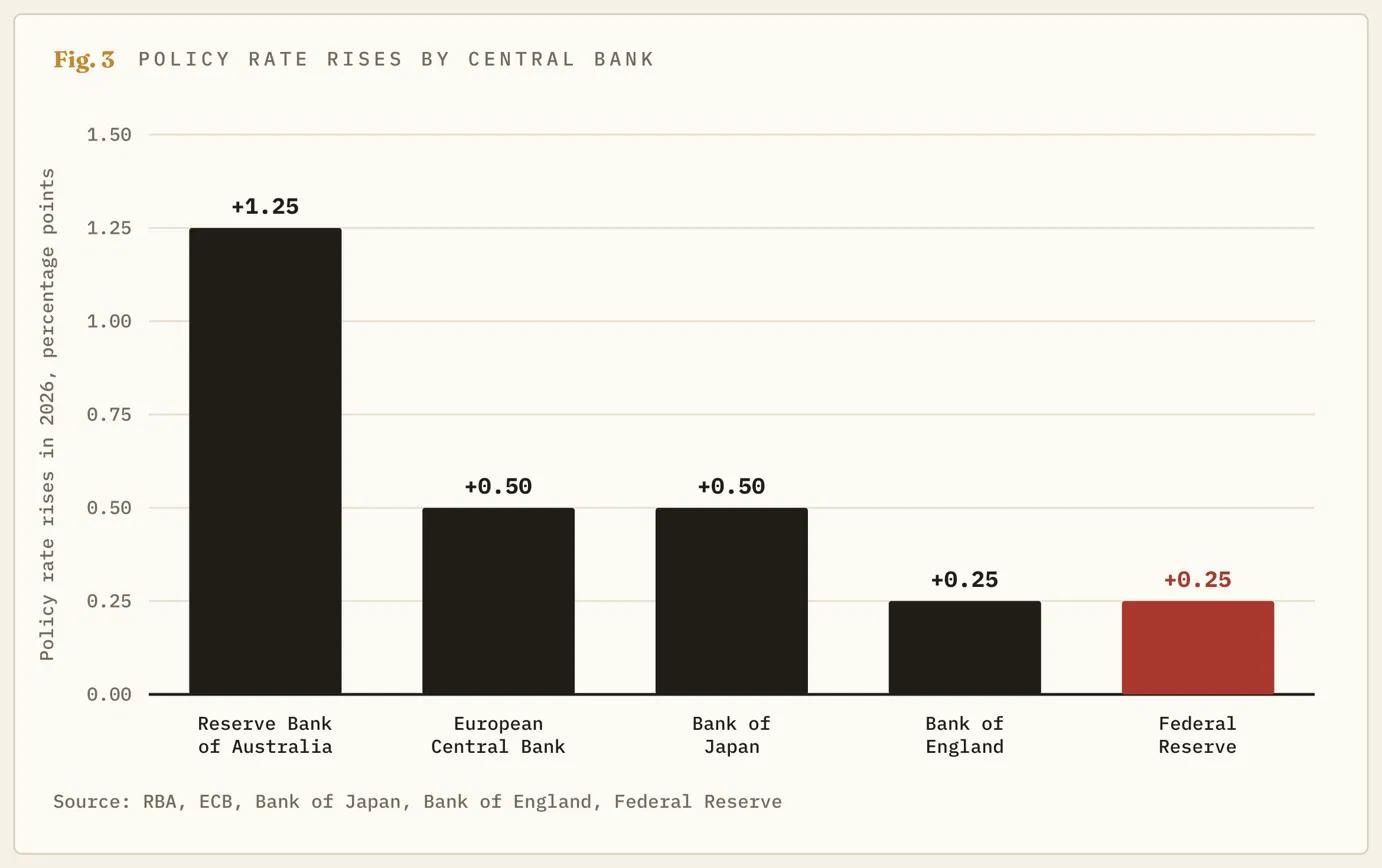
Higher rates lift a currency when they pull away from everyone else's, because money moves to where it earns more. The Fed has raised its rate once in 2026, to 3.75%-4.00% in September. The Reserve Bank of Australia (RBA) has raised rates five times, the ECB twice, and the Bank of England (BoE) went to 4% on November 5. The two-year Treasury yield, which moves with what traders expect from the Fed, jumped to about 4.74% on Tuesday and remains below its late-September high of 4.92%.
That shows up in what the news has bought. Since October 14, the Dollar has had a jobs report at more than double the forecast, another 0.3% month for underlying inflation and a Fed governor raising the idea of a half-point move, and the index is back where it was four weeks ago.
What a strong Dollar would look like
The fork is in December. The Fed decides on December 9 between a quarter-point and a half-point, and the ECB meets in the same month, when traders expect its own rise. If the Fed goes by a half-point and the ECB holds again, the rate gap widens in the Dollar's favour and the Euro has further to fall.
Three things would show the rally is as strong as it looks, and each can be checked. The Dollar would be gaining against currencies that aren't in trouble, with the Pound, the Franc and the Yuan being the ones to check. The two-year yield would be above 4.92%. USD/JPY would be holding above 160.00 without Tokyo selling. Any two of those, and the argument here is wrong.
Without them, the lean is lower from here. The index turned down from this level on October 14 within a day, and most of what has carried it back is Euro selling. An ECB rise in December or a named successor to Lagarde would take away the part of the rally that has done most of the work, and nothing else in the index has shown it can replace it.
Author

Joshua Gibson
FXStreet
Joshua joins the FXStreet team as an Economics and Finance double major from Vancouver Island University with twelve years' experience as an independent trader focusing on technical analysis.