Australian Dollar remains stronger as US Dollar weakens on Fed cut bets
- Australian Dollar receives support from waning odds of further RBA rate cuts.
- China’s Retail Sales climbed 3.4% YoY in August, against 3.8% expected and 3.7% in July.
- US labor market increases the chances of the Federal Reserve delivering its first rate cut of the year on Thursday.

The Australian Dollar (AUD) inches higher against the US Dollar (USD) on Monday, recovering its losses registered in the previous session. The AUD/USD pair holds ground despite disappointing economic data from Australia’s close trading partner, China.
The National Bureau of Statistics (NBS) showed on Monday that China’s Retail Sales rose 3.4% year-over-year (YoY) in August vs. 3.8% expected and 3.7% in July. Chinese Industrial Production increased 5.2% YoY in the same period, compared to the 5.8% forecast and 5.7% seen previously.
The National Bureau of Statistics (NBS) said during its press conference on Monday that economic operation was generally steady in August, but domestic demand will expand and promote a rebound in prices. Some firms are having difficulties in operations as the external environment is very severe, NBS added.
US Treasury Secretary Scott Bessent, Trade Representative Jamieson Greer, and their Chinese counterpart, Vice Premier He Lifeng, discussed trade and the economy during high-level talks in Madrid. Traders will be watching closely as the US-China talks move into their second day.
The AUD finds support on diminishing expectations of further Reserve Bank of Australia (RBA) rate cuts. Swaps now price in an 86% likelihood of unchanged policy in September, bolstered by Australia’s strong July trade surplus, solid Q2 GDP, and hotter July inflation.
Australia’s Consumer Inflation Expectations also climbed in September, signaling stronger domestic demand and raising concerns about renewed inflationary pressures. RBA Governor Michele Bullock noted that the private sector is showing “a little bit more growth,” which she described as a positive sign for the economy.
Australian Dollar advances as market mood improves on Fed rate cut odds
- The US Dollar Index (DXY), which measures the value of the US Dollar against six major currencies, is holding ground and trading around 97.60 at the time of writing. The US Dollar may struggle as a weakening US labor market boosts the likelihood of the US Federal Reserve (Fed) delivering its first rate cut of the year on Wednesday.
- Traders are also monitoring whether Stephen Miran will be sworn in as a Fed governor before the meeting. According to Reuters, citing the Senate schedule set by Republican leaders, the full Senate vote on his confirmation is scheduled for Monday evening.
- The US Federal Reserve (Fed) is expected to lower rates by 25 basis points at its September meeting, though there remains a slight chance of a 50-basis-point cut. Markets have also factored in continued easing through 2026 to help stave off a potential recession.
- Morgan Stanley and Deutsche Bank now expect the US central bank to deliver three rate cuts this year, after recent data pointed to easing inflation pressures. In separate notes on Friday, the brokerages projected 25-basis-point reductions at each of the Fed’s remaining meetings in September, October, and December, according to Reuters.
- Bets on multiple Fed rate cuts strengthened after US Weekly Initial Jobless Claims climbed to their highest since October 2021, following last week’s weak Nonfarm Payrolls report, overshadowing a hotter-than-expected consumer inflation reading.
- US Consumer Price Index (CPI) climbed 2.9% year-over-year in August, as expected, but came in higher than 2.7% in July. On a monthly basis, the CPI inflation climbed to 0.4% from a 0.2% increase prior. The core CPI, which excludes volatile food and energy prices, increased 3.1% on a yearly basis in August, matching the estimate.
- US Initial Jobless Claims rose to 263K, the highest since 2021, against the expected 235K and 236K prior (revised from 237K).
- The US Bureau of Labor Statistics’ (BLS) preliminary estimate of the Current Employment Statistics (CES) national benchmark revision suggests total Nonfarm employment for March 2025 will likely be revised down by 911,000, or about 76,000 fewer jobs per month, signaling a weaker labor market than previously estimated. The final benchmark revision will be issued in February 2026 with the publication of the January 2026 Employment Situation news release," the BLS noted in its press release.
Australian Dollar targets 11-month highs near 0.6700
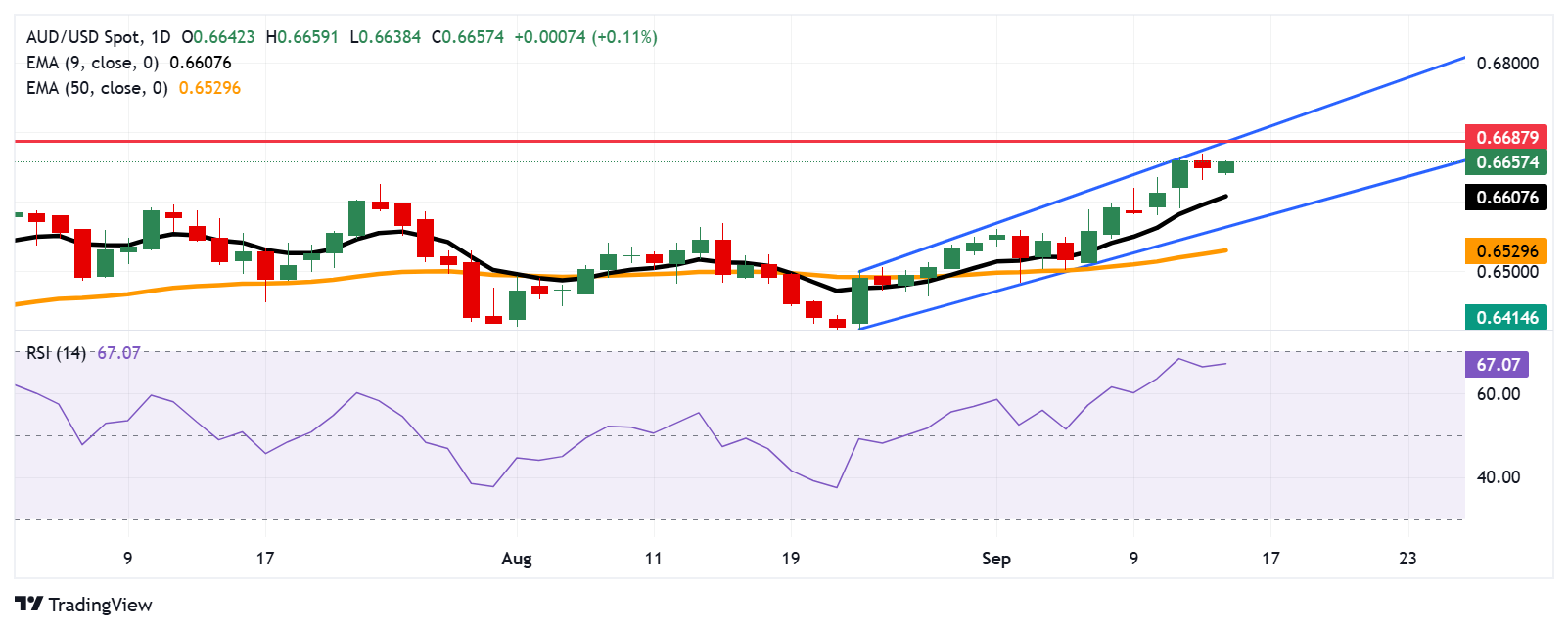
AUD/USD is trading around 0.6660 on Monday. The technical analysis of the daily chart shows the pair moves upwards within an ascending channel pattern, indicating the market bias is bullish. Additionally, the pair is positioned above the nine-day Exponential Moving Average (EMA), indicating short-term price momentum is stronger.
On the upside, the AUD/USD pair may approach the 11-month high of 0.6687, recorded in November 2024, followed by the upper boundary of the ascending channel around 0.6700.
The initial support lies at the nine-day EMA of 0.6607, followed by the ascending channel’s lower boundary around 0.6570. A break below the channel would weaken the short-term price momentum and lead the AUD/USD pair to test the 50-day EMA at 0.6529.
Correction done: (The story was corrected on September 15 at 7:15 GMT, to say in the first point under market movers that the Fed will deliver a rate cut on Wednesday, and not on Thursday.)
AUD/USD: Daily Chart
Australian Dollar Price Today
The table below shows the percentage change of Australian Dollar (AUD) against listed major currencies today. Australian Dollar was the strongest against the US Dollar.
| USD | EUR | GBP | JPY | CAD | AUD | NZD | CHF | |
|---|---|---|---|---|---|---|---|---|
| USD | 0.02% | -0.09% | -0.16% | -0.01% | -0.29% | -0.21% | -0.01% | |
| EUR | -0.02% | -0.08% | -0.24% | -0.03% | -0.27% | -0.25% | -0.03% | |
| GBP | 0.09% | 0.08% | -0.08% | 0.07% | -0.19% | -0.18% | -0.06% | |
| JPY | 0.16% | 0.24% | 0.08% | 0.13% | -0.08% | -0.05% | 0.16% | |
| CAD | 0.01% | 0.03% | -0.07% | -0.13% | -0.18% | -0.24% | -0.12% | |
| AUD | 0.29% | 0.27% | 0.19% | 0.08% | 0.18% | 0.00% | 0.22% | |
| NZD | 0.21% | 0.25% | 0.18% | 0.05% | 0.24% | -0.01% | 0.12% | |
| CHF | 0.00% | 0.03% | 0.06% | -0.16% | 0.12% | -0.22% | -0.12% |
The heat map shows percentage changes of major currencies against each other. The base currency is picked from the left column, while the quote currency is picked from the top row. For example, if you pick the Australian Dollar from the left column and move along the horizontal line to the US Dollar, the percentage change displayed in the box will represent AUD (base)/USD (quote).
Australian Dollar FAQs
One of the most significant factors for the Australian Dollar (AUD) is the level of interest rates set by the Reserve Bank of Australia (RBA). Because Australia is a resource-rich country another key driver is the price of its biggest export, Iron Ore. The health of the Chinese economy, its largest trading partner, is a factor, as well as inflation in Australia, its growth rate and Trade Balance. Market sentiment – whether investors are taking on more risky assets (risk-on) or seeking safe-havens (risk-off) – is also a factor, with risk-on positive for AUD.
The Reserve Bank of Australia (RBA) influences the Australian Dollar (AUD) by setting the level of interest rates that Australian banks can lend to each other. This influences the level of interest rates in the economy as a whole. The main goal of the RBA is to maintain a stable inflation rate of 2-3% by adjusting interest rates up or down. Relatively high interest rates compared to other major central banks support the AUD, and the opposite for relatively low. The RBA can also use quantitative easing and tightening to influence credit conditions, with the former AUD-negative and the latter AUD-positive.
China is Australia’s largest trading partner so the health of the Chinese economy is a major influence on the value of the Australian Dollar (AUD). When the Chinese economy is doing well it purchases more raw materials, goods and services from Australia, lifting demand for the AUD, and pushing up its value. The opposite is the case when the Chinese economy is not growing as fast as expected. Positive or negative surprises in Chinese growth data, therefore, often have a direct impact on the Australian Dollar and its pairs.
Iron Ore is Australia’s largest export, accounting for $118 billion a year according to data from 2021, with China as its primary destination. The price of Iron Ore, therefore, can be a driver of the Australian Dollar. Generally, if the price of Iron Ore rises, AUD also goes up, as aggregate demand for the currency increases. The opposite is the case if the price of Iron Ore falls. Higher Iron Ore prices also tend to result in a greater likelihood of a positive Trade Balance for Australia, which is also positive of the AUD.
The Trade Balance, which is the difference between what a country earns from its exports versus what it pays for its imports, is another factor that can influence the value of the Australian Dollar. If Australia produces highly sought after exports, then its currency will gain in value purely from the surplus demand created from foreign buyers seeking to purchase its exports versus what it spends to purchase imports. Therefore, a positive net Trade Balance strengthens the AUD, with the opposite effect if the Trade Balance is negative.
Author

Akhtar Faruqui
FXStreet
Akhtar Faruqui is a Forex Analyst based in New Delhi, India. With a keen eye for market trends and a passion for dissecting complex financial dynamics, he is dedicated to delivering accurate and insightful Forex news and analysis.