Australian Dollar edges up against US Dollar ahead of US flash PMI data
- The Australian Dollar ticks higher against the US Dollar as the antipodean outperforms.
- Investors expected to the RBA to hike interest rates again.
- The Fed to expected to leave interest rates steady on Wednesday.

The Australian Dollar (AUD) trades marginally higher at around 0.7018 against the US Dollar (USD) during the European trade on Friday. The Aussie pair ticks higher as the Australian Dollar outperforms amid firm expectations that the Reserve Bank of Australia (RBA) will hike interest rates against this year.
Australian Dollar Price Today
The table below shows the percentage change of Australian Dollar (AUD) against listed major currencies today. Australian Dollar was the strongest against the Swiss Franc.
| USD | EUR | GBP | JPY | CAD | AUD | NZD | CHF | |
|---|---|---|---|---|---|---|---|---|
| USD | 0.17% | 0.19% | 0.09% | -0.04% | 0.02% | -0.02% | 0.43% | |
| EUR | -0.17% | 0.03% | -0.07% | -0.20% | -0.14% | -0.19% | 0.26% | |
| GBP | -0.19% | -0.03% | -0.10% | -0.21% | -0.17% | -0.20% | 0.23% | |
| JPY | -0.09% | 0.07% | 0.10% | -0.12% | -0.08% | -0.12% | 0.34% | |
| CAD | 0.04% | 0.20% | 0.21% | 0.12% | 0.06% | 0.00% | 0.46% | |
| AUD | -0.02% | 0.14% | 0.17% | 0.08% | -0.06% | -0.04% | 0.40% | |
| NZD | 0.02% | 0.19% | 0.20% | 0.12% | -0.01% | 0.04% | 0.45% | |
| CHF | -0.43% | -0.26% | -0.23% | -0.34% | -0.46% | -0.40% | -0.45% |
The heat map shows percentage changes of major currencies against each other. The base currency is picked from the left column, while the quote currency is picked from the top row. For example, if you pick the Australian Dollar from the left column and move along the horizontal line to the US Dollar, the percentage change displayed in the box will represent AUD (base)/USD (quote).
Aussie climbs as RBA warning sharpens focus on inflation data
Analysts at Commerzbank note that the Aussie “received further support from a significant rise in interest rate expectations,” with AUD-USD pushed to its highest level since late September after comments from RBA Deputy Governor Andrew Hauser. Hauser described the inflation outlook as “materially worse” than the RBA had previously expected and warned of a potential “de-anchoring of inflation expectations,” remarks that have sharpened market attention on upcoming price data.
According to Commerzbank, Hauser highlighted survey evidence showing that “a growing share of businesses believe that inflation of 3-3.5% is ‘the new normal’.” With the RBA’s long-term inflation target set at 2-3%, the bank argues this is “certainly be concerning,” particularly as “trimmed-mean inflation most recently stood at 3.6%, further above the target range.”
Commerzbank stresses that this backdrop “makes the inflation data due on 28 October all the more important.” In its August forecasts, the RBA had already expected “headline inflation to fall to 3.6% and trimmed-mean inflation to 3.3% by December,” and the upcoming release “should at least provide indications that inflation is indeed moving in that direction.” The bank cautions that if “price pressures remain similarly elevated or even intensify, however, this would validate the recent rise in rate-hike expectations and cement the risk of another rate move at the RBA’s meeting on 3 November.”
On the US Dollar front, investors await the preliminary United States (US) S&P Global PMI data for October, which will be published at 13:45 GMT. Both the manufacturing and services PMI are expected to have increased again, but at a moderate pace.
As of writing, the USD Index trades 0.1% higher to near 101.75. The DXY bounces back after revisiting the three-week low of 101.44 posted on Thursday.
Going forward, the major trigger for the US Dollar will be the Federal Reserve’s (Fed) monetary policy announcement next week. The Fed is expected to leave interest rates unchanged in the 3.75%-4.00% range.
AUD/USD Technical Analysis
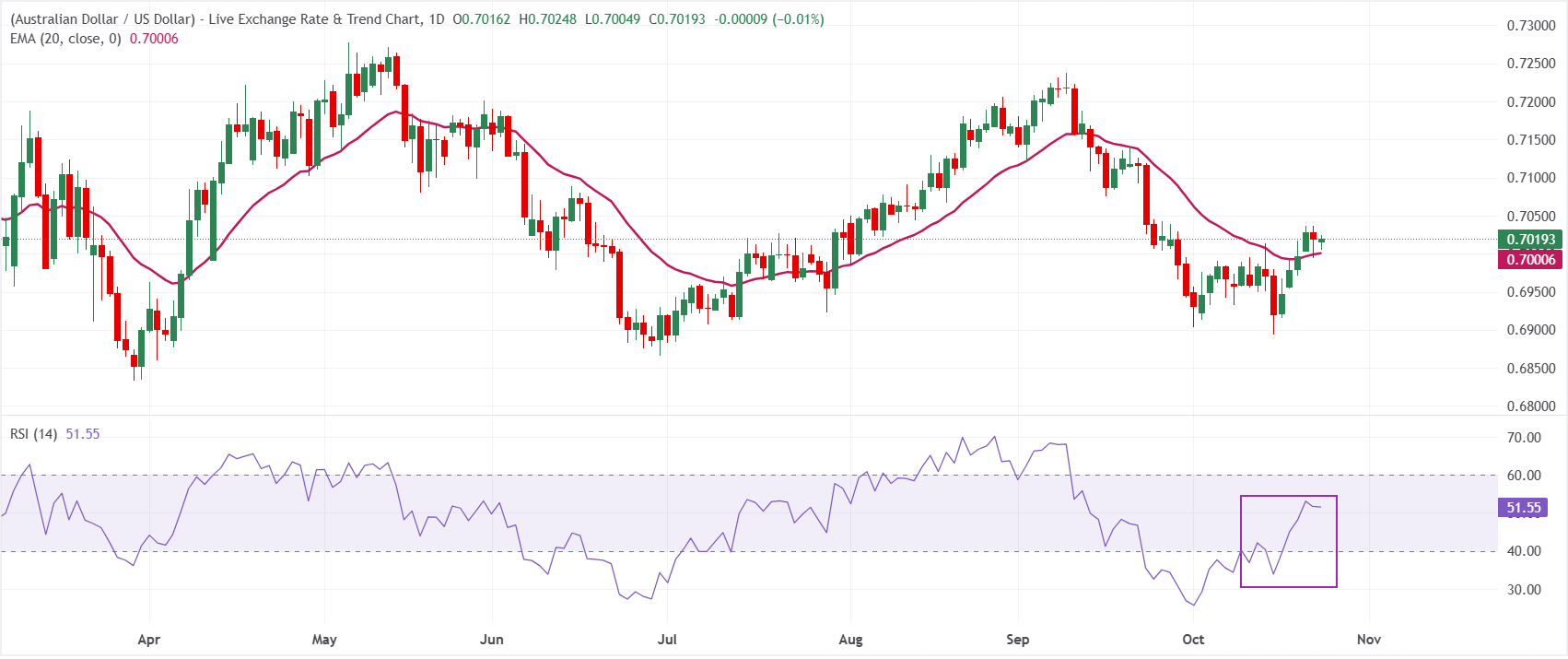
In the daily chart, AUD/USD trades at 0.7019. The pair holds marginally above the 20-day exponential moving average (EMA) at 0.7001, giving the near-term tone a mildly bullish bias as price defends this dynamic floor. The Relative Strength Index (RSI) at 51.5 sits just above the neutral line, hinting at stabilizing momentum after the recent recovery from oversold territory rather than an outright impulsive rally.
On the downside, immediate support is seen at the 20-day EMA around 0.7001, with the 0.7020/0.7020 area acting as the nearby pivot where price opened today, a loss of which would weaken the constructive bias and expose deeper consolidation. With no clear overhead technical levels in the current dataset, further gains would likely depend on whether buyers can continue to defend the EMA base and push the pair away from the 0.70 handle, keeping the broader recovery structure intact.
(The technical analysis of this story was written with the help of an AI tool. Know more.)
Economic Indicator
Fed Interest Rate Decision
The Federal Reserve (Fed) deliberates on monetary policy and makes a decision on interest rates at eight pre-scheduled meetings per year. It has two mandates: to keep inflation at 2%, and to maintain full employment. Its main tool for achieving this is by setting interest rates – both at which it lends to banks and banks lend to each other. If it decides to hike rates, the US Dollar (USD) tends to strengthen as it attracts more foreign capital inflows. If it cuts rates, it tends to weaken the USD as capital drains out to countries offering higher returns. If rates are left unchanged, attention turns to the tone of the Federal Open Market Committee (FOMC) statement, and whether it is hawkish (expectant of higher future interest rates), or dovish (expectant of lower future rates).
Read more.Next release: Wed Oct 28, 2026 18:00
Frequency: Irregular
Consensus: 4%
Previous: 4%
Source: Federal Reserve
Author

Sagar Dua
FXStreet
Sagar Dua is associated with the financial markets from his college days. Along with pursuing post-graduation in Commerce in 2014, he started his markets training with chart analysis.