Australian Dollar defies Iran war jitters as RBA hike bets double
- AUD/USD climbs 0.44% to 0.7027, extending its winning streak.
- RBA's Hauser warns inflation outlook is deteriorating despite restrictive policy.
- RBA hike odds nearly double to 60% ahead of Flash PMIs.
The Australian Dollar rallies for the fourth straight day against the US Dollar as market mood remains positive amid high tensions in the Middle East, pointing to a resumption of hostilities, as reported by recent news. Despite this, the AUD/USD trades at 0.7027, up 0.44%.
AUD/USD extends its four-day rally as hawkish RBA expectations outweigh geopolitical uncertainty
US equities closed mostly unchanged but were boosted by the AI trade after hours, with Meta and Tesla reporting earnings. However, in the FX space, the Greenback recovered some ground on news that the US State Department is preparing to issue an order to depart for some personal and family members at the US embassy in Saudi Arabia.
Iran’s foreign minister said the country is ready to give diplomacy another chance, but warned that if the US chooses war, it will face an even greater strategic failure. Meanwhile, Fars reported hearing multiple explosions in Sirik, though their origin and nature remain unknown.
In the US, the economic docket was absent, with traders eyeing Initial Jobless Claims on Thursday, followed by the release of the University of Michigan Consumer Sentiment. Nevertheless, the main focus is on the Federal Reserve monetary policy decision next week and also on the release of the Fed’s preferred inflation gauge, the Core Personal Consumption Expenditures (PCE) Price Index.
In Australia, the schedule was absent except for hawkish comments by the Reserve Bank of Australia (RBA) Deputy Governor Andrew Hauser, who said that “inflation outlook appears worse than forecast, slightly above expectations,” and that even though monetary policy is effective, the inflation outlook shows signs of deterioration.
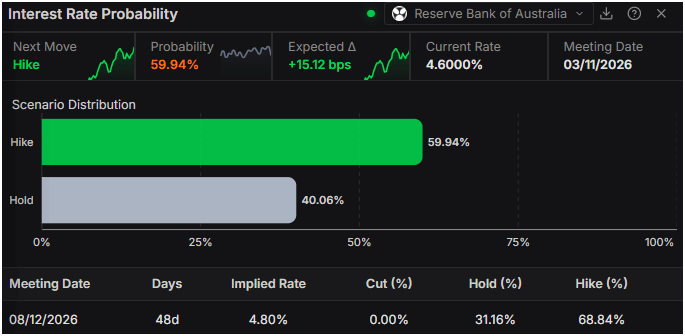
Following Hauser’s remarks, money markets had priced in nearly a 60% chance of the RBA raising rates by 25 basis points to 4.85%, compared with a 30% chance a day earlier, according to Prime Terminal data.
Ahead, the Aussie economic docket will feature the release of S&P Global Flash PMIs on October 22.
AUD/USD Price Forecast: Technical outlooks
In the daily chart, AUD/USD trades around 0.7024, maintaining a bearish near-term tone as spot holds beneath the triple simple moving average (SMA) cluster around 0.7077 and a series of upward-sloping trend lines that have shifted into overhead resistance near 0.7086–0.7087 and 0.7111–0.7118. The Relative Strength Index (RSI) at 52.5 is mildly positive but close to neutral, suggesting only modest recovery momentum that so far fails to offset the weight of these caps.
On the topside, initial resistance is seen at the triple SMA near 0.7077, followed by a dense confluence of former support trend lines at 0.7086–0.7087 and then 0.7111–0.7118, while a more distant horizontal barrier sits at 0.7198. On the downside, the immediate focus remains on whether price can hold the current pivot area around 0.7024, with the next notable structural support coming from an upward trend line near 0.6946 and, much lower, the longer-term downward trend-line anchor around 0.6246.
(The technical analysis of this story was written with the help of an AI tool. Know more.)
Australian Dollar FAQs
One of the most significant factors for the Australian Dollar (AUD) is the level of interest rates set by the Reserve Bank of Australia (RBA). Because Australia is a resource-rich country another key driver is the price of its biggest export, Iron Ore. The health of the Chinese economy, its largest trading partner, is a factor, as well as inflation in Australia, its growth rate and Trade Balance. Market sentiment – whether investors are taking on more risky assets (risk-on) or seeking safe-havens (risk-off) – is also a factor, with risk-on positive for AUD.
The Reserve Bank of Australia (RBA) influences the Australian Dollar (AUD) by setting the level of interest rates that Australian banks can lend to each other. This influences the level of interest rates in the economy as a whole. The main goal of the RBA is to maintain a stable inflation rate of 2-3% by adjusting interest rates up or down. Relatively high interest rates compared to other major central banks support the AUD, and the opposite for relatively low. The RBA can also use quantitative easing and tightening to influence credit conditions, with the former AUD-negative and the latter AUD-positive.
China is Australia’s largest trading partner so the health of the Chinese economy is a major influence on the value of the Australian Dollar (AUD). When the Chinese economy is doing well it purchases more raw materials, goods and services from Australia, lifting demand for the AUD, and pushing up its value. The opposite is the case when the Chinese economy is not growing as fast as expected. Positive or negative surprises in Chinese growth data, therefore, often have a direct impact on the Australian Dollar and its pairs.
Iron Ore is Australia’s largest export, accounting for $118 billion a year according to data from 2021, with China as its primary destination. The price of Iron Ore, therefore, can be a driver of the Australian Dollar. Generally, if the price of Iron Ore rises, AUD also goes up, as aggregate demand for the currency increases. The opposite is the case if the price of Iron Ore falls. Higher Iron Ore prices also tend to result in a greater likelihood of a positive Trade Balance for Australia, which is also positive of the AUD.
The Trade Balance, which is the difference between what a country earns from its exports versus what it pays for its imports, is another factor that can influence the value of the Australian Dollar. If Australia produces highly sought after exports, then its currency will gain in value purely from the surplus demand created from foreign buyers seeking to purchase its exports versus what it spends to purchase imports. Therefore, a positive net Trade Balance strengthens the AUD, with the opposite effect if the Trade Balance is negative.
Author

Christian Borjon Valencia
FXStreet
Markets analyst, news editor, and trading instructor with over 14 years of experience across FX, commodities, US equity indices, and global macro markets.
















