Australian Dollar corrects against US Dollar, US CPI takes centre stage
- The Australian Dollar drops to near 0.7210 against the US Dollar as the latter bounces back.
- Investors keenly await RBA Hauser’s interview during the day.
- Fed’s Waller said that recent data showed some signs of disinflation.

The Australian Dollar (AUD) is down 0.13% to near 0.7210 against the US Dollar (USD) during the European trading session on Tuesday. The Aussie pair comes under pressure as the US Dollar turns positive after a weak start.
As of writing, the US Dollar Index (DXY), which gauges the Greenback’s value against six major currencies, trades 0.1% higher to near 99.00.
US Dollar Price Today
The table below shows the percentage change of US Dollar (USD) against listed major currencies today. US Dollar was the strongest against the New Zealand Dollar.
| USD | EUR | GBP | JPY | CAD | AUD | NZD | CHF | |
|---|---|---|---|---|---|---|---|---|
| USD | 0.10% | 0.12% | -0.14% | -0.08% | 0.11% | 0.58% | 0.28% | |
| EUR | -0.10% | 0.01% | -0.20% | -0.13% | -0.00% | 0.49% | 0.18% | |
| GBP | -0.12% | -0.01% | -0.25% | -0.20% | -0.02% | 0.48% | 0.17% | |
| JPY | 0.14% | 0.20% | 0.25% | 0.07% | 0.26% | 0.74% | 0.44% | |
| CAD | 0.08% | 0.13% | 0.20% | -0.07% | 0.19% | 0.67% | 0.38% | |
| AUD | -0.11% | 0.00% | 0.02% | -0.26% | -0.19% | 0.50% | 0.19% | |
| NZD | -0.58% | -0.49% | -0.48% | -0.74% | -0.67% | -0.50% | -0.30% | |
| CHF | -0.28% | -0.18% | -0.17% | -0.44% | -0.38% | -0.19% | 0.30% |
The heat map shows percentage changes of major currencies against each other. The base currency is picked from the left column, while the quote currency is picked from the top row. For example, if you pick the US Dollar from the left column and move along the horizontal line to the Japanese Yen, the percentage change displayed in the box will represent USD (base)/JPY (quote).
The US Dollar rebounds, but is expected to remain broadly sideways, with investors awaiting the United States (US) Consumer Price Index (CPI) data for August that will be published on Friday.
TD Securities sees core inflation contained even as headline CPI firms
According to TD Securities, the August CPI report is likely to show that “underlying inflation stayed under control,” with core prices “rising 0.19% m/m (2.3% y/y).” The bank expects the “services segment” to be the main driver of gains, while “core goods prices likely acted as a drag by posting a modest m/m drop.” In contrast, TD looks for “headline CPI” to post “a stronger 0.37% m/m (3.4% y/y) due to rising energy prices and a slight pickup in food inflation.” The bank also cautions that “risks to our forecasts” are “skewed to the upside,” noting that its projections assume “a number of large price declines in tariff-exposed goods categories, including apparel and household goods.”
Meanwhile, few Fed board members have signaled that the latest data on inflation has been encouraging, but also see August inflation data as a key driving factor for the Fed’s decision-making on interest rates at the policy meeting next month.
“Finally seeing some signs of disinflation in recent data," Fed Governor Christopher Waller said last week, and added, “If August inflation data comes in hot, he would consider a September rate hike."
On the Australian Dollar front, financial markets await Reserve Bank of Australia (RBA) Deputy Governor Andrew Hauser’s interview with the ABC during the day.
Strategists at the Commonwealth Bank of Australia say the Aussie could remain near 72 cents for most of this week, especially if Hunter sounds hawkish, Reuters reported.
AUD/USD Technical Analysis
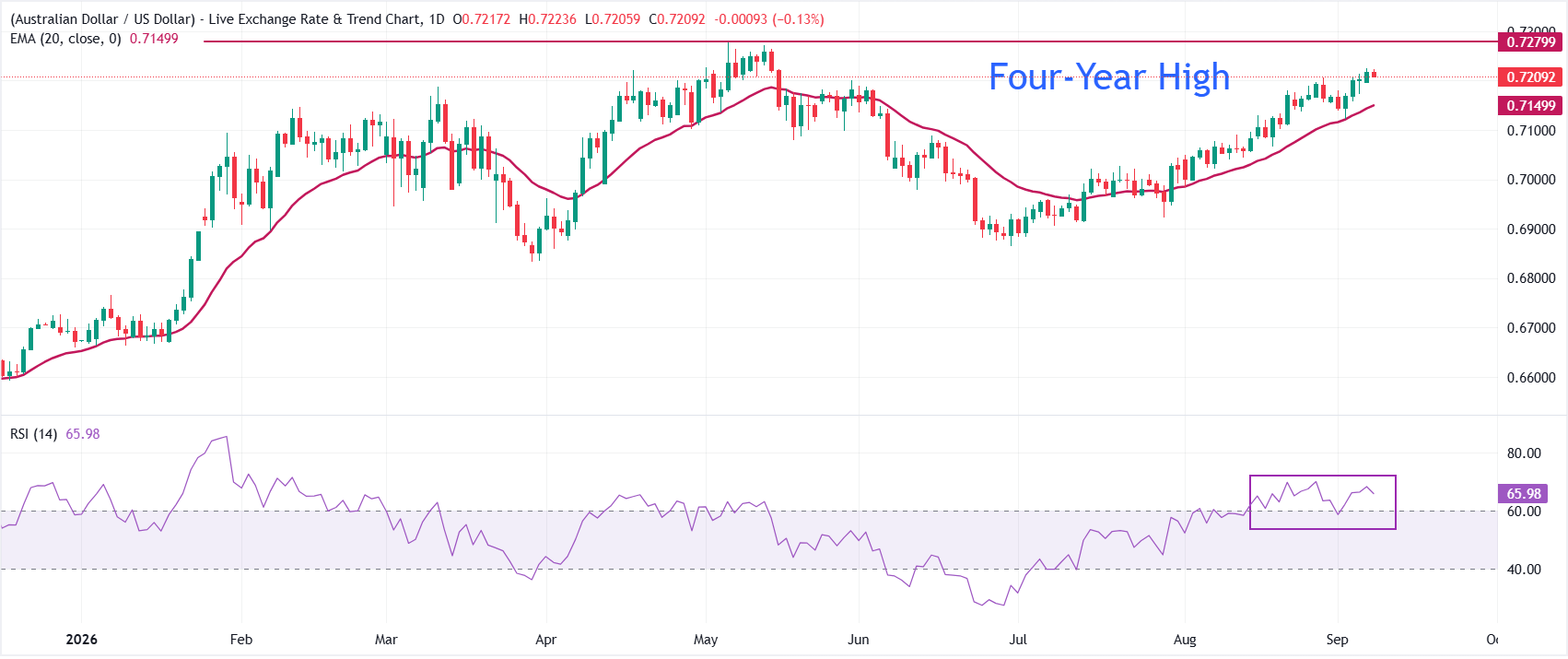
In the daily chart, AUD/USD trades at 0.7209, maintaining a bullish near-term bias as it holds above the 20-day Exponential Moving Average (EMA) at 0.7150. The pair’s steady advance from the mid-0.70s is underpinned by this rising dynamic support, while the 14-day Relative Strength Index around 66 suggests firm but not yet extreme bullish momentum.
On the downside, initial support is located at the 20-day EMA near 0.7150, where a break would hint at a deeper corrective phase toward prior mid-0.71 consolidation zones.
(The technical analysis of this story was written with the help of an AI tool. Know more.)
Inflation FAQs
Inflation measures the rise in the price of a representative basket of goods and services. Headline inflation is usually expressed as a percentage change on a month-on-month (MoM) and year-on-year (YoY) basis. Core inflation excludes more volatile elements such as food and fuel which can fluctuate because of geopolitical and seasonal factors. Core inflation is the figure economists focus on and is the level targeted by central banks, which are mandated to keep inflation at a manageable level, usually around 2%.
The Consumer Price Index (CPI) measures the change in prices of a basket of goods and services over a period of time. It is usually expressed as a percentage change on a month-on-month (MoM) and year-on-year (YoY) basis. Core CPI is the figure targeted by central banks as it excludes volatile food and fuel inputs. When Core CPI rises above 2% it usually results in higher interest rates and vice versa when it falls below 2%. Since higher interest rates are positive for a currency, higher inflation usually results in a stronger currency. The opposite is true when inflation falls.
Although it may seem counter-intuitive, high inflation in a country pushes up the value of its currency and vice versa for lower inflation. This is because the central bank will normally raise interest rates to combat the higher inflation, which attract more global capital inflows from investors looking for a lucrative place to park their money.
Formerly, Gold was the asset investors turned to in times of high inflation because it preserved its value, and whilst investors will often still buy Gold for its safe-haven properties in times of extreme market turmoil, this is not the case most of the time. This is because when inflation is high, central banks will put up interest rates to combat it. Higher interest rates are negative for Gold because they increase the opportunity-cost of holding Gold vis-a-vis an interest-bearing asset or placing the money in a cash deposit account. On the flipside, lower inflation tends to be positive for Gold as it brings interest rates down, making the bright metal a more viable investment alternative.
Author

Sagar Dua
FXStreet
Sagar Dua is associated with the financial markets from his college days. Along with pursuing post-graduation in Commerce in 2014, he started his markets training with chart analysis.