AUD/USD rises on positive China’s news, risk-on sentiment
- Positive inflation data from China, Australia’s largest trading partner, lifts the Aussie Dollar.”
- Bank of Japan Governor Kazuo Ueda hints at ending negative interest rates, weakening the US Dollar and boosting the AUD.
- Upcoming Australian economic data includes Westpac Consumer Confidence and NAB Business Confidence.

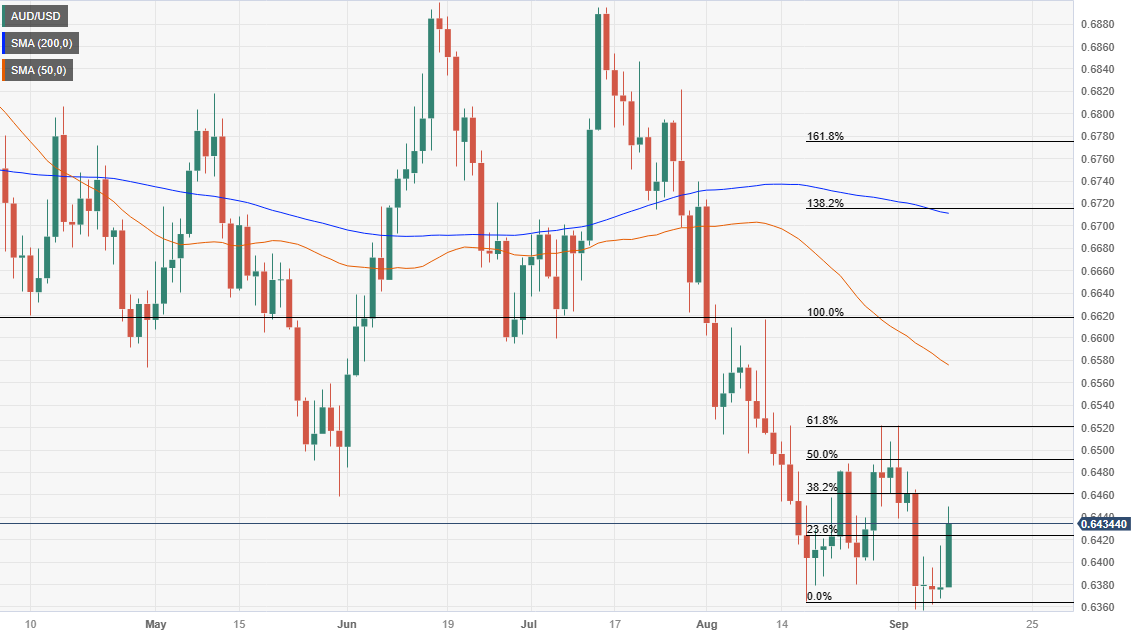
The Australian Dollar (AUD) climbs sharply against the US Dollar (USD) during the North American session on positive news from China ahead of Aussie’s economic data release. That, alongside a risk-on impulse, keeps the AUD/USD trading with gains of 0.97%, exchanging hands at 0.6436 after hitting a daily low of 0.6376.
Australian Dollar gains nearly 1% against the US Dollar as upbeat Chinese inflation data and a risk-on market mood boost the currency
The Greenback retraces on Monday due to an upbeat market mood, but also on comments from a top official of the Bank of Japan (BoJ). That and China’s data portraying the economy as exiting from a deflationary scenario spurred a rally in global equities.
BoJ Governor Kazuo Ueda hinted the BoJ could finish its era of negative interest rates, spurring a reaction on Japanese Yen (JPY) shorts, weakening the US Dollar, and sparking JPY gains by close to 1%.
Aside from this, the Aussie Dollar (AUD) was bolstered by China’s inflation report, with the Consumer Price Index (CPI) for August expanding by 0.1% YoY following a -0.3% number in July, while on a monthly basis, raised more than July’s data.
It should be said that amid the lack of economic data revealed by Australia and the United States (US), China is Australia’s largest trading partner and usually weighs on the former due to that condition. Even though Chinese authorities increased stimulus, the People’s Bank of China. (PBoC) cut interest rates; the economy remains weaker as the services sector continues deteriorating.
Therefore, upbeat developments in China could underpin the Australian Dollar (AUD), which is sensitive to the former economic developments.
The Australian economic agenda would feature consumer and business confidence. The Westpac Consumer Confidence is expected at 0.6% in September. The NAB Business Confidence is foreseen to dip to 1 in August, up from a -2 contraction in July. On the US front, the release of the Consumer Price Index (CPI) for Wednesday, August, would be crucial. Headline inflation is expected to rise above July’s numbers, contrary to core CPI, which is expected to contract further.
If US inflation comes hotter than expected, that would be positive for the USD and negative for the AUD, as it would suggest the Federal Reserve needs to tighten monetary policy. Estimates for the upcoming September meeting remain unchanged, but for the November meeting, chances for higher interest rate increases.
AUD/USD Price Analysis: Technical outlook
From a daily chart perspective, the AUD/USD is ongoing an upward correction after diving toward a year-to-date (YTD) low of 0.6357, but it would need a daily close above the prior week’s high of 0.6521 if buyers would like to remain hopeful of higher prices. A breach of the latter would expose the confluence of the March 10 low and the 50-day Moving Average (DMA) at around 0.6564/74, followed by the 0.6600 figure. Conversely, sellers would extend their losses once they challenge the YTD lows.
Author

Christian Borjon Valencia
FXStreet
Markets analyst, news editor, and trading instructor with over 14 years of experience across FX, commodities, US equity indices, and global macro markets.