AUD/USD rises on RBA’s relatively hawkish stance
- AUD/USD rises as markets continue to expect the Fed to cut rates in June.
- The RBA by contrast is striking a more hawkish tone, suggesting rates may even need to rise.
- Iron Ore prices are a drag on AUD/USD as they tumble amidst China property slump.

AUD/USD is trading in the lower 0.6600s on Wednesday during the US session. It is marginally up by two tenths of a percent on the day as markets continue to expect the Federal Reserve (Fed) to cut interest rates in June, despite stickier inflation data. Lower interest rates are negative for USD since they mean less foreign capital inflows. This contrasts with the Reserve Bank of Australia (RBA) which may still hike.
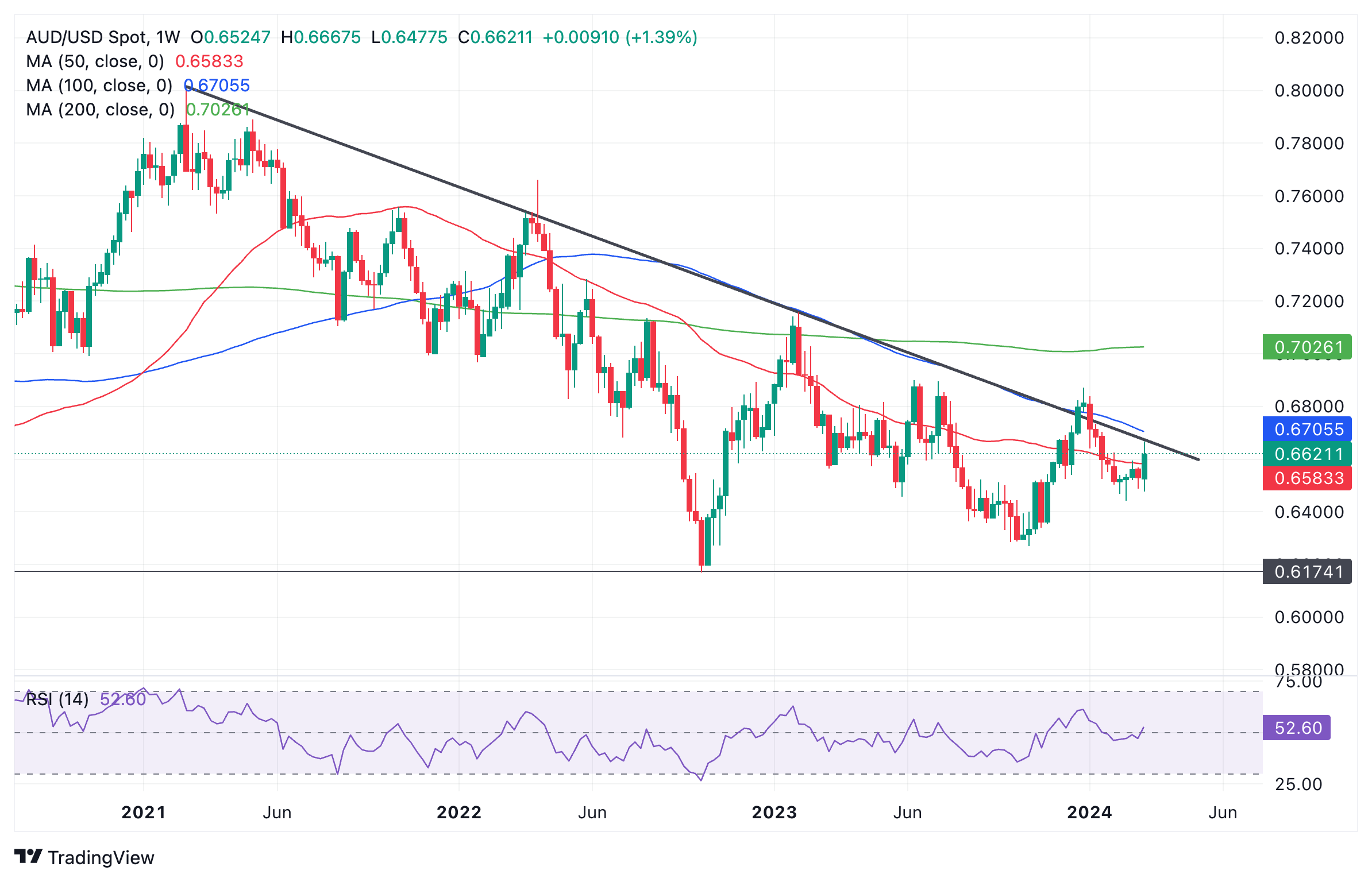
From a technical perspective AUD/USD has stalled after rallying up and hitting key resistance from a long-term trendline. Overall the outlook remains bearish as the pair is in a long-term downtrend, producing lower highs and lower lows.
Australian Dollar vs. US Dollar: Weekly chart
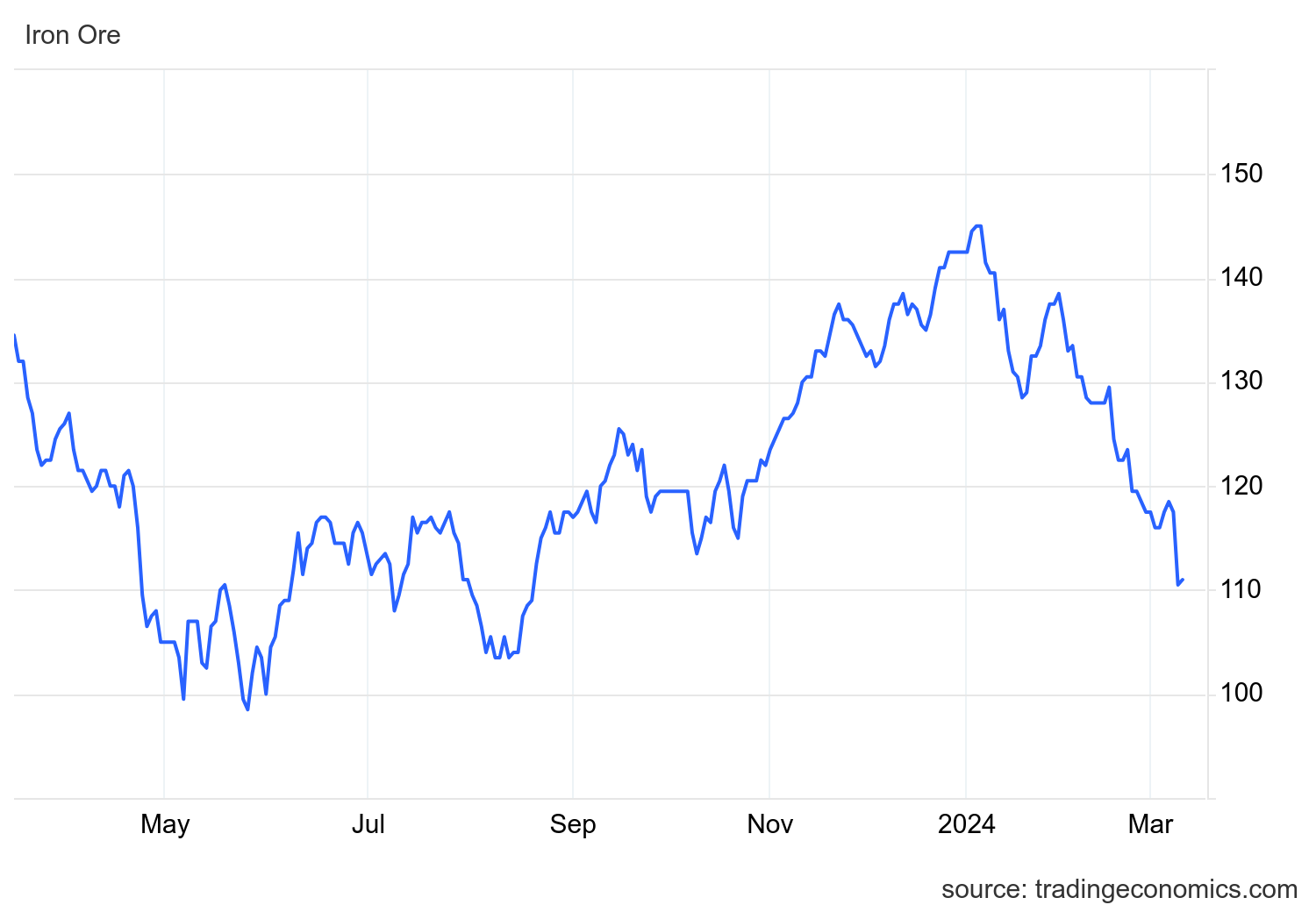
Despite recent gains, the mood music around the Australian Dollar remains negative due mainly to the steep fall in price of Australia’s largest export commodity, Iron Ore, which has dropped by over 20% since the start of 2024.
Iron Ore Prices in USD
The decline has been driven by a fall in demand from its biggest export partner China, which is using less iron to make steel for its beleaguered property sector.
Usually the Chinese government comes to the rescue when the economy takes a turn for the worse – not this time. At a meeting of the Chinese National People’s Congress on Monday, the party decided to withhold a bailout for the indebted property industry.
Instead, China’s Communist Party seemed more interested in punishing the property magnates behind the $7.5 trillion market’s collapse, according to news.com.au.
“Those who commit acts that harm the interests of the masses will be resolutely investigated and punished in accordance with the law. They will be made to pay the due price,” said Minister of Housing and Urban-Rural Development Ni Hong at the weekend.
This does not bode well for Iron Ore prices going forward or for the Australian Dollar.
Reserve Bank of Australia split on interest rates
Unlike the Federal Reserve, which is steadily reaching a consensus on the need for a June interest rate cut, the Reserve Bank of Australia (RBA) continues hinting it may have to raise rates even higher than their current 4.35% level.
Inflation in Australia fell more than expected – from 5.4% to 4.1% in Q4 of 2023, but it remains well above the RBA’s target range of 2%-3%. RBA Governor Michelle Bullock stated recently that inflation in Australia is mostly “homegrown” and “demand driven”, due to the strength of the labor market and rising wage inflation. This suggests it is more entrenched than in other countries, and will take longer to fall back to target. Indeed, the RBA does not see this happening till 2026 and Bullock hinted the RBA might still need to raise interest rates to tackle inflation.
On Wednesday, ex RBA Governor Philip Lowe said there is a two way risk on interest rates, and that the current RBA Governor Michelle Bullock was right to issue a warning that interest rates might still need to go higher.
The contrast in central bank policy stances suggests the US Dollar may actually weaken versus the Aussie, neutralizing some of the risks to the currency from the fall in demand for Australian Iron Ore.
Downtrend to continue?
The AUD/USD has just pushed back after touching a major trendline and there is a risk it could fall further, in line with the long-term downtrend.
A break below the last swing low of October 2023 at 0.6442 would solidify the bearish outlook and probably see prices ease further to around the 0.6170 October 2022 lows.
Alternatively, a break above the 0.6871 December 2023 high would indicate the long-term trend was probably reversing and the Australian Dollar might be set for sunnier slopes.
Author

Joaquin Monfort
FXStreet
Joaquin Monfort is a financial writer and analyst with over 10 years experience writing about financial markets and alt data. He holds a degree in Anthropology from London University and a Diploma in Technical analysis.