AUD/USD Price Forecast: Likely display one-sided strong move post Aussie Q1 CPI data
- AUD/USD falls to near 0.7175 as the US Dollar gains ahead of the Fed’s policy meeting.
- The Fed is expected to leave interest rates unchanged in the range of 3.50%-3.75%.
- Australian Q1 CPI data is expected to arrive higher at 4.1% YoY.

The AUD/USD pair trades 0.16% lower at around 0.7175 during the European trading session on Tuesday. The Aussie pair faces slight selling pressure as the US Dollar (USD) outperforms its major currency peers ahead of the two-day Federal Reserve (Fed) monetary policy meeting, which will start later in the day.
US Dollar Price Today
The table below shows the percentage change of US Dollar (USD) against listed major currencies today. US Dollar was the strongest against the Swiss Franc.
| USD | EUR | GBP | JPY | CAD | AUD | NZD | CHF | |
|---|---|---|---|---|---|---|---|---|
| USD | 0.25% | 0.33% | 0.10% | 0.21% | 0.20% | 0.40% | 0.56% | |
| EUR | -0.25% | 0.07% | -0.15% | -0.06% | -0.07% | 0.10% | 0.31% | |
| GBP | -0.33% | -0.07% | -0.22% | -0.12% | -0.12% | 0.05% | 0.24% | |
| JPY | -0.10% | 0.15% | 0.22% | 0.11% | 0.10% | 0.28% | 0.45% | |
| CAD | -0.21% | 0.06% | 0.12% | -0.11% | -0.00% | 0.16% | 0.35% | |
| AUD | -0.20% | 0.07% | 0.12% | -0.10% | 0.00% | 0.19% | 0.39% | |
| NZD | -0.40% | -0.10% | -0.05% | -0.28% | -0.16% | -0.19% | 0.18% | |
| CHF | -0.56% | -0.31% | -0.24% | -0.45% | -0.35% | -0.39% | -0.18% |
The heat map shows percentage changes of major currencies against each other. The base currency is picked from the left column, while the quote currency is picked from the top row. For example, if you pick the US Dollar from the left column and move along the horizontal line to the Japanese Yen, the percentage change displayed in the box will represent USD (base)/JPY (quote).
During the press time, the US Dollar Index (DXY), which tracks the Greenback’s value against six major currencies, trades 0.2% higher to near 98.70.
Investors expect the Fed to leave interest rates unchanged at their current levels for the third meeting in a row, and will likely warn of upside inflation risks amid elevated oil prices.
Meanwhile, the Australian Dollar (AUD) trades broadly higher ahead of the Aussie Q1 Consumer Price Index (CPI) data, which will be released on Wednesday. Inflationary pressures in the Australian economy are estimated to have grown strongly by 4.1% Year-on-Year (YoY) against the previous reading of 3.6%.
Signs of Australian inflationary pressures accelerating would prompt expectations of another interest rate hike by the Reserve Bank of Australia (RBA) in the May policy meeting. In March, the RBA raised its Official Cash Rate (OCR) by 25 basis points (bps) to 4.1%.
AUD/USD technical analysis
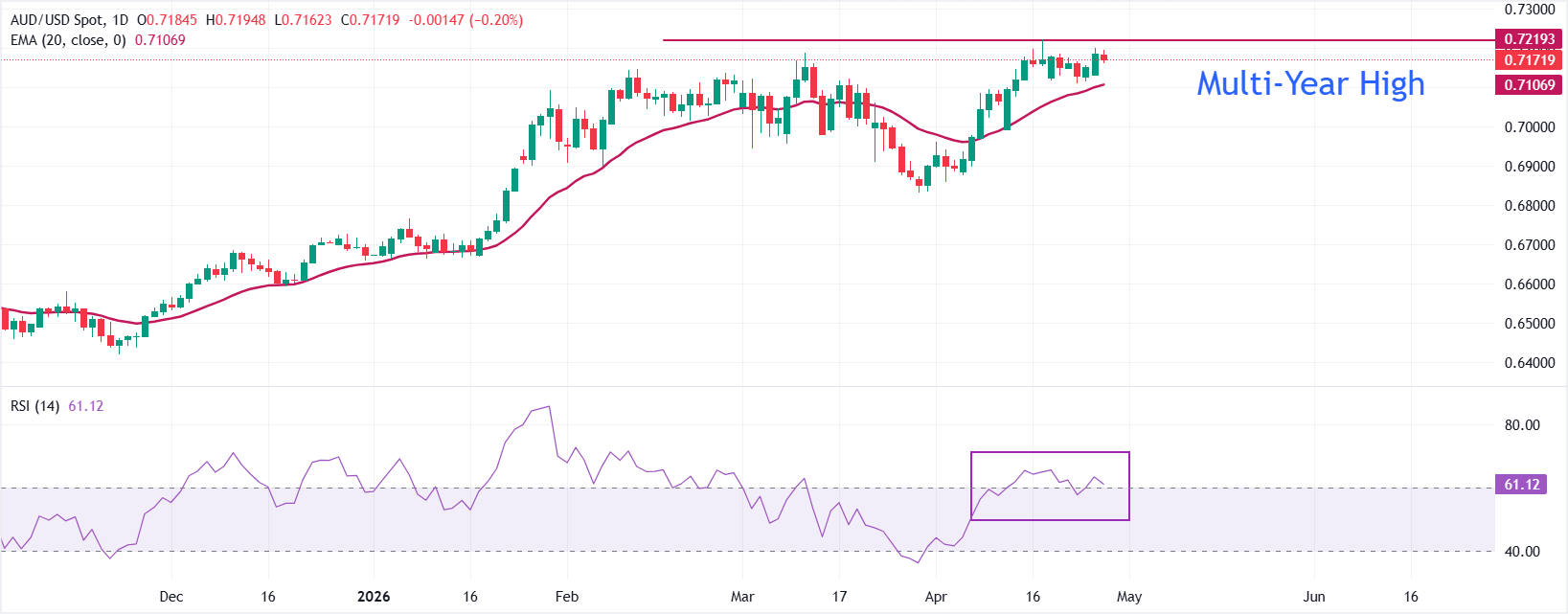
AUD/USD trades slightly lower at around 0.7175 at the press time. The pair holds a bullish near-term bias as spot remains above the 20-day exponential moving average (EMA) at 0.7107, suggesting underlying demand on shallow pullbacks.
The Relative Strength Index (RSI) at about 61 stays in positive territory, hinting that upside momentum is still intact even as price consolidates near recent highs.
On the downside, immediate support is seen at the 20-day EMA around 0.7107, where buyers are likely to defend the current advance and maintain the broader uptrend structure. A daily close below this level would soften the constructive tone and open room for a deeper correction towards the psychological level of 0.7000.
Looking up, the price could approach 0.7300 if it manages to break decisively above the multi-year high of 0.7222.
(The technical analysis of this story was written with the help of an AI tool.)
Economic Indicator
Quarterly Consumer Price Index (YoY)
The Consumer Price Index (CPI), released by the Australian Bureau of Statistics on a quarterly basis, measures the changes in the price of a fixed basket of goods and services acquired by household consumers. The quarterly CPI data series are calculated as the average of the three relevant monthly CPIs. The YoY reading compares prices in the reference quarter to the same quarter a year earlier. A high reading is seen as bullish for the Australian Dollar (AUD), while a low reading is seen as bearish.
Read more.Next release: Wed Apr 29, 2026 01:30
Frequency: Quarterly
Consensus: 4.1%
Previous: 3.6%
Source: Australian Bureau of Statistics
The quarterly Consumer Price Index (CPI) published by the Australian Bureau of Statistics (ABS) has a significant impact on the market and the AUD valuation. The gauge is closely watched by the Reserve Bank of Australia (RBA), in order to achieve its inflation mandate, which has major monetary policy implications. Rising consumer prices tend to be AUD bullish, as the RBA could hike interest rates to maintain its inflation target. The data is released nearly 25 days after the quarter ends.
Author

Sagar Dua
FXStreet
Sagar Dua is associated with the financial markets from his college days. Along with pursuing post-graduation in Commerce in 2014, he started his markets training with chart analysis.