AUD/USD Price Forecast: Finds support below 61.8% Fibo retracement at 0.7000
- AUD/USD rises to near 0.7007 as the US Dollar faces slight selling pressure.
- The US CPI cools down on a monthly basis, but rose expectedly on an annualized basis in May.
- Investors await the RBA’s monetary policy announcement on Tuesday.

The AUD/USD pair trades 0.14% higher to near 0.7007 during the European trading session on Thursday. The Aussie pair gains as the US Dollar (USD) ticks lower after the release of the softer monthly United States (US) Consumer Price Index (CPI) data for May.
As of writing, the US Dollar Index (DXY), which tracks the Greenback’s value against six major currencies, trades 0.1% lower to near 99.97.
On Wednesday, the US monthly headline CPI arrived lower at 0.5%, as expected, against the previous reading of 0.6%. Month-on-month core CPI – which excludes volatile food and energy items – growth cooled down to 0.2% from the previous reading of 0.4%. Meanwhile, Year-on-Year (YoY) headline and core CPI accelerated to 4.2% and 2.9%, as expected.
However, the broader outlook of the US Dollar appears to be firm as the next monetary policy adjustment by the Federal Reserve (Fed) appears to be on the upside. According to the CME FedWatch tool, the odds of the Fed delivering at least one interest rate hike this year are almost 71%.
On the Aussie front, investors await the Reserve Bank of Australia’s (RBA) monetary policy announcement on Tuesday, in which it is expected to leave interest rates unchanged.
AUD/USD technical analysis
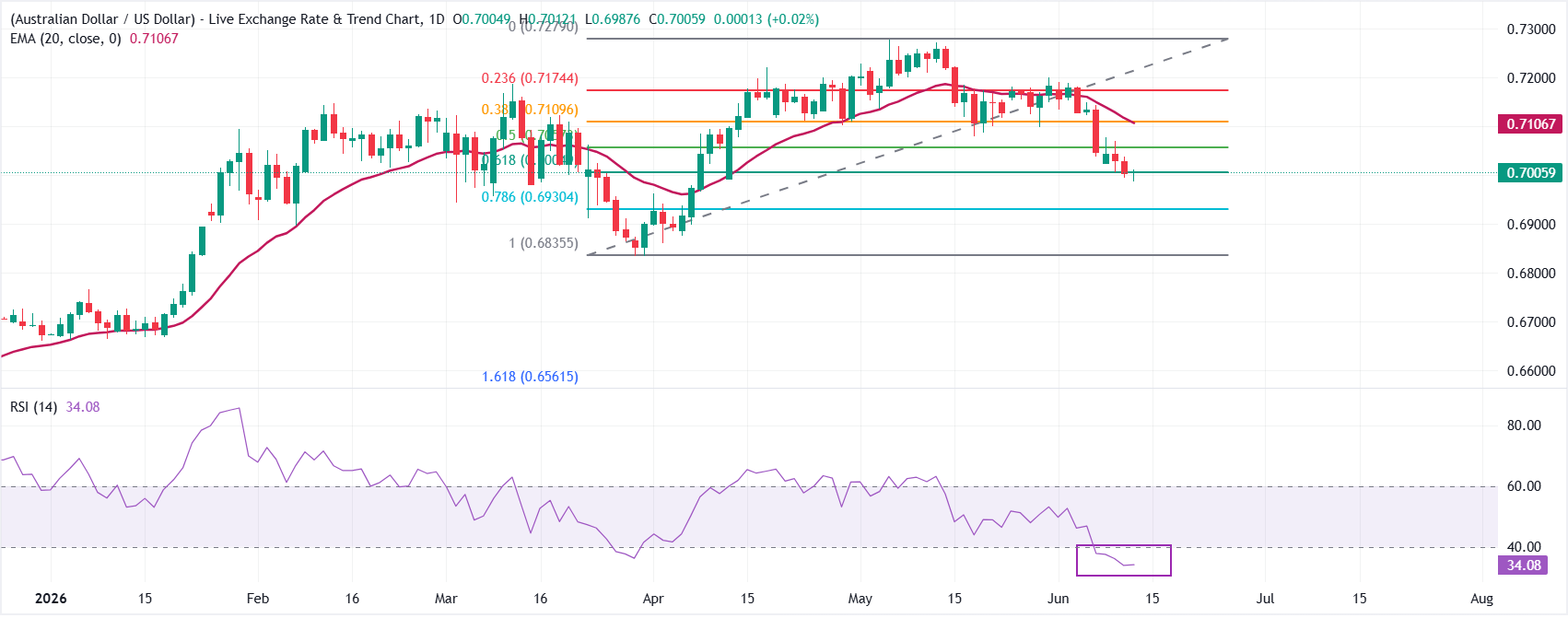
AUD/USD trades marginally higher at around 0.7007 at press time. However, the pair maintains a bearish near-term tone as spot holds beneath the 20-day exponential moving average (EMA) at 0.7107 and a dense Fibonacci resistance band starting at the 50.0% retracement around 0.7057.
The Relative Strength Index (14) hovers near 34, indicating persistent downside pressure but not yet extreme oversold, which suggests sellers remain in control while leaving room for further losses before a more meaningful corrective bounce.
On the downside, immediate support aligns with the 61.8% Fibonacci retracement at 0.7005, a break of which would expose the 78.6% level at 0.6930 ahead of the prior swing low area marked by the 100.0% retracement at 0.6836. On the topside, initial resistance is seen at the 50.0% retracement near 0.7057, followed by a tight cluster formed by the 20-day EMA at 0.7107 and the 38.2% retracement at 0.7110, with further recovery attempts likely capped while the pair trades below the 23.6% retracement at 0.7174.
(The technical analysis of this story was written with the help of an AI tool.)
Economic Indicator
RBA Interest Rate Decision
The Reserve Bank of Australia (RBA) announces its interest rate decision at the end of its eight scheduled meetings per year. If the RBA is hawkish about the inflationary outlook of the economy and raises interest rates it is usually bullish for the Australian Dollar (AUD). Likewise, if the RBA has a dovish view on the Australian economy and keeps interest rates unchanged, or cuts them, it is seen as bearish for AUD.
Read more.Next release: Tue Jun 16, 2026 04:30
Frequency: Irregular
Consensus: -
Previous: 4.35%
Source: Reserve Bank of Australia
Author

Sagar Dua
FXStreet
Sagar Dua is associated with the financial markets from his college days. Along with pursuing post-graduation in Commerce in 2014, he started his markets training with chart analysis.