AUD/USD holds the 61.8% ratio, despite bearish daily close
- AUD/USD pressured as the US dollar picks up a safe haven bid.
- Wall Street's benchmarks soured on concerns for global growth and coronavirus.
- US CPI and Australia Employment data will be the week's focus on the calendar.

AUD/USD was ending Friday offered, losing nearly 0.2% after falling from a high of 0.7409 and reaching a low of 0.7348. The markets were soured at the end of the week as the latest COVID-19 wave fueled growth worries while August US producer prices rose more than expected.
US Producer Prices rose 0.7% in August, ahead of expectations for a 0.6% increase in an Econoday survey. Core producer prices excluding the more volatile food and energy categories rose 0.6% versus expectations for a 0.5% gain and were up 6.7% year over year.
The Australian dollar is correlated to risk and the S&P 500 dropped for the fifth consecutive day, finishing 0.8% lower. Interestingly, the risk-off move in equities only saw North American government bond markets give back the prior day's gains.
The 10-year yield rallied by over 3.2%, firming in accumulation territories and the US dollar, as measured by the DXY, was supported, adding 0.13% on the day. Despite the stronger dollar, WTI and Copper gained 2.1% and 3.3%, respectively, helping the CRB index to end on a positive note, higher by near 0.9%.
AUD/USD key events this week
Meanwhile, the market's focus will shift to US Consumer Price Index, 14 Sep, in the build-up to the September Federal Open Market Committee meeting, 21-22 Sep, and Aussie Employment, 16 Aug.
Analysts at TD Securities expect that food and energy prices probably rose fairly strongly again in August, but the core CPI likely rose at its slowest pace since February. As for Aussie Employment data, the analysts argued that it likely fell in August but less than consensus:
''While job vacancies have declined, they remain at a very high level, hinting at resilience in labour demand. Moreover, we think fiscal support is likely to partly offset some job losses as the adjustment to the labour market occurs through reduced hours worked (as seen in July), and not job losses.''
AUD/USD developing themes
The greenback has continued to attract a safe-haven bid as markets look again with some concern over the coronavirus Delta-variant spread that looks likely to hinder the global economic recovery. At the same time, the potential combination of monetary tightening has moved to the fore.
The Reserve Bank of Australia delivered a dovish taper announcement last week, extending its no-tapering horizon until Feb 2022 which is a weight on the currency currently. The RBA has cast a cautious tone with regards to the fluid Delta coronavirus variant variable and the lockdown data is yet to be seen for the third quarter. This leaves AUD vulnerable.
On the flip side, there are some positives that could come from improved Sino/US relations that might be expected the downside in USD/CNH and transpire into support for AUD as a consequence. The US president Joe Biden and spoke with China’s President Xi over the phone for the first time since February. CNY has been supported on the news which could be the start of a bigger move in USD/CNY, away from the 6.50 level, which normally causes a positive spillover effect for APAC and EM-FX.
AUD/USD technical analysis
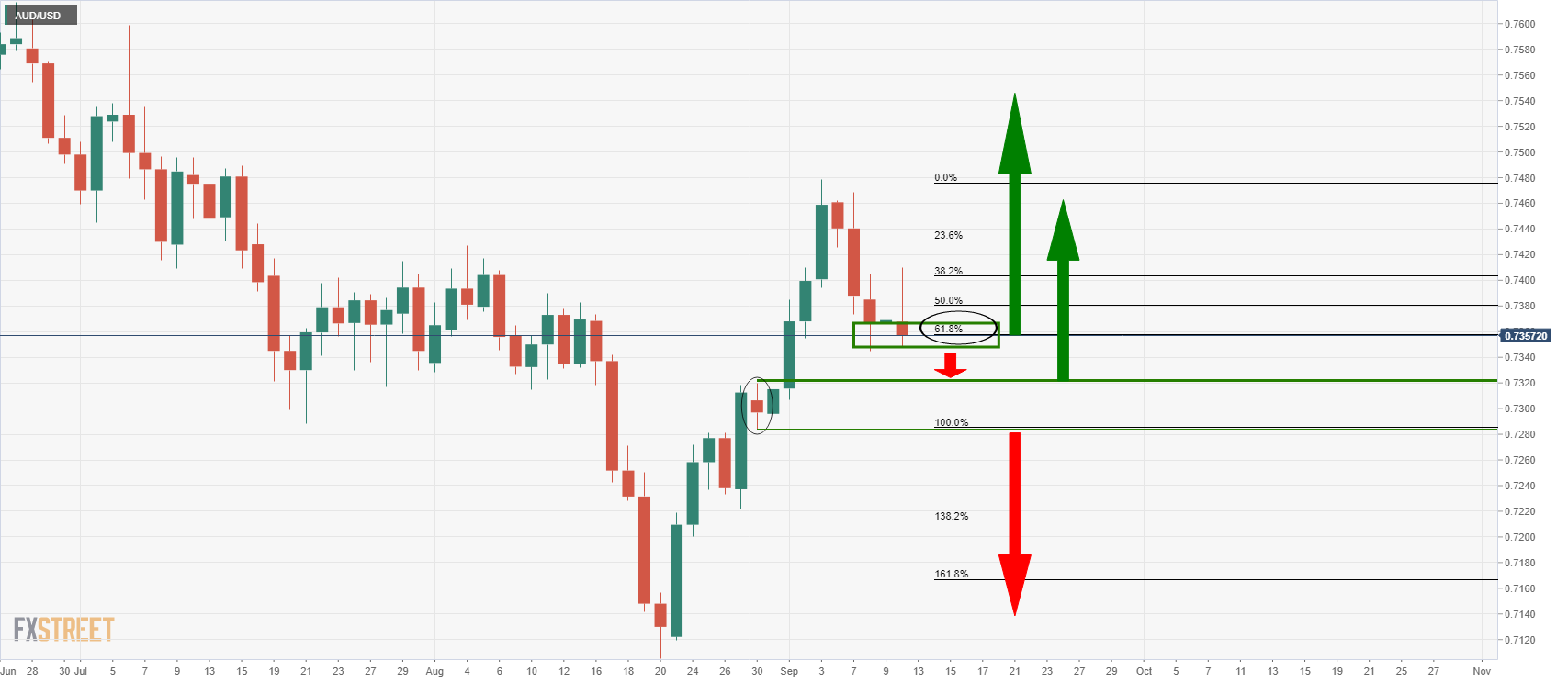
The price is being supported at the 61.8% ratio. So long as this area holds, or at least support from Aug 30 business near 0.7320, then there will be prospects of an upside continuation. A break of the 0.7320 level, on the other hand, will be significantly bearish for the days ahead.
Author

Ross J Burland
FXStreet
Ross J Burland, born in England, UK, is a sportsman at heart. He played Rugby and Judo for his county, Kent and the South East of England Rugby team.















