AUD/USD failure at 0.7400 exacerbated a correction towards 0.7373
- On Tuesday, the AUD/USD gained 0.32% but recorded a daily close below March’s 21 low, which opened the door for further losses.
- Geopolitics and Fed speaking capped the AUD/USD upside
- St. Louis Fed President Bullard opens the door for 75 bps rate hikes.
- AUD/USD Price Forecast: It is upward biased, but failure at 0.7400 paved the way for a downward move

The Australian dollar advances in the day but struggles around 0.7400 as the New York session winds down amidst a buoyant US dollar and a risk-on market mood. At 0.7375, the AUD/USD reflects the appetite for risk-sensitive currencies in the FX complex, though capped by a firm US dollar.
Tuesday’s session witnessed a mixed market mood throughout the day. However, the sentiment improved late in the US session, as reflected by US equities recording gains between 1.45% and 2.15%, and the greenback rose. The 10-year benchmark note rose to 2.940%, gaining eight basis points.
Geopolitics and Fed speaking capped the AUD/USD upside
Geopolitics dominates news headlines. The Russian offensive in Eastern Ukraine and the lack of peace talks at the ministry level keep investors hopeless of a cease-fire. So investors have shifted towards Fed speaking led by the Fed “hawk” James Bullard, St. Louis Fed President. On Monday, he said that inflation is “far too high for comfort,” Fed officials want to get to neutral rates expeditiously and opened the door for 75 bps increases to the Federal Funds Rate (FFR).
On Tuesday, the Chicago Fed President Charles Evan crossed the wires. Evans said that the US economy “will do very well even as rates rise.” He noted that he supports a “couple” of 50 bps increases, which could lift rates to the 1.25%-2.50% neutral rate.
In the meantime, the US Dollar Index, a gauge of the greenback’s value against a basket of six peers, is rising 0.17%, sitting at 100.989, a headwind for the AUD/USD.
Data-wise, the US economic docket featured Building Starts and Permits, which came more robust than expected. Meanwhile, the Australian economic docket would feature the Westpac-MI Leading Index. According to Westpac analysts, it is expected to “pop higher as last year’s delta disruptions cycle out of the six-month measure; other positive updates around equities, commodities, and dwelling approvals will also be included.”
AUD/USD Price Forecast: Technical outlook
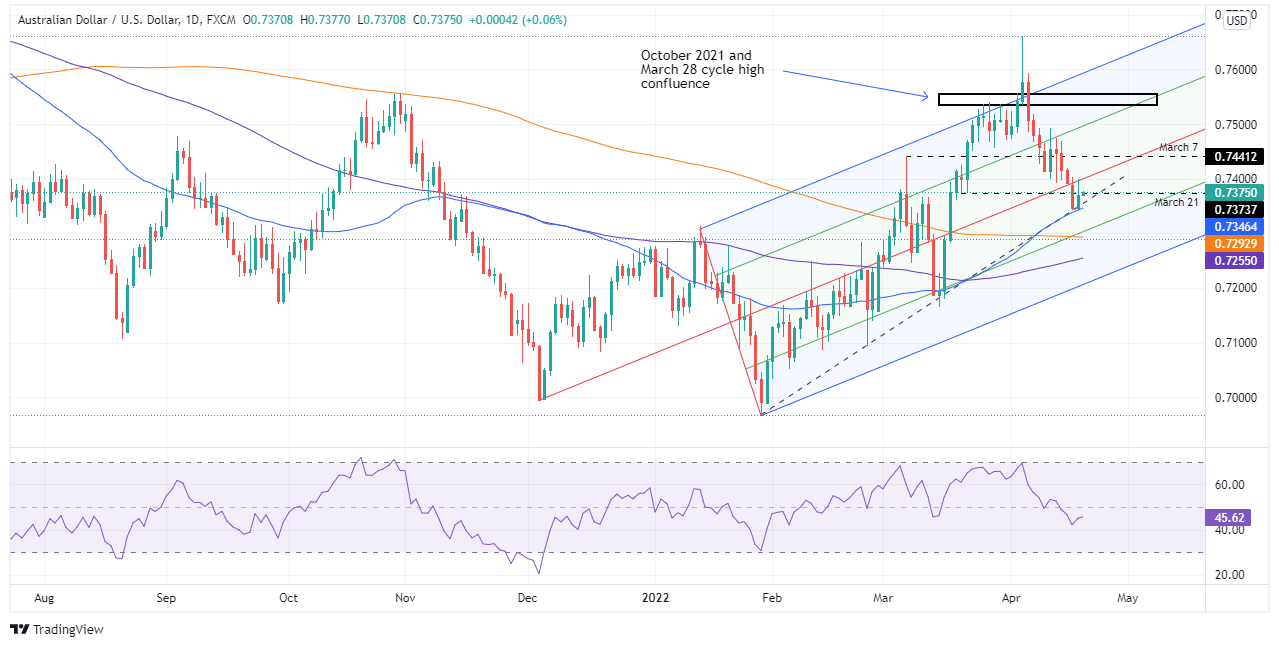
AUD/USD failure at 0.7400 has left the AUD/USD adrift to some selling pressure, despite recording gains on Tuesday. Also, the pair is shy of breaking below March’s 21 daily low at 0.7373. If the AUD/USD records a daily close under the latter, it will give way for further selling pressure on the AUD/USD.
The Relative Strength Index (RSI), an oscillator sitting at 45.47 in bearish territory, gives an additional selling signal to the abovementioned.
That said, the AUD/USD first support would be the 50-day moving average (DMA) at 0..7346. A breach of the latter would expose the confluence of the mid-parallel Pitchfork’s line between the central and bottom lines and the 200-DMA around the 0.7293-0.7305 range, followed by the 100-DMA at 0.7255.
Author

Christian Borjon Valencia
FXStreet
Markets analyst, news editor, and trading instructor with over 14 years of experience across FX, commodities, US equity indices, and global macro markets.
















