|

AUD/USD Bulls lurking in key H4 support ahead of Fed

  • AUD/SD traders await the Federal Reserve for next cues. 
  • Bears digging into support in a firm correction. 

AUD/USD lept over 1% against the US Dollar on Tuesday after a surprise rate hike by the Reserve Bank of Australia, RBA, reaching a high of 0.6717 from a low in the 0.6620s. 

The RBA hiked 25bp to 3.85%. ´´Given our own concerns about the stickiness of services and non-tradable price inflation, plus the robustness in the labor market and the business sector, we expect another 25bp rate hike in August,´´ analysts at ANZ Bank explained. 

The RBA began hiking rates back in May 2022 and has made 375 bp of tightening so far. According to analysts at Brown Brothers Harriman, there are ´´no more hikes priced in and the easing cycle is priced to start Q1 2024 with 25 bp of easing seen over the next 12 months and 50 bp over the next 24 months.´´

Meanwhile, the US Dollar is bid ahead of main events of the week that begin Wednesday with the Federal Reserve that began its own tightening cycle in March 2022 with 475 bp of tightening so far. the markets are pricing in another 25 bp with the easing cycle priced to start in November.

´´We expect a 25bp rate hike at next week's FOMC meeting and anticipate that post-meeting communication will: (i) emphasize that disinflation has been evolving slower than expected, leaving open the possibility of additional tightening, and (ii) acknowledge the more uncertain economic environment, especially with regard to credit conditions post SVB collapse,´´ analysts at TD Securities explained. 

AUD/SD technical analysis
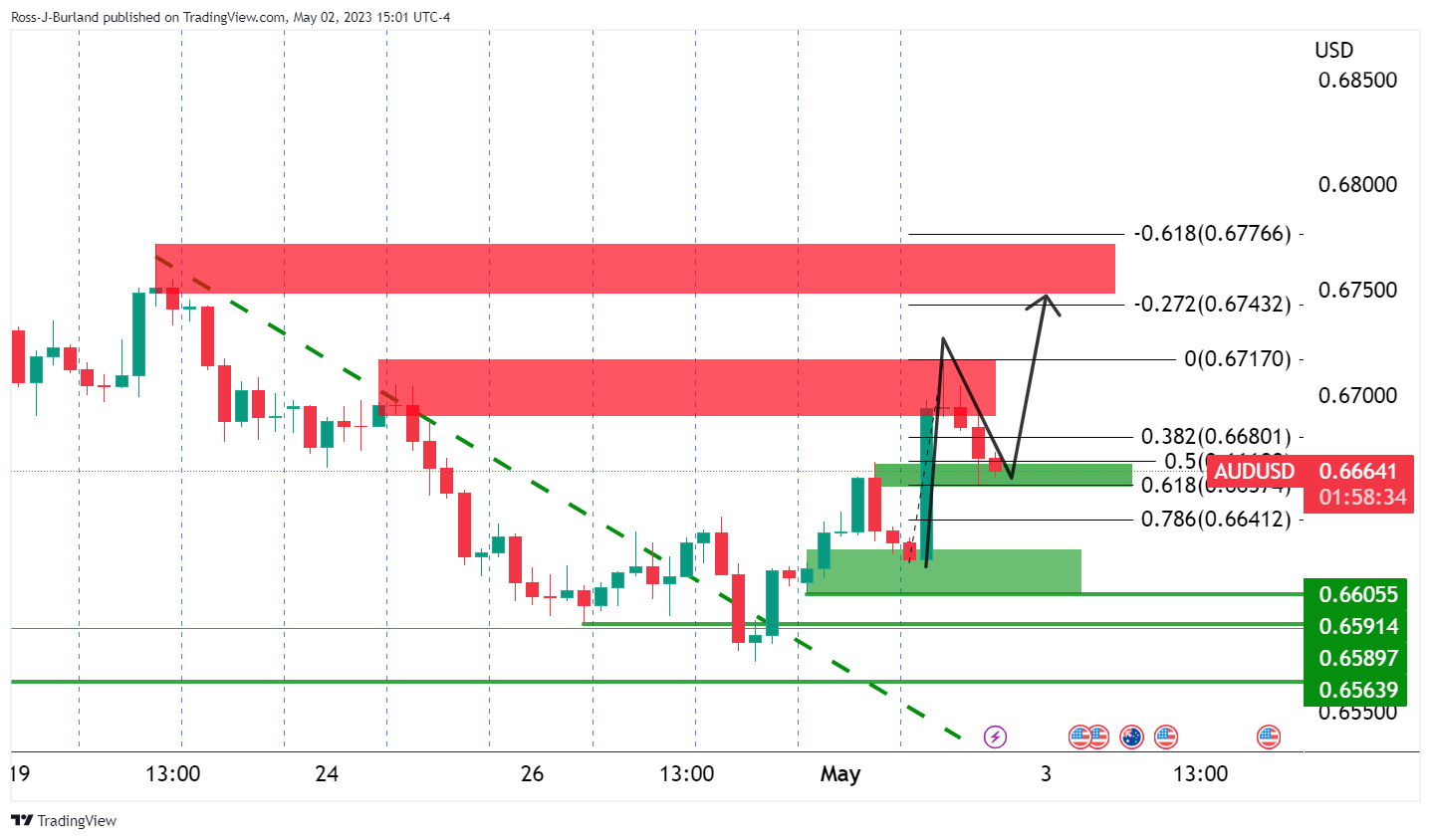
AUD/USD is holding in support but there could be another thrust from the bulls in the coming days with 0.6750 eyed. However, it depends on the outcome of the Federal Reserve and markets will be data-dependent. 

Author

Ross J Burland

Ross J Burland, born in England, UK, is a sportsman at heart. He played Rugby and Judo for his county, Kent and the South East of England Rugby team.


More from Ross J Burland
Share:

Editor's Picks

GBP/USD bounces off lows, back above 1.3200

After bottoming out near 1.3160, GBP/USD manages to regain a bit of shine and reclaim the 1.3200 mark and beyond at the end of the week. Stronger-than-expected UK Retail Sales data seem to be helping the British Pound limit its losses, while the chaotic UK political environment keeps the bulls at bay for now.

EUR/USD looks consolidative around 1.1460

EUR/USD stages a modest rebound after slipping to a three-month low below 1.1420 at the end of the week. That said, the pair now looks to consolidate humble gains just above 1.1460 despite growing uncertainty surrounding the next round of US-Iran negotiations, which keeps the US Dollar’s downside contained.

Gold slips back to six-day lows, targets $4,100

Gold retreats for the third consecutive day on Friday, eroding gains seen in the first half of the week and approaching the key $4,100 mark per troy ounce. Indeed, the precious metal continues to face headwinds from the Fed's hawkish stance and renewed uncertainty surrounding the next round of US-Iran negotiations.

Breaking: Iran closes the Strait of Hormuz amid ceasefire deal violation
Iran says it is closing the Strait of Hormuz after accusing the United States (US) and Israel of violating the ceasefire. According to Iran, the decision came over the continued Israeli strikes in Lebanon. The Iranian Revolutionary Guard Corps Navy issued a warning to all vessels: "Do not approach the Strait of Hormuz; otherwise, your security will be jeopardized."
The Iran war didn't break the US economy, but what happens next?

Nearly four months after the start of the Iran war, the US economy remains remarkably resilient. While the conflict initially triggered a severe disruption to global energy markets and a sharp rise in Oil prices, recent diplomatic progress between Washington and Tehran has eased concerns about a prolonged supply shock.

Regime change: Inside Kevin Warsh's first move to make the Fed unreadable on purpose

The rate did not move. That was the least interesting thing about Kevin Warsh's first meeting in charge of the Fed. The FOMC held its benchmark at 3.50%-3.75% for the fourth straight meeting, exactly as priced, and then the new chair used his first press conference to dismantle the machinery the market has leaned on for a decade.