|

AUD/JPY Price Analysis: Trades sideways around 91.70s despite an upbeat mood

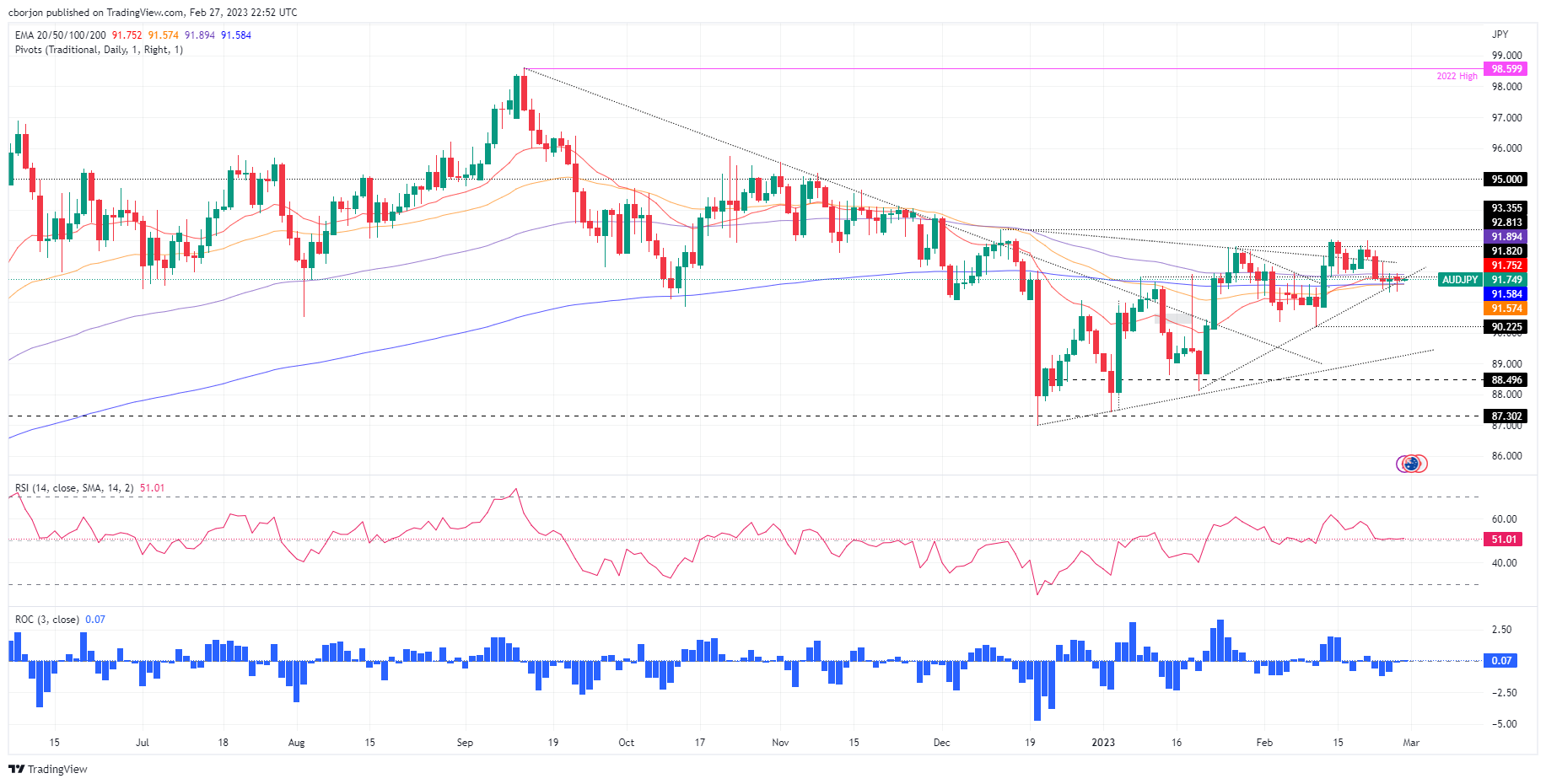
  • The AUD/JPY trades sideways, within a busy area surrounded by all the daily Moving Averages.
  • AUD/JPY Price Analysis: Range-bound within the 91.57-89 area.

The AUD/JPY fluctuates as the Asian session begins, registering minuscule gains of 0.07%, exchanging hands at around 91.73. A risk-on impulse bolstered the Australian Dollar(AUD), while the Bank of Japan’s (BoJ) newly appointed Governor Kazuo Ueda’s dovish comments were a headwind for the Japanese Yen (JPY).

With the AUD/JPY bottoming around the 91.30 area in the last couple of days, price action is contained within the confluence of all the daily Exponential Moving Averages (EMAs) around the 91.57-89 area. Furthermore, the AUD/JPY is trading sideways as the Relative Strength Index (RSI) shifts flat, meaning buyers and sellers are at equilibrium.

If the AUD/JPY clears the top of the range, the next resistance would be 92.00. A breach of the latter will expose the February 21 high at 93.00, followed by the December 13 high at 93.35. Once reclaimed, the AUD/JPY’s next stop would be the psychological 94.00 barrier.

As an alternate scenario, sellers would exert downward pressure on the pair if the AUD/JPY clears a one-month-old upslope support trendline. The AUD/JPY  first support would be the 91.00 figure. Break below, and the pair would fall toward the February 10 swing low at 90.22 and then the 90.00 psychological level.

AUD/JPY Daily chart
AUD/JPY Key technical levels

AUD/JPY

Overview
Today last price91.77
Today Daily Change0.01
Today Daily Change %0.01
Today daily open91.76
 
Trends
Daily SMA2091.82
Daily SMA5090.83
Daily SMA10092.11
Daily SMA20093.12
 
Levels
Previous Daily High91.94
Previous Daily Low91.31
Previous Weekly High93.01
Previous Weekly Low91.31
Previous Monthly High92.82
Previous Monthly Low87.41
Daily Fibonacci 38.2%91.7
Daily Fibonacci 61.8%91.55
Daily Pivot Point S191.4
Daily Pivot Point S291.04
Daily Pivot Point S390.77
Daily Pivot Point R192.03
Daily Pivot Point R292.3
Daily Pivot Point R392.67

Author

Christian Borjon Valencia

Markets analyst, news editor, and trading instructor with over 14 years of experience across FX, commodities, US equity indices, and global macro markets.


More from Christian Borjon Valencia
Share:

Editor's Picks

AUD/USD advances modestly, hovers around 0.7050

AUD/USD reverses part of Friday’s sharp decline and gyrates around the 0.7050 region ahead of the opening bell in Asia. The pair’s modest recovery comes amid humble losses in the Greenback, always amid the steady uncertainty on the geopolitical front. Moving forward, Westpac’s Consumer Confidence measure will be the salient release on Tuesday.

USD/JPY holds higher ground toward 160.50 despite 'Yentervention' fears

USD/JPY holds higher ground toward 160.50 in Monday's Asian trading, despite intervention fears. Japan’s revised GDP print, which confirmed that the economy lost momentum in the first quarter, weighs on the Japanese Yen. Meanwhile, Friday's upbeat US NFP report and fresh Israel-Iran attacks favor the US Dollar bulls, underpinning the currency pair.

Gold faces initial resistance near  $4,350

Gold manages to reclaim the $4,300 mark per troy ounce and above on Monday. The yellow metal’s small uptick comes on the back of modest losses in the US Dollar, while traders continue to follow geopolitical events in the Middle East and the likelihood of a tighter-for-longer Fed.

Why institutions prefer Solana over newer rivals for stablecoin adoption – Solstice CEO
The cryptocurrency industry has entered a new era spearheaded by stablecoins, real-world asset (RWA) tokenization, decentralized finance (DeFi), and Artificial Intelligence (AI) applications.
$1.75 trillion: Is SpaceX the most popular IPO in history, or the most engineered?

On June 12, the largest initial public offering (IPO) in history is set to hit the tape, and almost nobody is asking whether the price is right, because almost everybody already wants in.

The US economy defies the rules: 100 days into the Oil shock and the recession signal is still missing

More than three months after the start of the Iran war and the resulting disruption to global energy markets, the US economy continues to display remarkable resilience. The conflict has triggered a sharp rise in Oil prices, reignited inflationary pressures and fueled widespread concerns about a potential economic slowdown.