|

AUD/JPY Price Analysis: Pair drops to around 107.00, bearish outlook ahead

  • AUD/JPY declines to 107.10 while holding just above the 20-day SMA support.
  • A bearish outlook looms for the next few sessions, following a substantial dip from Thursday.

In Friday's trading session, a downward turn was observed for the AUD/JPY pair as it dipped by 0.23% to reach 107.10. This indicative decline marks a notable shift from the previous session's buoyancy, which saw the pair above the 109.00 mark. Present circumstances suggest a bearish outlook for the next few sessions, as it turns evident that the sellers have found their footing.

The daily Relative Strength Index (RSI) for the AUD/JPY marked a significant dip from Thursday's 79 to 54, drifting even near into negative territory. This trend shift hints at a weakening upward momentum, potentially signifying more bearish days ahead. In concert with this, the Moving Average Convergence Divergence (MACD) demonstrates rising red bars.

AUD/JPY daily chart
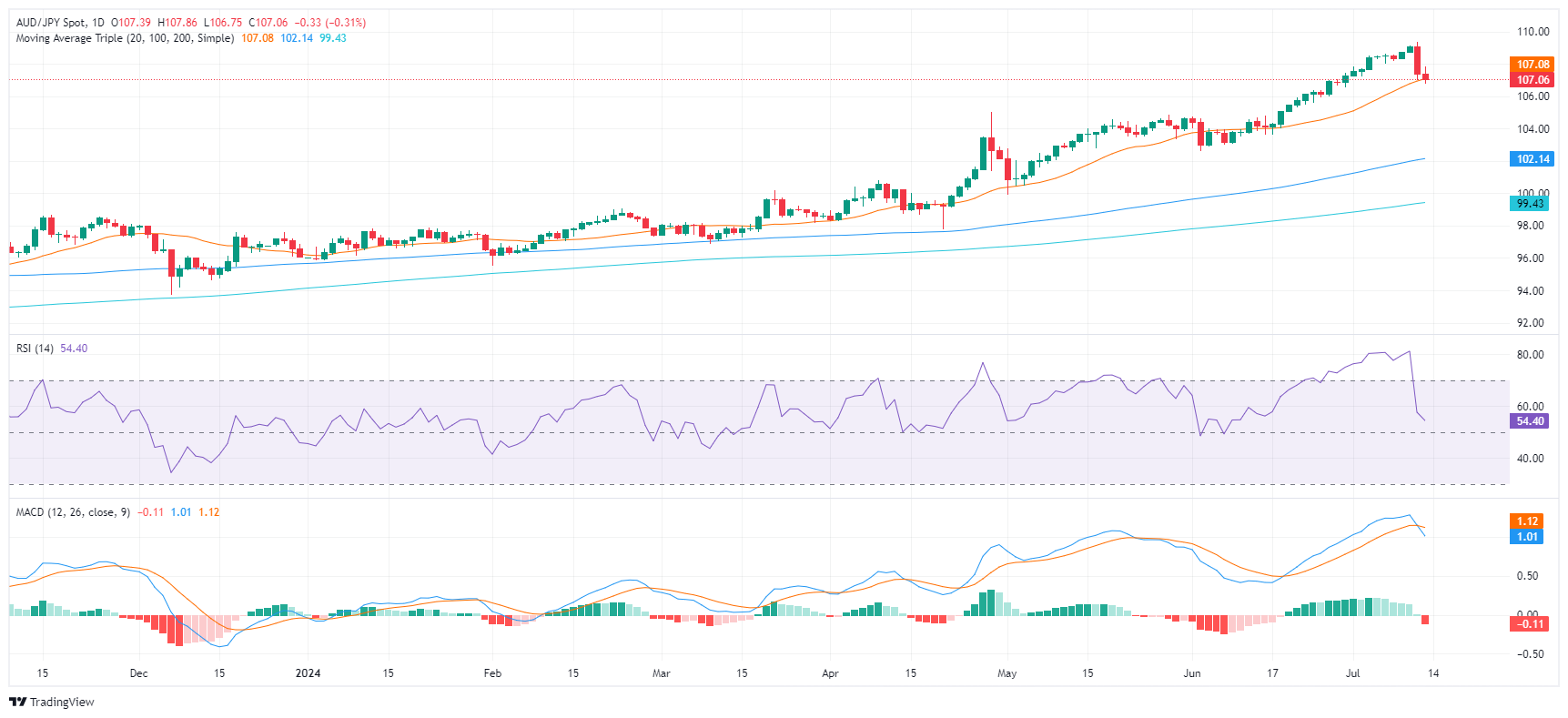
Looking at the broader perspective, the AUD/JPY still displays signs of possible bearish sentiment, given its position just slightly above the 20-day SMA support at 107.10. In case of further downward action, immediate support levels at 107.00 and 106.00 are key areas to watch. However, to avert further potential losses, buyers must target a recovery that extends towards the 108.00 barrier.

Author

Patricio Martín

Patricio is an economist from Argentina passionate about global finance and understanding the daily movements of the markets.


More from Patricio Martín
Share:

Editor's Picks

GBP/USD weakens below 1.3250 on UK political risks, BoE repricing

The GBP/USD pair trades in negative territory around 1.3245 during the early Asian trading hours on Wednesday. Traders await the UK political developments, focusing on potential leadership by Andy Burnham and adherence to existing fiscal rules. Bank of England Governor Andrew Bailey is set to speak later in the day. On Thursday, all eyes will be on the US jobs data for June.

EUR/USD declines to near 1.1400 as softer German inflation undercuts ECB hike bets

The EUR/USD pair loses momentum to near 1.1410 during the early Asian trading hours on Wednesday, pressured by receding bets for aggressive tightening by the European Central Bank (ECB). Traders will take more cues from the preliminary reading of the Harmonized Index of Consumer Prices from the Eurozone and US Manufacturing Purchasing Managers Index report, which are due later in the day.

Gold seems vulnerable around $4,000 amid a bullish USD

Gold trades with a mild negative bias around $4,000 following the previous day's two-way price swings as the US Dollar stands firm amid safe-haven demand, bolstered by uncertainty surrounding US-Iran talks. Meanwhile, Tuesday's strong labor market data reaffirmed bets for a Fed rate hike in 2026 . This further underpins the buck and keeps the non-yielding bullion close to the YTD trough set the previous day.

Ethereum: Sharplink makes first treasury purchase in 2026 amid ETH's fall from grace

Ethereum treasury firm Sharplink resumed accumulation of the second-largest cryptocurrency by market capitalization last week after months on the sidelines. The Florida-based firm acquired 10,000 ETH last week at an average price of $1,611 per ETH, marking its first purchase since October. The move has pushed its holdings to 886,725 ETH worth roughly $1.4 billion at the time of writing.

Why a hawkish Bank of Japan could trigger the next Bitcoin sell-off

The Japanese Yen hits a 40-year low of 162.00 against the US Dollar, raising concerns about intervention or additional rate hikes by the Bank of Japan. BoJ may sell US Treasuries to buy back Yen, potentially pushing US bond yields higher and making Bitcoin less attractive to investors.

Kevin Warsh isn't expected to say much in Sintra: That's exactly why markets will listen

Financial markets could find an important catalyst in the enchanting, fairytale-like landscape of Sintra this week. The ECB Forum will, as it does every year, gather the crème de la crème of central banks. The new boss at the Fed, who has clearly said that the Fed should stop explaining everything, will need to talk – and traders should listen.