|

AUD/JPY Price Analysis: Heavy losses drag pair near 88.60 as bearish momentum accelerates

  • AUD/JPY plunged near the 88.60 zone on Friday, marking a sharp retreat ahead of the Asian session.
  • MACD confirms a sell signal as the pair faces broad bearish pressure despite neutral oscillators.
  • Key resistance stands at 91.53 and 92.92, while moving averages point to extended downside risk.

The AUD/JPY pair tumbled aggressively on Friday, retreating toward the 88.60 area after shedding over 4% during the day. The move represents one of the steepest intraday declines in recent sessions, dragging the pair away from the recent highs and into a mid-range zone between 87.41 and 92.64. The plunge comes as broader technicals align in favor of sellers, even as some oscillators remain neutral.

Daily chart
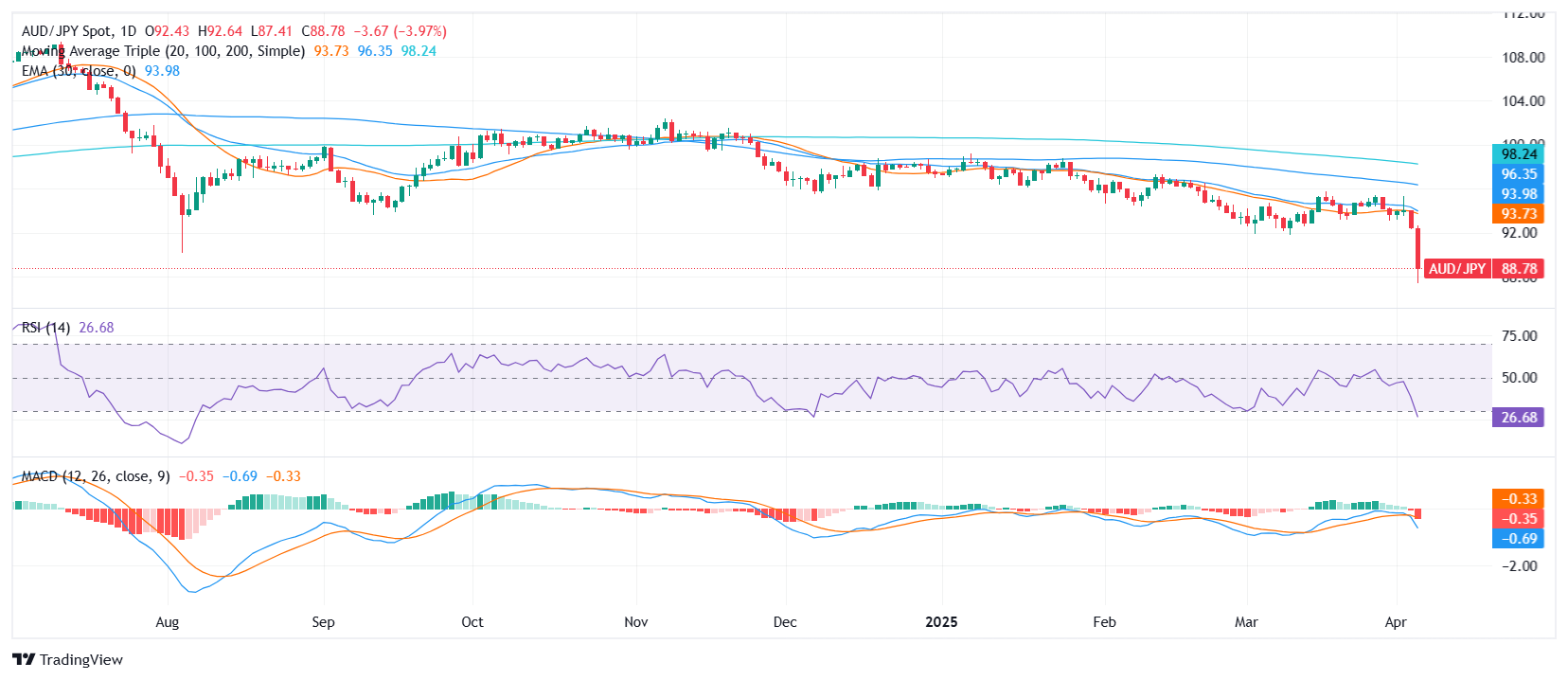
Technical indicators reflect a clearly bearish outlook. The Moving Average Convergence Divergence (MACD) is flashing a strong sell signal, reinforcing downside momentum. Meanwhile, the Relative Strength Index (RSI) sits at 25.56, still neutral but nearing oversold territory. Other momentum measures, such as the Awesome Oscillator (-1.112) and the Ultimate Oscillator (36.03), also remain in neutral zones, suggesting that the momentum may still be building rather than exhausted.

Supportive of the bearish structure, all key moving averages are aligned lower. The 20-day Simple Moving Average (SMA) at 93.72, the 100-day SMA at 96.42, and the 200-day SMA at 98.35 are all reinforcing sustained downside pressure. The 10-day Exponential Moving Average (EMA) and 10-day SMA, both hovering around 92.92–93.61, now act as firm resistance following the latest breakdown.

Author

Patricio Martín

Patricio is an economist from Argentina passionate about global finance and understanding the daily movements of the markets.


More from Patricio Martín
Share:

Editor's Picks

GBP/USD advaces towards 1.3450 after BoE decision, US Q2 GDP

GBP/USD gains positive momentum on Thursday, approaching 1.3450 and trading at fresh multi-week highs. The Bank of England decided to maintain the benchmark rate unchanged at 3.75%. The MPC voted 6-3 to keep rates on hold, with the 3 dissenters favoring a rate hike. US Q2 GDP missing expectations helped the pair advance, while renewed US Dollar weakness across the FX board pushes the pair further up ahead of the monthly close.

EUR/USD jumps above 1.1500, highest in six weeks

The EUR/USD pair trades north of 1.1500 in the American session on Thursday, reaching fresh six-week highs. The US Dollar is in sell-off mode, with multiple factors weighing on the American currency. Not only did the Federal Reserve vote divided to keep rates on hold on Wednesday, creating doubts about a September hike, but US Q2 GDP missed expectations. A suspected JPY intervention adds pressure on the Greenback.

Gold recovers the $4,100 level as US Dollar weakens further

Gold trades just above $4,100 amid a US Dollar sell-off. The Greenback enjoyed some near-term demand following Wednesday's post-FOMC downfall, but was unable to retain its gains. The preliminary estimate of the US Q2 GDP showed the economy grew at an annual rate of 1.5%, missing the market's expectations of 2.1%.

Ripple Price Forecast: XRP builds recovery momentum as whales increase exposure
Ripple (XRP) rises toward the pivotal $1.10 resistance on Thursday, marking three consecutive days of gains. This neutral-to-slightly bullish outlook follows the Federal Reserve (Fed) decision to leave interest rates unchanged in the 3.50%-3.75% range.
The FOMC: Rates left on hold; dollar falls as Warsh fails to vote for hike
The Fed kept interest rates on hold today, defying a 30% chance in the Fed Funds Futures market that rates would rise. The Committee voted 9-3 to keep rates on hold, with governors Kashkari, Hammack and Logan all voting to hike rates due to concerns about inflation. The immediate market reaction has been a sharp drop in the USD on a broad basis.
US Dollar mid-year outlook: Exceptional currency, exceptional risks?
The US Dollar enters the second half of 2026 in a markedly different position from a year ago. The King currency has recovered, reflecting persistent US inflation, changing expectations for Fed policy, geopolitical tensions and renewed demand for defensive assets.















