AMC Entertainment Stock Forecast: AMC closes down more than 13% following share sale
- AMC filed to sell $350 million worth of common stock on Thursday.
- The share sale sent AMC stock tumbling more than 20% at the open.
- Twice on Thursday, AMC's share price recovered above $9.
- US indices pulled back on Thursday as a US Treasury auction sent yields higher.
AMC Entertainment (AMC) stock sank 13.7% on Thursday, closing at $8.71, but sold off another 1% afterhours.
AMC stock attempted a recovery on Thursday afternoon after shares of the cinema chain opened 20% lower following management’s announcement of another $350 million share sale.
AMC stock opened on Thursday near the intraday low of $8.02 after closing Wednesday at $10.09. During the session, however, shares recovered twice back above $9. The second recovery subsided, however, and AMC stock traded in the $8.60s, down more than 14%, toward the end of the session.
The S&P 500, Dow Jones and NASDAQ Composite all dipped on Thursday as US Treasury yields rose due to a poor showing for the government’s 30-year bond auction. The 30-year yield rose 2.7% to 4.78%.
AMC stock news: Yet another share sale
AMC filed to sell up to $350 million worth of common stock on Thursday. The deal is being handled by Citigroup, Barclays, B. Riley and Goldman Sachs.
A rumor in the afternoon said that the agents had already sold 30 million shares at $10 per share to raise $300 million, but that information has not yet been confirmed. AMC had nearly 200 million shares outstanding prior to this week’s filing.
Management said it planned to use the proceeds from the share sale to pay down debt, which exploded during the covid pandemic and still sits near $5 billion.
CEO Adam Aron has been strenuous and creative in his efforts to keep AMC out of bankruptcy court. When shareholders initially denied him the ability to raise new equity capital, Aron ignored them by creating new preferred share units under the ticker APE. He then went to court and succeeded at converting the APE units into common equity.
Then in September, Aron went back to the markets to sell 40 million new AMC shares to raise $325 million in order to once again reduce the company’s sizable debt load.
Management appears to have popped shareholders’ feeling of renewed optimism after the company posted an earnings beat for the third quarter on Wednesday. The company posted GAAP earnings of $0.08, which was 25 cents better than Wall Street’s consensus. Revenue of $1.41 billion was its highest since the fourth quarter of 2019 and beat consensus by $146 million on the strength of the Barbie movie.
S&P 500 FAQs
What is the S&P 500?
The S&P 500 is a widely followed stock price index which measures the performance of 500 publicly owned companies, and is seen as a broad measure of the US stock market. Each company’s influence on the computation of the index is weighted based on market capitalization. This is calculated by multiplying the number of publicly traded shares of the company by the share price. The S&P 500 index has achieved impressive returns – $1.00 invested in 1970 would have yielded a return of almost $192.00 in 2022. The average annual return since its inception in 1957 has been 11.9%.
How are companies chosen to be included in the S&P 500?
Companies are selected by committee, unlike some other indexes where they are included based on set rules. Still, they must meet certain eligibility criteria, the most important of which is market capitalization, which must be greater than or equal to $12.7 billion. Other criteria include liquidity, domicile, public float, sector, financial viability, length of time publicly traded, and representation of the industries in the economy of the United States. The nine largest companies in the index account for 27.8% of the market capitalization of the index.
How can I trade the S&P 500?
There are a number of ways to trade the S&P 500. Most retail brokers and spread betting platforms allow traders to use Contracts for Difference (CFD) to place bets on the direction of the price. In addition, that can buy into Index, Mutual and Exchange Traded Funds (ETF) that track the price of the S&P 500. The most liquid of the ETFs is State Street Corporation’s SPY. The Chicago Mercantile Exchange (CME) offers futures contracts in the index and the Chicago Board of Options (CMOE) offers options as well as ETFs, inverse ETFs and leveraged ETFs.
What factors drive the S&P 500?
Many different factors drive the S&P 500 but mainly it is the aggregate performance of the component companies revealed in their quarterly and annual company earnings reports. US and global macroeconomic data also contributes as it impacts on investor sentiment, which if positive drives gains. The level of interest rates, set by the Federal Reserve (Fed), also influences the S&P 500 as it affects the cost of credit, on which many corporations are heavily reliant. Therefore, inflation can be a major driver as well as other metrics which impact the Fed decisions.
AMC stock forecast
Looking on the bright side, AMC stock’s plunge on Thursday is not quite as bad as its crash in August and September. In the space of one month, AMC stock collapsed more than 80%. In light of that catastrophe, reaction to the current post-earnings share sale is mild in comparison.
Bulls were able to push the AMC share price back above $9 twice in Thursday’s session, which means there might still be an appetite for this miserable asset. If AMC plunges further, there could still be support in the demand zone witnessed in September between $7.05 and $7.35.
On the other side of the chart, resistance springs from the semi-double top created on October 12 and November 6 in the region between $11 and $11.40.
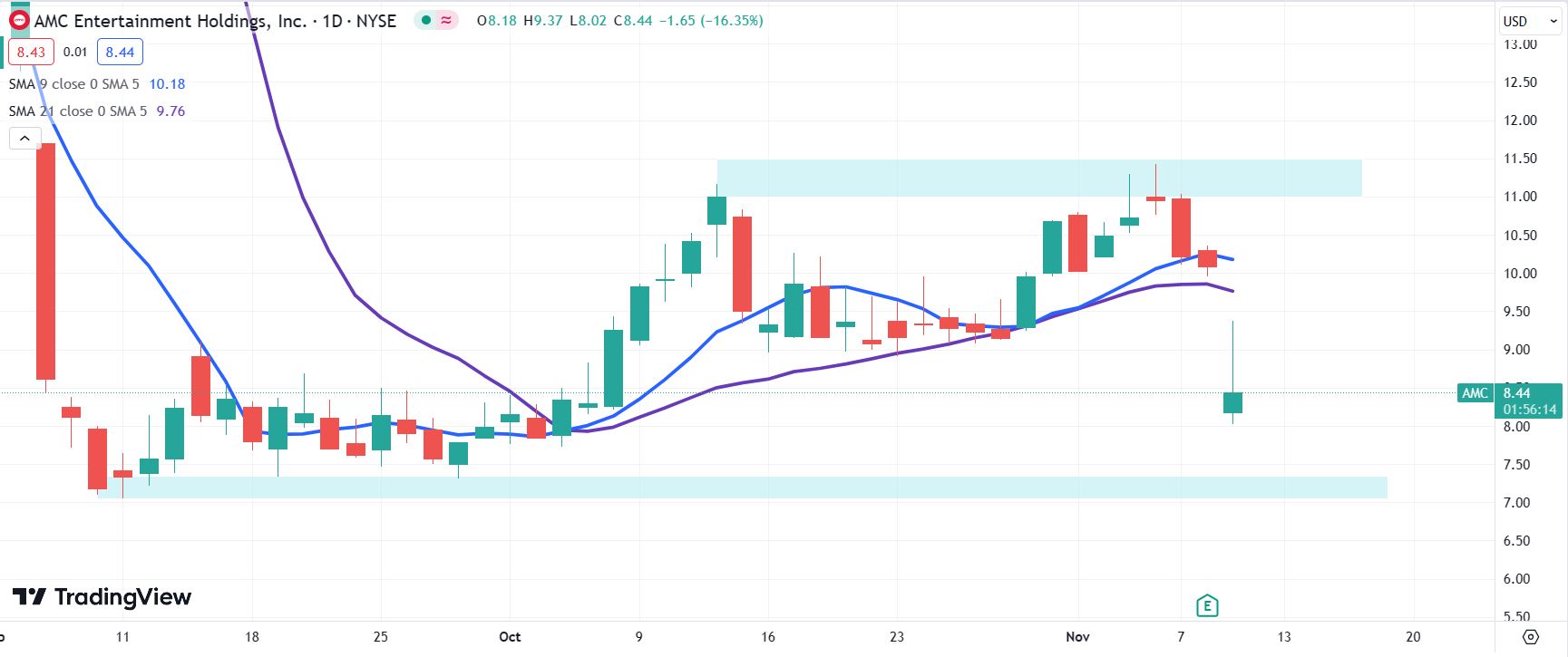
AMC daily chart
Author

Clay Webster
FXStreet
Clay Webster grew up in the US outside Buffalo, New York and Lancaster, Pennsylvania. He began investing after college following the 2008 financial crisis.