GBP/USD Price Forecast: Holds ground near 1.3200, near-term bias remains bearish
- GBP/USD rises to near 1.3245 as the British Pound outperforms its major peers.
- The British currency gains even as market experts doubt hawkish BoE repricing.
- Investors keenly await the US NFP data for September scheduled for Friday.
The British Pound (GBP) is up 0.15% at around 1.3245 against the US Dollar (USD) in the early European session on Monday. The GBP/USD pair gains as the British currency outperforms its peers despite market experts questioning hawkish Bank of England (BoE) repricing.
Pound Sterling Price Today
The table below shows the percentage change of British Pound (GBP) against listed major currencies today. British Pound was the strongest against the Japanese Yen.
| USD | EUR | GBP | JPY | CAD | AUD | NZD | CHF | |
|---|---|---|---|---|---|---|---|---|
| USD | 0.08% | -0.10% | 0.28% | 0.09% | 0.04% | -0.16% | 0.12% | |
| EUR | -0.08% | -0.03% | 0.20% | 0.02% | -0.03% | -0.11% | 0.05% | |
| GBP | 0.10% | 0.03% | 0.23% | 0.05% | -0.01% | -0.07% | 0.19% | |
| JPY | -0.28% | -0.20% | -0.23% | -0.21% | -0.26% | -0.34% | -0.04% | |
| CAD | -0.09% | -0.02% | -0.05% | 0.21% | -0.07% | -0.15% | 0.13% | |
| AUD | -0.04% | 0.03% | 0.01% | 0.26% | 0.07% | -0.09% | 0.20% | |
| NZD | 0.16% | 0.11% | 0.07% | 0.34% | 0.15% | 0.09% | 0.30% | |
| CHF | -0.12% | -0.05% | -0.19% | 0.04% | -0.13% | -0.20% | -0.30% |
The heat map shows percentage changes of major currencies against each other. The base currency is picked from the left column, while the quote currency is picked from the top row. For example, if you pick the British Pound from the left column and move along the horizontal line to the US Dollar, the percentage change displayed in the box will represent GBP (base)/USD (quote).
Strategists at Brown Brothers Harriman (BBH) highlight a growing disconnect between market pricing and their own expectations for the BoE policy path. They note that “the swaps curve continues to imply about 100bps of BoE rate hikes in the next twelve months to 4.75%,” but argue that “the BoE may not need to tighten as much as markets expect,” adding rates are already in the 2%-4% neutral range.
Last week, BoE Governor Andrew Bailey warned while speaking at the Monetary Economics Conference that persistently higher energy prices could challenge central bank’s stance of not raising interest rates.
Meanwhile, the US Dollar trades marginally higher at the start of the week, with United States (US) Treasury Yields remaining elevated near the 19-year high of 5.23%. This week, investors will pay close attention to the US Nonfarm Payrolls (NFP) data for September, which will be published on Friday.
GBP/USD Technical Analysis
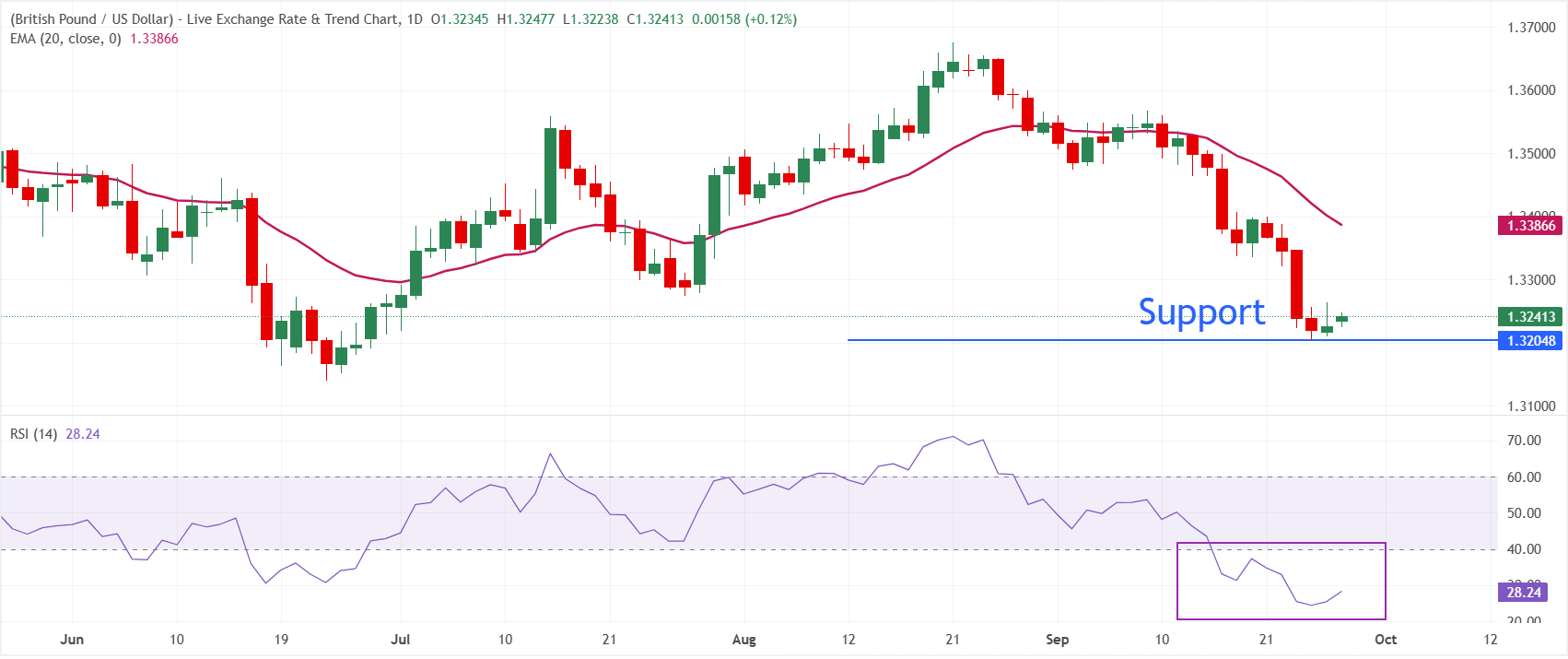
In the daily chart, GBP/USD trades around 1.3240, maintaining a bearish near-term bias as price holds below the 20-period exponential moving average (EMA) at 1.3387. The pair has been sliding away from late-July highs, and the EMA now aligns as overhead supply, hinting that rallies are likely to be capped while this barrier remains intact.
The Relative Strength Index (14) sits near 28, in oversold territory, suggesting that while downside pressure dominates, the pace of the decline could start to moderate if sellers hesitate at lower levels.
Analysts at UOB Group note that GBP/USD “extended its sharp decline from Wednesday, dropping to a low of 1.3205 before closing 0.16% lower at 1.3219.” They add that, “unsurprisingly, conditions are deeply oversold due to the sharp decline,” yet “the bias for GBP remains on the downside, even though any decline is likely to stay within a 1.3190/1.3245 range” in the near term.
Looking beyond the next 24 hours, UOB recalls that in its update from 23 September, when spot was at 1.3345, “it is unclear for now whether GBP could break below 1.3300,” and concedes that it “did not expect GBP to easily break 1.3300 and plunge, reaching a low of 1.3205 yesterday.” While the weakness that “started two weeks ago… appears to be overextended,” the bank still sees “a chance for GBP to test the June low of 1.3140 before stabilisation is likely.” On the topside, UOB flags that “a breach of 1.3295 (‘strong resistance’ level previously at 1.3390) would indicate that 1.3140 is out of reach.”
(The technical analysis of this story was written with the help of an AI tool. Know more.)
Pound Sterling FAQs
The Pound Sterling (GBP) is the oldest currency in the world (886 AD) and the official currency of the United Kingdom. It is the fourth most traded unit for foreign exchange (FX) in the world, accounting for 12% of all transactions, averaging $630 billion a day, according to 2022 data. Its key trading pairs are GBP/USD, also known as ‘Cable’, which accounts for 11% of FX, GBP/JPY, or the ‘Dragon’ as it is known by traders (3%), and EUR/GBP (2%). The Pound Sterling is issued by the Bank of England (BoE).
The single most important factor influencing the value of the Pound Sterling is monetary policy decided by the Bank of England. The BoE bases its decisions on whether it has achieved its primary goal of “price stability” – a steady inflation rate of around 2%. Its primary tool for achieving this is the adjustment of interest rates. When inflation is too high, the BoE will try to rein it in by raising interest rates, making it more expensive for people and businesses to access credit. This is generally positive for GBP, as higher interest rates make the UK a more attractive place for global investors to park their money. When inflation falls too low it is a sign economic growth is slowing. In this scenario, the BoE will consider lowering interest rates to cheapen credit so businesses will borrow more to invest in growth-generating projects.
Data releases gauge the health of the economy and can impact the value of the Pound Sterling. Indicators such as GDP, Manufacturing and Services PMIs, and employment can all influence the direction of the GBP. A strong economy is good for Sterling. Not only does it attract more foreign investment but it may encourage the BoE to put up interest rates, which will directly strengthen GBP. Otherwise, if economic data is weak, the Pound Sterling is likely to fall.
Another significant data release for the Pound Sterling is the Trade Balance. This indicator measures the difference between what a country earns from its exports and what it spends on imports over a given period. If a country produces highly sought-after exports, its currency will benefit purely from the extra demand created from foreign buyers seeking to purchase these goods. Therefore, a positive net Trade Balance strengthens a currency and vice versa for a negative balance.
Author

Sagar Dua
FXStreet
Sagar Dua is associated with the financial markets from his college days. Along with pursuing post-graduation in Commerce in 2014, he started his markets training with chart analysis.