Euro edges up against US Dollar in countdown to US Midterm elections
- Euro ticks higher against the US Dollar amid caution ahead of US Midterm elections.
- ING says Democrats have a 70-72% chance of taking both the House and the Senate.
- Investors also await the US JOLTS Job Openings and the flash Eurozone HICP data.

The Euro (EUR) trades marginally higher at around 1.1195 against the US Dollar (USD) during the European trading session on Tuesday. The EUR/USD pair ticks up as the US Dollar is under pressure amid caution ahead of United States (US) Midterm elections later in the day.
At press time, the US Dollar Index (DXY), which gauges the Greenback’s value against six major currencies, trades slightly lower to near 101.73.
Dollar outlook clouded as US midterm odds point to Democrat sweep
ING’s Chris Turner flags the US midterm elections as the key event risk for FX this week, noting that betting markets now give the Democrats a “70-72% chance of taking both the House and the Senate.” He argues that “one could make the case that the Dollar should come lower on such an outcome,” as a Democrat clean sweep would likely “lead to gridlock on the debt ceiling, a prolonged government shutdown next year and could encourage President Trump to pursue an even more activist foreign policy agenda.” Against that backdrop, Turner suggests investors will be weighing these political risks against the still-supportive mix of strong US growth, above-target inflation and ongoing Fed tightening for the Dollar and DXY around the 102.00 area.
On the economic front, investors await the JOLTS Job Openings data for September, which will be published at 15:00 GMT. According to estimates, US employers posted 7.13 million fresh jobs, slightly higher than 7.097 million in August.
In the Eurozone, investors await the preliminary Harmonized Index of Consumer Prices (HICP) data for October, which will be released on Wednesday. The data is expected to have a significant impact on European Central Bank’s (ECB) monetary policy expectations.
The HICP growth is expected to have remained at 3.9% Year-on-Year (YoY), faster than 3.8% in September. The core HICP – which strips off volatile components like food, energy, alcohol, and tobacco – is seen remaining steady at 2.5% YoY.
EUR/USD Technical Analysis
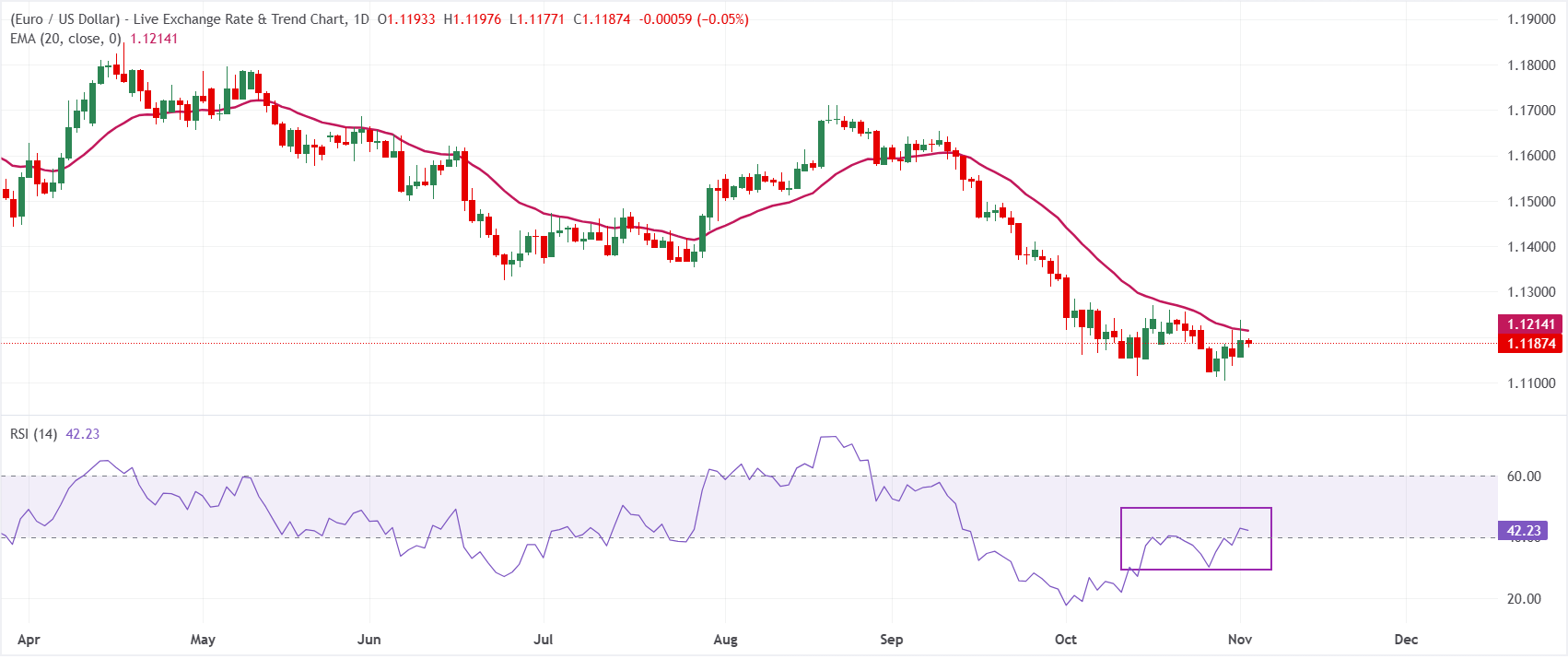
In the daily chart, EUR/USD trades at 1.1187, maintaining a bearish near-term bias as spot holds beneath the 20-day exponential moving average (EMA) at 1.1214. The pair continues to trade below this short-term trend gauge, suggesting rallies remain capped, while the Relative Strength Index (14) around 42 hints at moderating downside pressure but stops short of signaling oversold conditions.
On the topside, immediate resistance is located at the 20-day EMA at 1.1214, and a sustained break above this level would be needed to ease the current bearish tone and allow for a more constructive recovery phase. In the absence of clearly defined nearby support levels from the present dataset, traders may instead look to price action around recent lows to gauge whether selling momentum resumes or consolidative flows dominate.
(The technical analysis of this story was written with the help of an AI tool. Know more.)
Economic Indicator
JOLTS Job Openings
JOLTS Job Openings is a survey done by the US Bureau of Labor Statistics to help measure job vacancies. It collects data from employers including retailers, manufacturers and different offices each month.
Read more.Next release: Tue Nov 03, 2026 15:00
Frequency: Monthly
Consensus: 7.13M
Previous: 7.079M
Source: US Bureau of Labor Statistics
Author

Sagar Dua
FXStreet
Sagar Dua is associated with the financial markets from his college days. Along with pursuing post-graduation in Commerce in 2014, he started his markets training with chart analysis.