AUD/USD Price Forecast: Australian Dollar faces wrath of RBA’s dovish hike
- AUD/USD trades sharply lower as RBA’s dovish hike weighs heavily on the Australian Dollar.
- The communication from the RBA signaled that the bar for another interest rate hike is high.
- The outcome of US midterm elections is expected to have a short-term pressure on the US Dollar.

The Australian Dollar (AUD) underperforms its major currency peers on Tuesday, trading 0.45% lower to near 0.6965 against the US Dollar (USD) during the European trading session.
The Australian currency is under immense pressure as the Reserve Bank of Australia (RBA) seems less interested in hiking borrowing costs further after raising the Official Cash Rate (OCR) by 25 basis points (bps) to 4.85% earlier in the day.
Aussie slips as RBA hike comes with dovish signals and softer outlook
Analysts at ING note that the Aussie Dollar “came under pressure this morning after the RBA hiked rates as expected to 4.85%, but delivered some dovish signals.” They highlight that “the 6-3 split suggests lower conviction around today’s decision than in markets, which had almost fully priced in a hike (21bp),” underscoring a less forceful policy stance than investors had anticipated.
ING adds that “the statement dropped its reference to potential further hikes for the first time since June,” while “the economic outlook was revised sharply to the downside, with a focus on falling house prices weighing on consumers and upside risks to unemployment.” At the press conference, Governor Michele Bullock “reinforced the RBA’s wait-and-see approach, stressing that monetary tightening still has to feed through to the economy.”
ING notes that “she left the door open to further tightening, but the bar is clearly higher now,” with the RBA appearing “happy to assess the impact of previous hikes before acting again.” “This is in line with our forecast of no further RBA hikes,” ING added.
The next key trigger for the Australian Dollar will be the Trade Balance data for September, which is scheduled for Thursday.
Meanwhile, the US Dollar trades with caution ahead of United States (US) midterm elections in the late North American trading session.
ING strategists write that “we don’t expect today’s US midterm results to cause structural shifts in FX, but the Dollar may face some short-term pressure should the Democrats secure both the House (widely expected) and the Senate (close call).”
Their baseline is that “markets fully price in a Republican loss of the House, but only partially a Democratic clean sweep,” and that “a blue sweep can put some pressure on the Dollar.”
ING warns that “fears of tougher regulation could weigh on AI stocks (we’ve recently seen how that can hit the greenback), while markets could price in greater risks of decision-making gridlock around issues such as government funding and the debt ceiling.” Even so, they stress that “we doubt that’s enough to trigger a structural directional shift in the Dollar. The greenback continues to respond predominantly to the Fed story, which shouldn’t face an immediate and direct impact from the midterm result. We expect a split Congress (R-S, D-H) to have a neutral or slightly positive USD impact.”
AUD/USD Technical Analysis
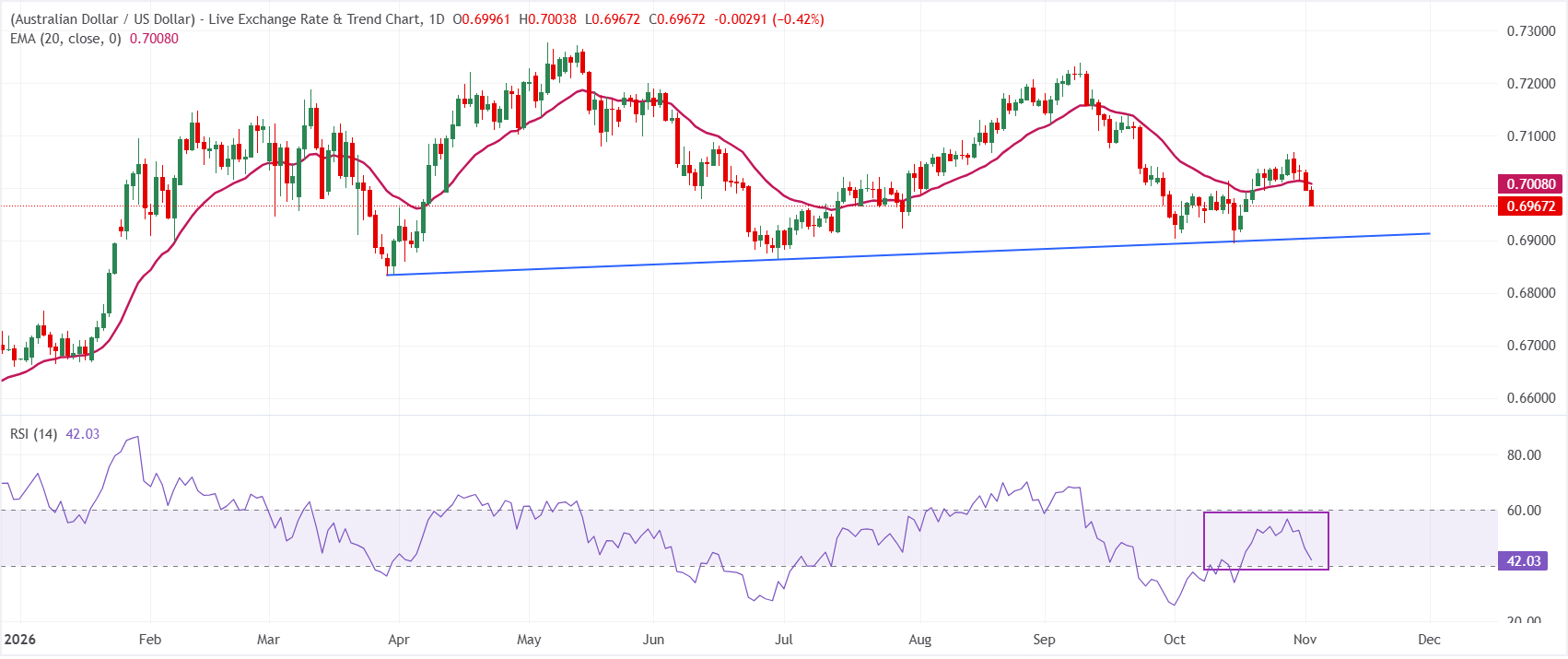
On the daily chart, AUD/USD trades at 0.6967, holding a bearish near-term bias as it remains below the 20-day Exponential Moving Average (EMA) at 0.7008. The Relative Strength Index (RSI) near 42 suggests only modest downside momentum rather than outright oversold conditions.
On the downside, initial support aligns with the former break area around 0.6904, before the structural trend-line base near 0.6834. On the topside, the 20-day EMA at 0.7008 is the first resistance to clear; a sustained move above this barrier would be needed to ease bearish pressure and open the way for a more constructive recovery.
(The technical analysis of this story was written with the help of an AI tool. Know more.)
Economic Indicator
RBA Interest Rate Decision
The Reserve Bank of Australia (RBA) announces its interest rate decision at the end of its eight scheduled meetings per year. If the RBA is hawkish about the inflationary outlook of the economy and raises interest rates it is usually bullish for the Australian Dollar (AUD). Likewise, if the RBA has a dovish view on the Australian economy and keeps interest rates unchanged, or cuts them, it is seen as bearish for AUD.
Read more.Last release: Tue Nov 03, 2026 03:30
Frequency: Irregular
Actual: 4.85%
Consensus: 4.85%
Previous: 4.6%
Source: Reserve Bank of Australia
Author

Sagar Dua
FXStreet
Sagar Dua is associated with the financial markets from his college days. Along with pursuing post-graduation in Commerce in 2014, he started his markets training with chart analysis.