XRP pulls back 4% even as Ripple releases details of stablecoin RLUSD
- XRP corrects on Wednesday, down nearly 4% to $0.5644.
- Ripple releases details of its stablecoin, RLUSD, says the asset is geared toward regulatory compliance.
- Ripple mentions Clarity of Payments Stablecoin Act, which if passed could support innovation in the asset class.

Ripple (XRP) shared details of its stablecoin project Ripple USD (RUSD) in a blog published on Tuesday. The cross-border payment remittance firm discusses relevant legislation and plans to support the digital asset economy through RLUSD.
XRP erased nearly 4% value on Wednesday despite that announcement with the coin trading at $0.5644.
Daily digest market movers: XRP corrects even as Ripple discusses RLUSD application, future plans
- Ripple discussed the demand for its stablecoin RLUSD, regulatory compliance, and the regulation that could support innovation in stablecoins and blockchain technology in the US.
Stablecoins combine the speed, security, and efficiency of blockchain with the trust of USD. As cash use declines, more are turning to stablecoins for fast, secure, low-cost payments.
— Ripple (@Ripple) September 17, 2024
Get the latest on emerging trends in stablecoin payments: https://t.co/stVjXAjOKQ
- Ripple’s post says stablecoins combine speed, security and efficiency of the blockchain, and it argues the declining use of cash paves way for adoption of stables.
- Ripple is used to offering cross-border payment remittance at low cost, and the launch of RLUSD for stablecoins would assure the same.
- While most cryptocurrencies face the double spend problem, where a token can be spent more than once through an alteration in the blockchain, stablecoins eliminate this challenge and provide a reliable and low-cost alternative to users.
- Ripple CTO David Schwartz said in a recent tweet on X that RLUSD will only ever be available to institutions and compared the asset to Circle’s USD Coin (USDC) and USD Tether (USDT).
Technical analysis: XRP could lose 9% to sweep low at $0.5188
XRP attempted to break out of its multi-month downward trend on four occasions between July and September 2024 to no avail. XRP remains range-bound between the September 6 low of $0.5026 and the August 7 high of $0.6434.
The Relative Strength Index (RSI), a momentum indicator, reads neutral at 50.
XRP could erase 8.5% of its value and extend losses to the lower boundary of the Fair Value Gap (FVG) between $0.5188 and $0.5785, as seen in the XRP/USDT daily chart.
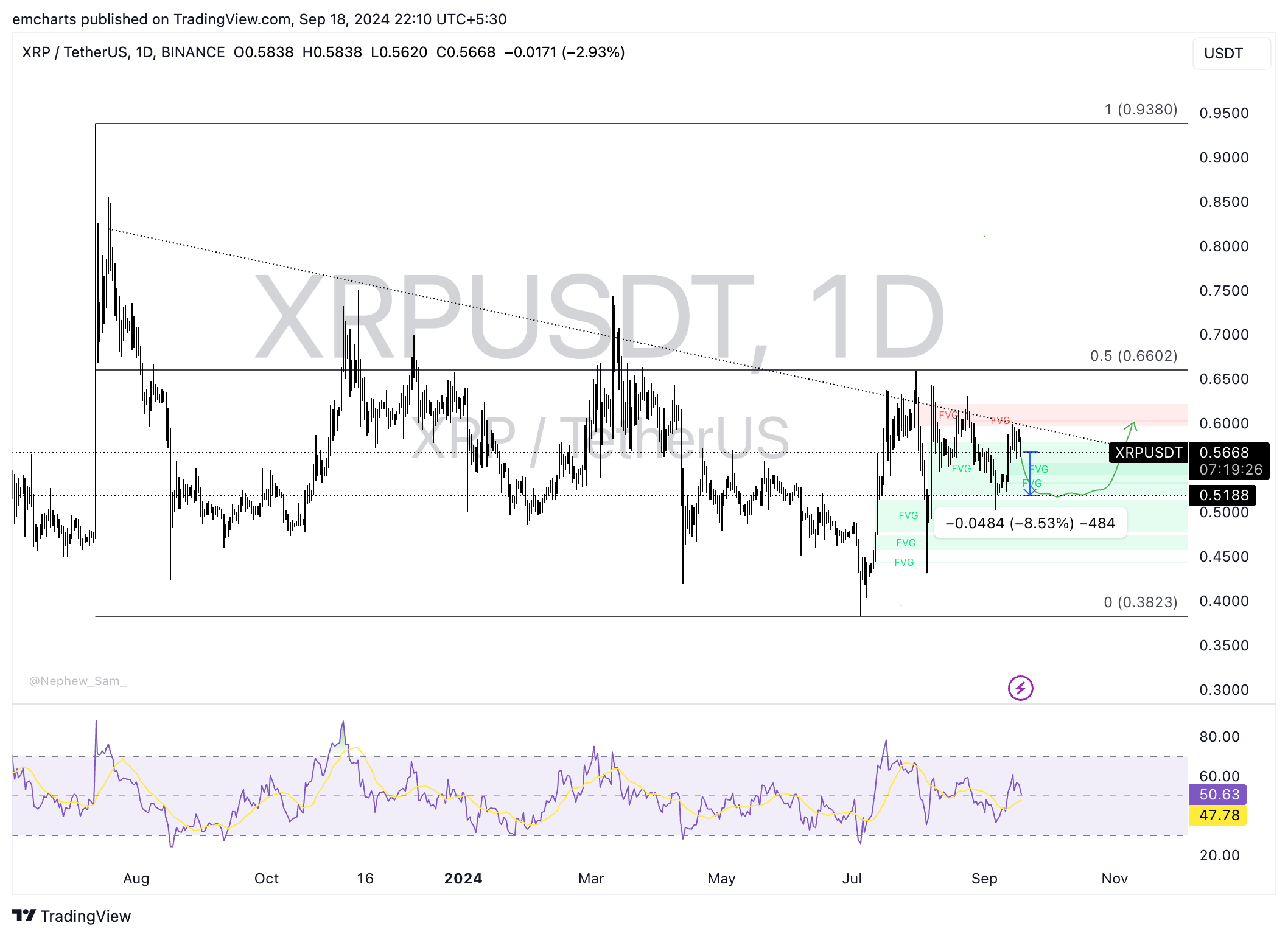
XRP/USDT daily chart
XRP could also rally toward the FVG between $0.5970 and $0.6217, if the asset successfully breaks out of the downward trend.
Ripple FAQs
Ripple is a payments company that specializes in cross-border remittance. The company does this by leveraging blockchain technology. RippleNet is a network used for payments transfer created by Ripple Labs Inc. and is open to financial institutions worldwide. The company also leverages the XRP token.
XRP is the native token of the decentralized blockchain XRPLedger. The token is used by Ripple Labs to facilitate transactions on the XRPLedger, helping financial institutions transfer value in a borderless manner. XRP therefore facilitates trustless and instant payments on the XRPLedger chain, helping financial firms save on the cost of transacting worldwide.
XRPLedger is based on a distributed ledger technology and the blockchain using XRP to power transactions. The ledger is different from other blockchains as it has a built-in inflammatory protocol that helps fight spam and distributed denial-of-service (DDOS) attacks. The XRPL is maintained by a peer-to-peer network known as the global XRP Ledger community.
XRP uses the interledger standard. This is a blockchain protocol that aids payments across different networks. For instance, XRP’s blockchain can connect the ledgers of two or more banks. This effectively removes intermediaries and the need for centralization in the system. XRP acts as the native token of the XRPLedger blockchain engineered by Jed McCaleb, Arthur Britto and David Schwartz.
Author

Ekta Mourya
FXStreet
Ekta Mourya has extensive experience in fundamental and on-chain analysis, particularly focused on impact of macroeconomics and central bank policies on cryptocurrencies.