XRP price dips below $0.6 amid Bitcoin rally; lack of institutional interest likely at fault
- XRP price witnessed a dip below $0.600 during intra-day trading hours on Monday.
- The decline in price was unexpected, given Bitcoin price crossed $42,000, and Ripple shares a rather positive correlation with the crypto.
- One likely reason is the lack of interest displayed by institutions that continue to pick Solana over XRP.

XRP price is showing signs of a recovery with the potential to breach its next major resistance level. However, to the market’s surprise, the Ripple native token took a different direction than the rest of the altcoins despite Bitcoin price marking a major milestone on Monday. While a specific reason cannot be named, one of the biggest factors likely is the lack of institutional interest.
Ripple needs more from institutions
Ripple has been a community favorite token for years now, but its target, more importantly, is the institutions since they are considered to be the drivers of the next bull run. At the moment, XRP seems to be lacking on that front and is being surpassed by Solana by a significant mile.
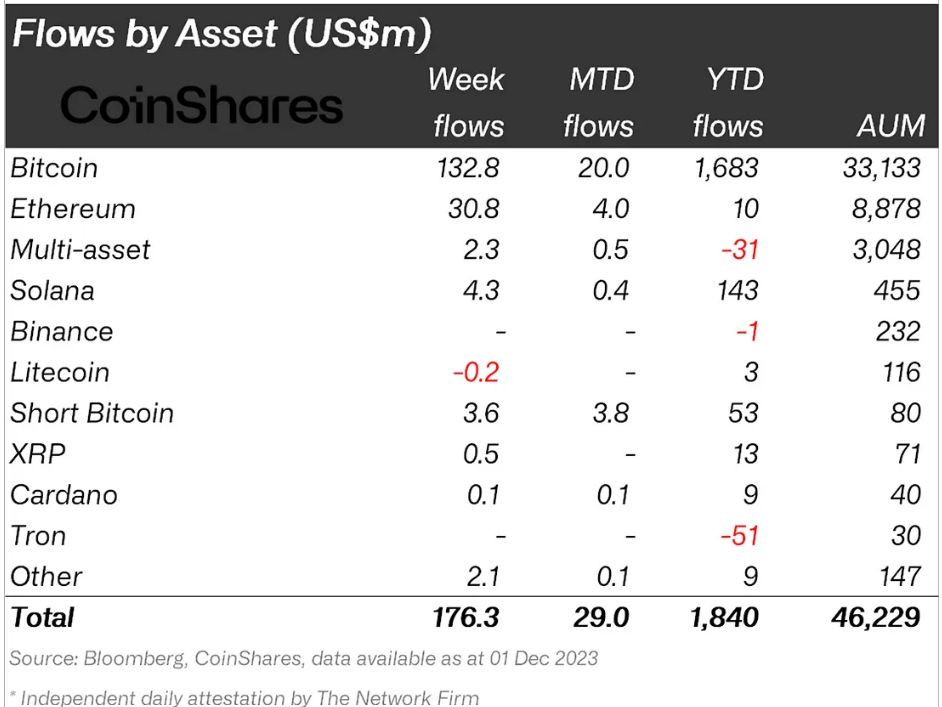
According to the weekly inflows registered when it comes to exchange-traded investment products, XRP has noted inflows worth $0.5 million for the week ending December 1. Solana, on the other hand, marked $4.3 million worth of institutional money flowing into the ETP. The difference is not as significant, but when the yearly flows are compared, the gap becomes evident.
Institutional inflows
Ripple over the past 11 months marked $13 million worth of inflows, which is less than 10% of SOL’s total inflows since the beginning of 2023, standing tall at $143 million. While this has not made a direct impact on the token in the past, some influence of the same can be seen at the moment.
XRP price and investors’ hearts drop
XRP price made its investors witness a rather surprising turn of events on Monday as the altcoin fell by almost 6% during the intra-day trading hours. This resulted in the Ripple token losing the support of $0.600. The dip, however, did not result in major losses except for $4 million worth of long liquidations as the price recovered in the next half hour.
If such instances are repeated where Ripple fails to see institutional interest, XRP price will likely decline. However, in the short term, the altcoin is far from a fall. Instead, it is showing stronger signs of recovery. Trading at $0.622, the cryptocurrency is close to breaching the $0.644 resistance.
The Relative Strength Index (RSI) and the Moving Average Convergence Divergence (MACD) are both exhibiting positive signals at the moment, which would support a rally towards $0.644 and beyond.

XRP/USD 1-day chart
But if a breach fails, XRP price is also vulnerable to a fall to $0.600. In the short term, if this support line is lost, the bullish thesis would be invalidated, and the Ripple token will likely hit $0.551.
Cryptocurrency metrics FAQs
What is circulating supply?
The developer or creator of each cryptocurrency decides on the total number of tokens that can be minted or issued. Only a certain number of these assets can be minted by mining, staking or other mechanisms. This is defined by the algorithm of the underlying blockchain technology. Since its inception, a total of 19,445,656 BTCs have been mined, which is the circulating supply of Bitcoin. On the other hand, circulating supply can also be decreased via actions such as burning tokens, or mistakenly sending assets to addresses of other incompatible blockchains.
What is market capitalization?
Market capitalization is the result of multiplying the circulating supply of a certain asset by the asset’s current market value. For Bitcoin, the market capitalization at the beginning of August 2023 is above $570 billion, which is the result of the more than 19 million BTC in circulation multiplied by the Bitcoin price around $29,600.
What is trading volume?
Trading volume refers to the total number of tokens for a specific asset that has been transacted or exchanged between buyers and sellers within set trading hours, for example, 24 hours. It is used to gauge market sentiment, this metric combines all volumes on centralized exchanges and decentralized exchanges. Increasing trading volume often denotes the demand for a certain asset as more people are buying and selling the cryptocurrency.
What is funding rate?
Funding rates are a concept designed to encourage traders to take positions and ensure perpetual contract prices match spot markets. It defines a mechanism by exchanges to ensure that future prices and index prices periodic payments regularly converge. When the funding rate is positive, the price of the perpetual contract is higher than the mark price. This means traders who are bullish and have opened long positions pay traders who are in short positions. On the other hand, a negative funding rate means perpetual prices are below the mark price, and hence traders with short positions pay traders who have opened long positions.
Author

Aaryamann Shrivastava
FXStreet
Aaryamann Shrivastava is a Cryptocurrency journalist and market analyst with over 1,000 articles under his name. Graduated with an Honours in Journalism, he has been part of the crypto industry for more than a year now.