XRP slides despite Ripple's agentic AI transactions surpassing 1 million
- XRP declines while trading broadly sideways in the $1.10-$1.15 range.
- RippleX head engineer Ayo Akinyele expects agentic transactions to reach 10 million after crossing the 1 million milestone.
- The XRP Ledger provides a seamless payment infrastructure sought after by developers in the sector.

Ripple (XRP) is losing momentum on Thursday, albeit gradually, trading above $1.13. The remittance token tagged a weekly high of $1.16 on Tuesday, with gains mainly attributed to developments on the United States (US) Clarity Act and recent signs that inflation is easing in the world’s largest economy.
However, the war between the US and Iran has continued to weigh on risk assets, as reflected in the broader crypto market sentiment remaining in Fear territory, according to the Fear & Greed Index. In the chart below, sentiment is down to 31 on Thursday, from 33 the day before, undermining investor interest in the token and related digital investment products.
RippleX surpasses 1 million agentic AI transactions
RippleX, the company behind the XRP Ledger, has reportedly hit a new milestone, with Artificial Intelligence (AI) agent transactions surpassing 1 million.
Ayo Akinyele, RippleX head engineer, told The Block that he expects the growth trajectory to accelerate rapidly toward 10 million agentic transactions.
Agentic transactions “may even get to 100 million within the next couple of years given the pace of development with agents and how the infrastructure continues to get better,” Akinyele said.
Agentic payments refer to financial transactions initiated, authorized and executed by autonomous AI agents without human input or approval at each stage. AI agents function within a defined set of rules, including spending policies, and independently determine when, where and how to transact to achieve a set of goals.
Developers are increasingly turning to agentic transactions, as AI models advance. AI agents are used to autonomously monitor systems and pay for data, computing power and other services required to complete predefined tasks.
Akinyele opines that the primary focus for RippleX “is making it frictionless for AI agents to pay for APIs and digital services on XRP Ledger because of the strengths that we offer from a settlement perspective.”
Price analysis: XRP rebound stalls amid a broader bearish outlook
XRP trades above $1.13 while capped below the key Exponential Moving Averages (EMAs), with the 50-day EMA at $1.15, the 100-day EMA at $1.23 and the 200-day EMA at $1.44 all acting as overhead supply. Still, the spot price holds above the Bollinger Bands' middle layer at $1.11, suggesting some underlying demand, while the Relative Strength Index (RSI) at about 54 points to mildly positive but not overstretched momentum.
At the same time, the Moving Average Convergence Divergence (MACD) indicator stays in positive territory, hinting that any bounce is still unfolding within a broader capped structure.
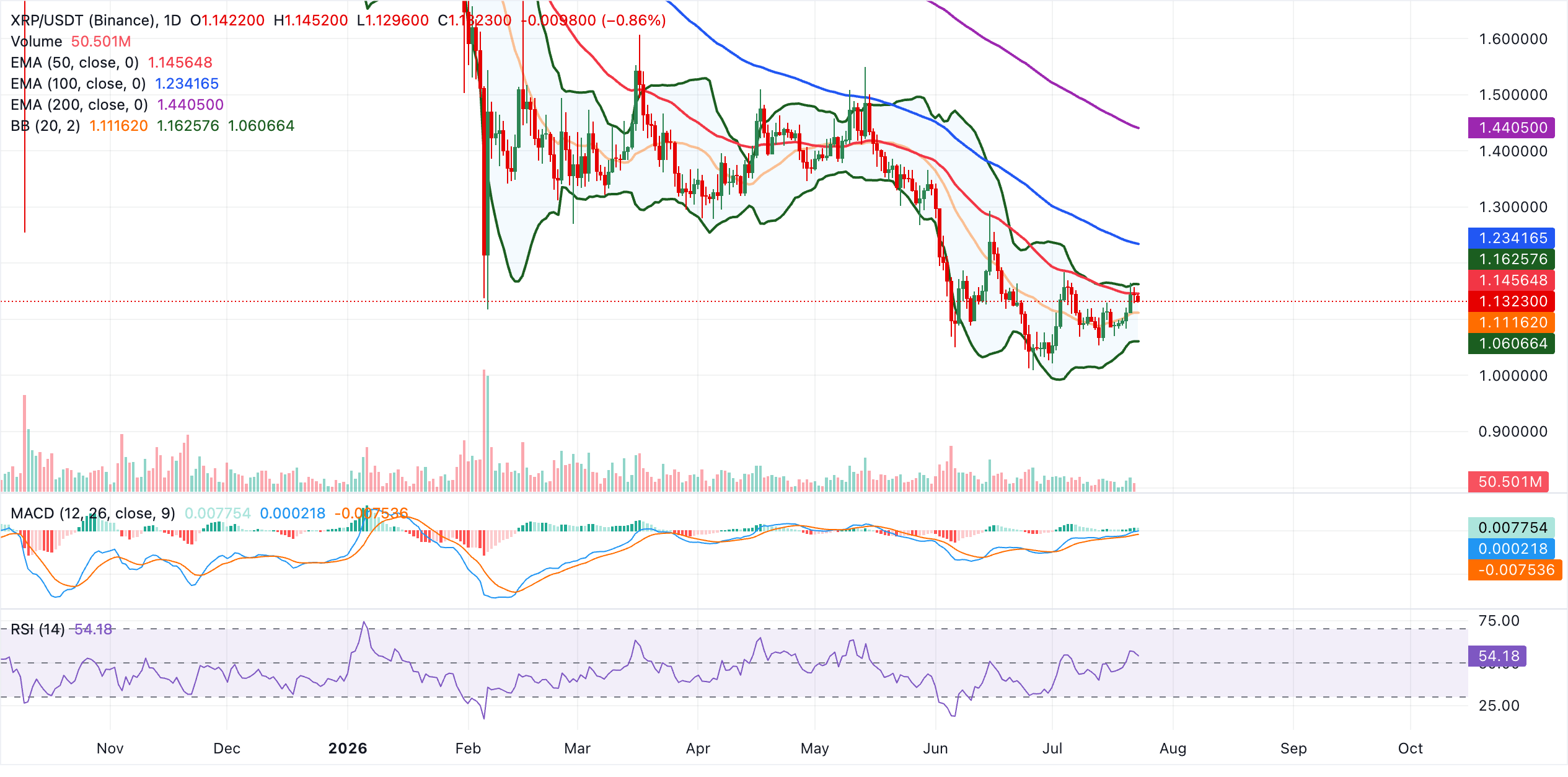
On the topside, immediate resistance lies at the 50-day EMA around $1.15, followed by the upper Bollinger Band at $1.16, with higher hurdles at the 100-day EMA around $1.23 and the 200-day EMA at $1.44 if buyers attempt a more sustained recovery. On the flip side, initial support aligns with the Bollinger middle layer at $1.11, ahead of stronger demand near the lower Bollinger Band around $1.06, where a break would likely reopen room for a deeper corrective phase.
(The technical analysis of this story was written with the help of an AI tool. Know more.)
Cryptocurrency prices FAQs
Token launches influence demand and adoption among market participants. Listings on crypto exchanges deepen the liquidity for an asset and add new participants to an asset’s network. This is typically bullish for a digital asset.
A hack is an event in which an attacker captures a large volume of the asset from a DeFi bridge or hot wallet of an exchange or any other crypto platform via exploits, bugs or other methods. The exploiter then transfers these tokens out of the exchange platforms to ultimately sell or swap the assets for other cryptocurrencies or stablecoins. Such events often involve an en masse panic triggering a sell-off in the affected assets.
Macroeconomic events like the US Federal Reserve’s decision on interest rates influence crypto assets mainly through the direct impact they have on the US Dollar. An increase in interest rate typically negatively influences Bitcoin and altcoin prices, and vice versa. If the US Dollar index declines, risk assets and associated leverage for trading gets cheaper, in turn driving crypto prices higher.
Halvings are typically considered bullish events as they slash the block reward in half for miners, constricting the supply of the asset. At consistent demand if the supply reduces, the asset’s price climbs.
Author

John Isige
FXStreet
John Isige is a seasoned cryptocurrency journalist and markets analyst committed to delivering high-quality, actionable insights tailored to traders, investors, and crypto enthusiasts. He enjoys deep dives into emerging Web3 tren