Where does Vitalik Buterin’s allegiance lie: RAI or Circle’s stablecoin USDC?
- Vitalik Buterin’s wallet addresses converted 20,040 RAI to 56,746 USDC earlier today.
- Buterin has previously shared his optimism on Reflexer’s algorithmic stablecoin that is backed by Ethereum.
- It is uncertain whether Buterin’s move can be interpreted as support for Circle’s stablecoin USDC.

Ethereum co-founder Vitalik Buterin recently converted his holdings of algorithmic stablecoin Reflexer (RAI) into Circle’s stablecoin USDC. It is uncertain whether this is support for the stablecoin during its crisis or a strategic move.
Also read: Can Bitcoin accumulation by sharks and whales catalyse BTC price recovery?
Why did Circle’s stablecoin USDC depeg?
Circle’s US Dollar pegged stablecoin USDC is currently battling a crisis. USDC lost its $1 parity and nosedived to $0.90. The stablecoin hit an all-time low of $0.87 earlier today. The collapse of the Silicon Valley Bank and Circle’s exposure to the institution triggered the depeg and the subsequent price drop.
Several other stablecoins like FRAX, DAI, USDP and TUSD have suffered a decline in price amidst rising uncertainty in the crypto ecosystem. It is likely that crypto market participants are turning to stablecoins like RAI and LUSD, with limited to no exposure to Circle and its stablecoin USDC.
Find out more here: Will Circle’s stablecoin suffer same fate as UST: Binance and Coinbase react to USDC depeg
Vitalik Buterin converts RAI to USDC: Show of support or something else
Ethereum co-founder Buterin converted 20,040 Reflexer tokens to 56,746 USDC on Saturday. The Etherscan transaction is shown below:
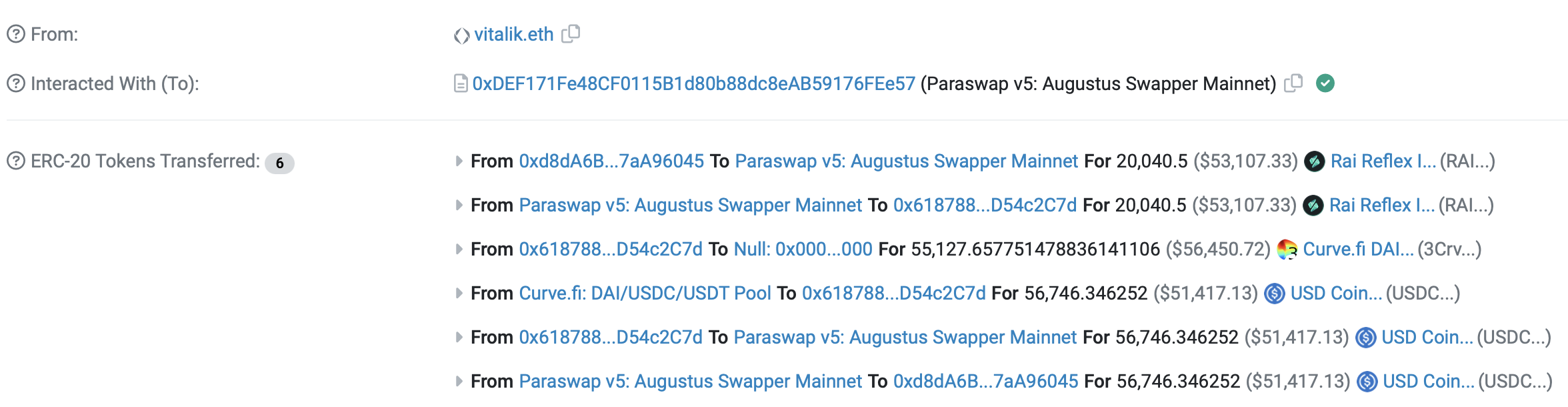
RAI converted to USDC
Reflexer’s algorithmic stablecoin has previously garnered positive commentary from the Ethereum co-founder. Buterin has shared his optimism about RAI in the past. Buterin’s latest move is currently open to interpretation and it is uncertain whether the ETH co-founder is supporting USDC in its crisis or just shedding his RAI holdings.
Until June 2020, Circle’s stablecoin USDC was exclusive to the Ethereum blockchain. In June 2020, Centre, the collaboration between Circle and Coinbase announced a framework for multi-chain support for USDC. It is likely that Buterin is extending support to USDC, converting his algorithmic stablecoin holdings into Circle’s stablecoin.
Where does Ethereum stand when trouble is brewing in DeFi?
Circle’s USDC is one of the important elements of the DeFi ecosystem. So are the other stablecoins that are currently suffering a depeg. Amidst wider crypto market uncertainty, the DeFi ecosystem is hit by the declining total volume locked on networks like Ethereum.
Analysts at Citron Research, a stock commentary firm believe Ethereum is at risk of a decline to $350. The technical experts argue the case that Ethereum is a security and the New York State Attorney General is set to “end the charade.”
Attorney General Letitia James recently filed a suit against KuCoin, alleging that the exchange is violating securities laws, arguing “Ethereum is a security.” When the AG focuses on the Ethereum Network, analysts expect that James could uncover self-dealing, ICO transactions, multiple attempts to avoid federal laws of taxation and securities, all while being controlled by a small group of people.
Experts believe switching from Proof-of-Work to Proof-of-Stake turned Ethereum into a security and made it an investment vehicle, not just a smart contract network. Experts have drawn parallels between Vitalik’s altruism and defunct FTX exchange founder Samuel Bankman-Fried’s charity efforts.
1/ The situation in Ethereum could get real ugly. If $ETH would be worth same as ChatGPT parent OpenAi it would put price of $ETH around $350.
— Citron Research (@CitronResearch) March 10, 2023
Citron Researchers believe $175 billion in market capitalization puts Ethereum at the same level as Open AI, Twitter (TWTR), Chipotle Mexican Sausage (CMG) and Lululemon Athletica Inc (LULU) combined. Citron’s take on Ethereum has garnered mass criticism on Twitter, however it remains to be seen where ETH is headed next with Circle’s fast spreading contagion.
Author

Ekta Mourya
FXStreet
Ekta Mourya has extensive experience in fundamental and on-chain analysis, particularly focused on impact of macroeconomics and central bank policies on cryptocurrencies.