UNI price unfazed despite positive development in Uniswap class action lawsuit at SDNY court
- Judge Katherine Polk Failla of SDNY court dismissed the putative class action against Uniswap protocol.
- The platform had been pursued for liability on damage caused by third-party misuse of software code.
- It entailed allegations that they were responsible for plaintiffs being harmed in a rug pull engineered by scam token issuers.

Uniswap (UNI) price remains bearish, with the gloom overshadowing a recent positive development in the case involving Uniswap Labs. The matter touches on foreseeable harm responsibility for third-party misuse and damage.
Uniswap gets a positive break in court
Uniswap Labs has won in a lawsuit that users filed against the decentralized exchange (DEX). It happened that a cohort of the protocol's users claimed it was dealing with securities advertised as digital assets. With the plaintiff calling out Uniswap protocol for securities law violation, the legitimacy of its tokens was put to the stand.
The litigation was longstanding, with the outcome coming after multiple hearings with the network's regulatory compliance coming into question. Among the plaintiffs, Nessa Riley claims to have lost $10,400 because Uniswap failed to investigate assets on its platform, leaving users susceptible to scammers. With this, allegations of the protocol running a swindle or "pump-and-dump" scheme sprouted.
SDNY court rules in favor of Uniswap
On August 30, the Southern District of New York (SDNY) court decided to dismiss the lawsuit because "software misuse does not create liability for developers."
More broadly, senior counsel and director of global regulatory matters at ConsenSys Software, Bill Hughes, who supports the court's decision, says today's outcome could have a huge influence on crypto regulation, perhaps more intricately than the recent partial victory of XRP against the US Securities and Exchange Commission (SEC).
"I'm beginning to like Judge Failla very, very much. Look at this shade she throws at the SEC: "ERC-20s may or may not be securities. Dunno, neither the courts nor Congress have said anything on the subject."
— Bill Hughes : wchughes.eth (@BillHughesDC) August 30, 2023
Savage. pic.twitter.com/7LpVEoXnYI
His stance on the court's ruling is that:
"A trading software/crypto exchange can't be liable for customer losses emerging from third-party token issuers."
Impact of SDNY ruling on DeFi platforms
While the decision bodes well for decentralized finance (DeFi) platforms, it may have set precedence for regulatory rubbles, prompting projects in the same line of work to defend their decentralized statuses during times of legal challenges. Such a position could change how legislators oversee the industry.
Impact on Uniswap price
Meanwhile, the decision has sent resounding excitement among UNI community members, but the hype has not influenced the token's price. At the time of writing, the Uniswap token is valued at $4.653, down around 5% in 24 hours.
Momentum is falling, as indicated by the nose-diving Relative Strength Index (RSI), while the Awesome Oscillator's histogram bars remain in the negative zone. With such a gloomy outlook, Uniswap price could revisit the immediate support at $4.540 or extrapolate to the $4.044 support floor in the dire case. This would mean a 12% downswing.
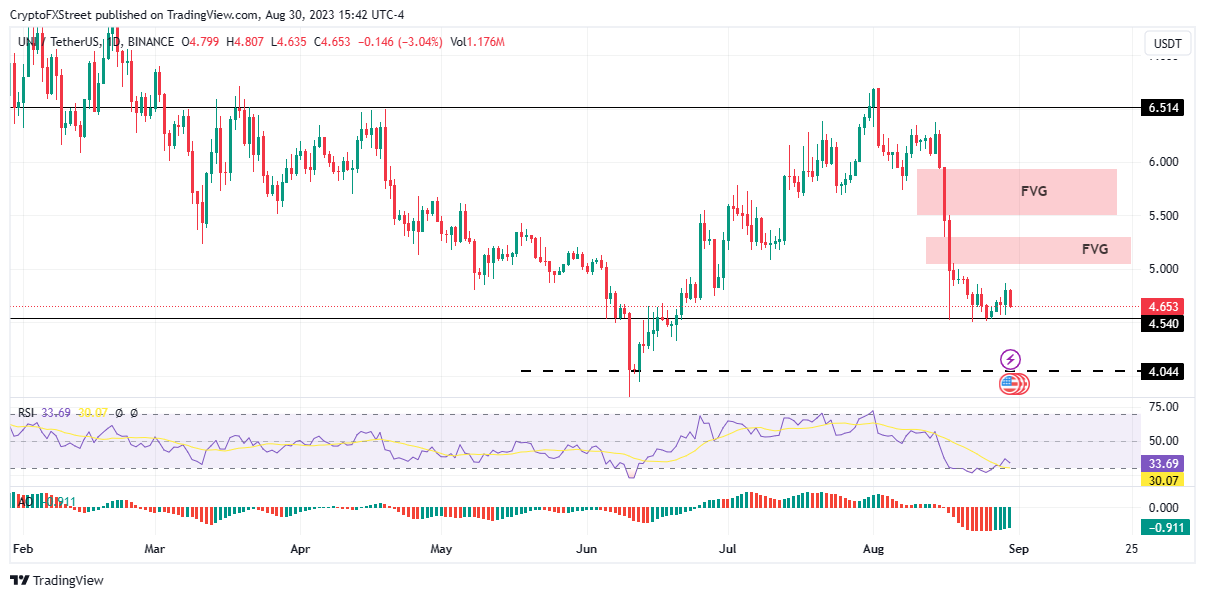
UNI/USDT 1-day chart
Conversely, increased buyer momentum could send Uniswap price north, with several imbalance zones standing out. Notably, price always fills these imbalance zones. UNI price could continue its downtrend after filling these gaps.
Nevertheless, highly ambitious cases could see Uniswap price break above the fair value gaps to tag the $6.514 resistance level.
Cryptocurrency metrics FAQs
What is circulating supply?
The developer or creator of each cryptocurrency decides on the total number of tokens that can be minted or issued. Only a certain number of these assets can be minted by mining, staking or other mechanisms. This is defined by the algorithm of the underlying blockchain technology. Since its inception, a total of 19,445,656 BTCs have been mined, which is the circulating supply of Bitcoin. On the other hand, circulating supply can also be decreased via actions such as burning tokens, or mistakenly sending assets to addresses of other incompatible blockchains.
What is market capitalization?
Market capitalization is the result of multiplying the circulating supply of a certain asset by the asset’s current market value. For Bitcoin, the market capitalization at the beginning of August 2023 is above $570 billion, which is the result of the more than 19 million BTC in circulation multiplied by the Bitcoin price around $29,600.
What is trading volume?
Trading volume refers to the total number of tokens for a specific asset that has been transacted or exchanged between buyers and sellers within set trading hours, for example, 24 hours. It is used to gauge market sentiment, this metric combines all volumes on centralized exchanges and decentralized exchanges. Increasing trading volume often denotes the demand for a certain asset as more people are buying and selling the cryptocurrency.
What is funding rate?
Funding rates are a concept designed to encourage traders to take positions and ensure perpetual contract prices match spot markets. It defines a mechanism by exchanges to ensure that future prices and index prices periodic payments regularly converge. When the funding rate is positive, the price of the perpetual contract is higher than the mark price. This means traders who are bullish and have opened long positions pay traders who are in short positions. On the other hand, a negative funding rate means perpetual prices are below the mark price, and hence traders with short positions pay traders who have opened long positions.
Author

Lockridge Okoth
FXStreet
Lockridge is a believer in the transformative power of crypto and the blockchain industry.




