Solana Price Forecast: SOL gains ETF boost amid $3 billion unlock fears
- Solana is experiencing rising bearish sentiment fueled by token unlocks worth over $3 billion within the next three months.
- Franklin Templeton showed interest in a Solana ETF by filing a SOL Trust in Delaware.
- Solana saw a rejection near an upper descending channel boundary as it struggled around the $206 resistance.

Solana (SOL) is down 1% on Tuesday following negative sentiment surrounding its upcoming $3 billion token unlock. Meanwhile, Franklin Templeton is likely entering the race for a Solana exchange-traded fund (ETF) following its filing for a Solana Trust in Delaware.
SOL struggles as upcoming unlocks strike fears
Solana has seen increased bearish momentum lately as investors digest news of its upcoming $3 billion token unlocks over the next three months.
The unlocks combined will constitute Solana's largest supply injection since its launch. Starting this month, the crypto market will experience unlocks of 15.7 million SOL worth approximately $3 billion for the next three months.
In February alone, over 3 million SOL will be injected into the market, which could negatively impact the token's price.
Historically, prices tend to decline if demand fails to catch up with the rising circulating supply during token unlocks.
For example, SOL declined nearly 20% following a $340 million token unlock in August.
While crypto community members continue discussing the potential effect of the unlocks, Solana ETF filings are seeing progress.
The Securities and Exchange Commission (SEC) has acknowledged filings for Solana spot ETFs submitted by 21Shares, Bitwise, Grayscale and VanEck.
This sets a positive tone for the possibility of a Solana ETF approval later in the year. The SOL ETF is one of only two crypto ETF filings the SEC has acknowledged so far in the race for crypto ETFs.
Asset manager Franklin Templeton also appears to be showing interest in the Solana ETF race after submitting a Solana Trust filing in the state of Delaware.
The firm registered the Franklin Solana Trust in Delaware, which often precedes issuers' actions before filing a crypto ETF request with the SEC.
The increasing number of applications for a Solana ETF indicates rising interest from institutional investors.
Bloomberg analysts Eric Balchunas and James Seyffart also predicted a 70% chance for a Solana ETF approval in 2025.
Solana Price Forecast: SOL faces a descending channel's resistance hurdle amid bearish momentum
Solana saw $8.32 million in futures liquidations in the past 24 hours, per Coinglass data. The total amount of long and short liquidations accounted for $6.68 million and $1.63 million, respectively.
SOL saw a rejection near the $206 resistance level, which coincides with the upper boundary of a descending channel. If the bearish pressure persists and SOL continues seeing a rejection, it could decline toward the channel's lower boundary.
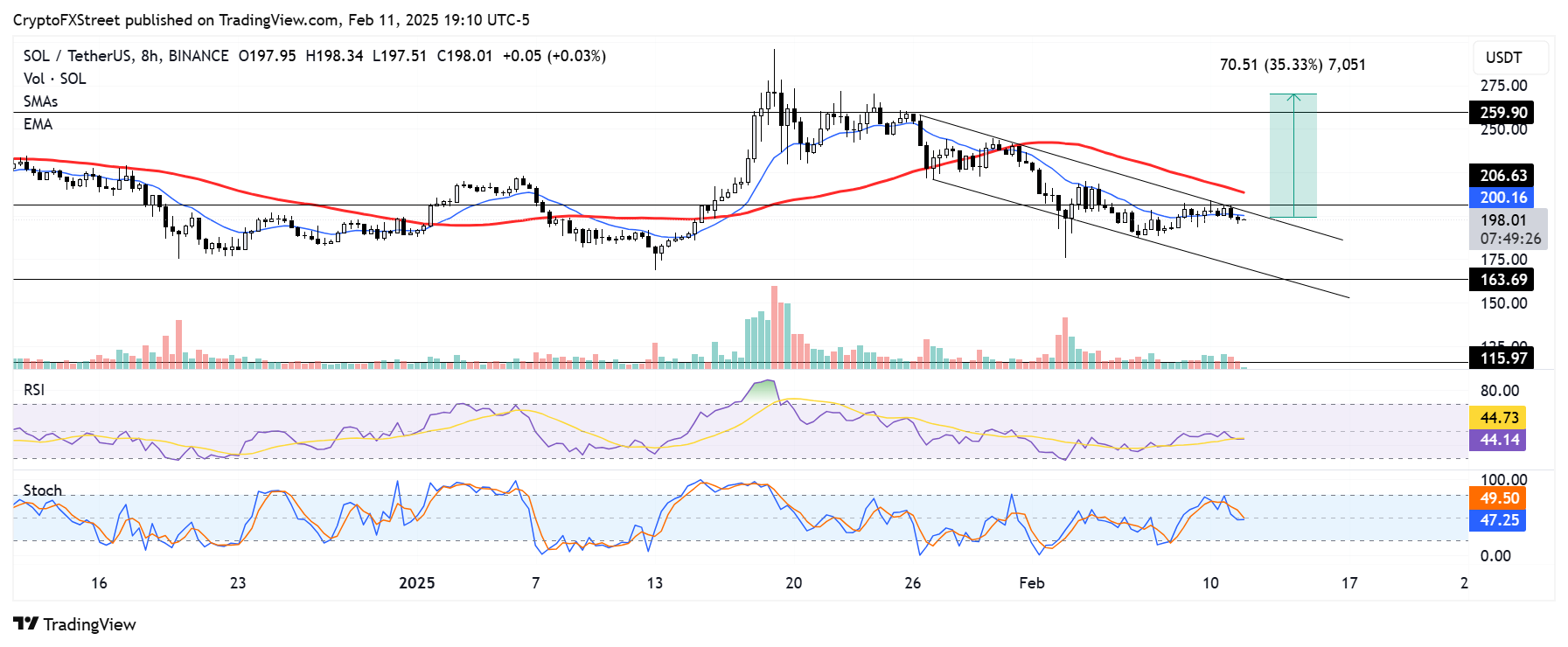
SOL/USDT 8-hour chart
However, a breakout above the channel's upper boundary resistance — while holding it as support — could spark a 35% SOL rally toward the $270 level.
The Relative Strength Index (RSI) and Stochastic Oscillator (Stoch) are below their neutral levels, signaling dominant bearish momentum.
A firm daily candlestick close below $163 will invalidate the thesis and could send SOL toward the $115 level.
Cryptocurrency metrics FAQs
The developer or creator of each cryptocurrency decides on the total number of tokens that can be minted or issued. Only a certain number of these assets can be minted by mining, staking or other mechanisms. This is defined by the algorithm of the underlying blockchain technology. On the other hand, circulating supply can also be decreased via actions such as burning tokens, or mistakenly sending assets to addresses of other incompatible blockchains.
Market capitalization is the result of multiplying the circulating supply of a certain asset by the asset’s current market value.
Trading volume refers to the total number of tokens for a specific asset that has been transacted or exchanged between buyers and sellers within set trading hours, for example, 24 hours. It is used to gauge market sentiment, this metric combines all volumes on centralized exchanges and decentralized exchanges. Increasing trading volume often denotes the demand for a certain asset as more people are buying and selling the cryptocurrency.
Funding rates are a concept designed to encourage traders to take positions and ensure perpetual contract prices match spot markets. It defines a mechanism by exchanges to ensure that future prices and index prices periodic payments regularly converge. When the funding rate is positive, the price of the perpetual contract is higher than the mark price. This means traders who are bullish and have opened long positions pay traders who are in short positions. On the other hand, a negative funding rate means perpetual prices are below the mark price, and hence traders with short positions pay traders who have opened long positions.
Author

Michael Ebiekutan
FXStreet
With a deep passion for web3 technology, he's collaborated with industry-leading brands like Mara, ITAK, and FXStreet in delivering groundbreaking reports on web3's transformative potential across diverse sectors. In addition to