Optimism receives backlash after decision to split 116 million OP tokens for treasury management
- Optimism revealed plans to sell 116 million tokens to seven purchasers in a private sale for treasury management.
- Despite the transaction not affecting price significantly, it has raised concerns among onlookers.
- Based on the community’s governance rules for treasury appropriations, the decision ought to have been put to a vote.

Optimism (OP) network recently announced the sale of 116 million OP tokens valued at around $162.4 million in a private sale to seven purchasers for treasury management. While the transaction was not expected to impact OP price, it has provoked backlash from onlookers with some questioning the network’s commitment to its own rules.
Also Read: Optimism price outlook as network sells 116 million OP tokens
Optimism community backlash
In the beginning, one user lauded the Optimism ecosystem for informing the community involved, highlighting that this transparency explained the level of interest other DAOs have expressed toward the Optimism network, looking to learn and build around it.
However, what they missed was that such decisions, requiring treasury appropriations, require community involvement, going as deep as a vote instead of merely informing them.
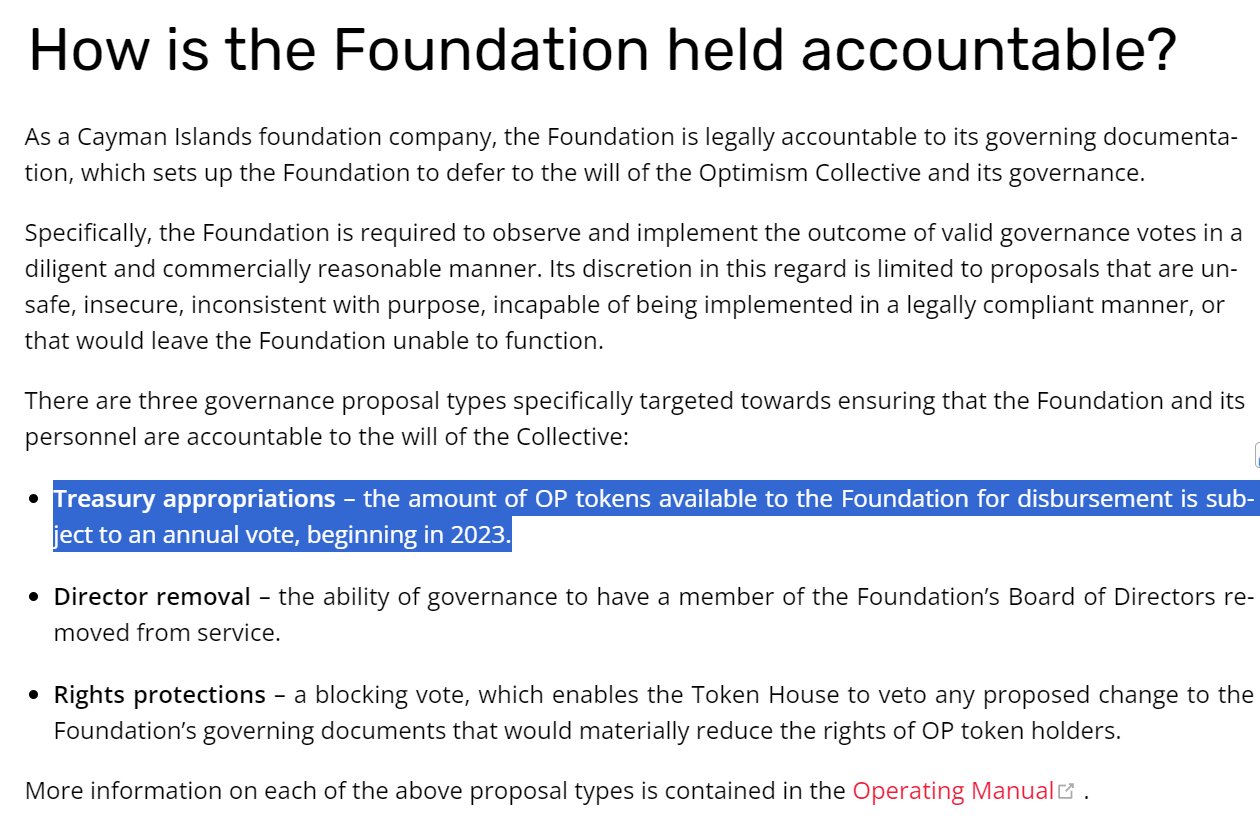
Optimism Foundation accountability manual
One onlooker, @WazzCrypto, attributed this oversight to why DAOs tend to have a hard time staying on top, saying, “They do not even make an effort to obey their own rules.” Another, @HsakaTrades, renowned as a useful source for key insights in the crypto realm, called out the Optimism network for refusing to disclose the terms of the sale.
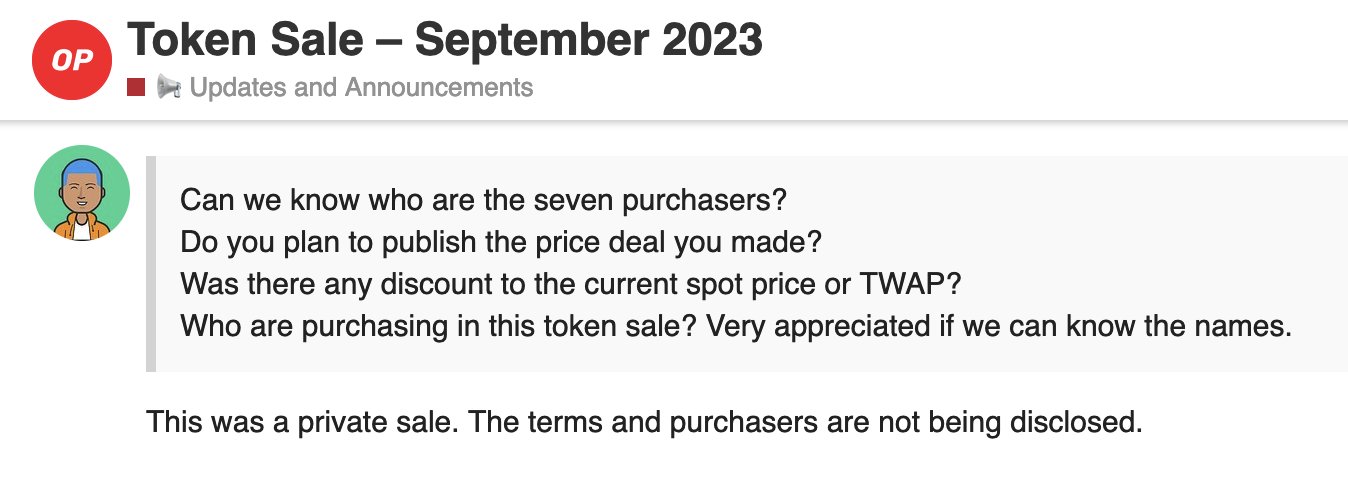
Op governance response
The two backlashes are only a tiny drop in the ocean, with engagements intensifying as community members respond to the announcement. One community member said:
Is there more about (if any) previously agreed commitments on how they will be involved in governance? Because currently 69M OP tokens are delegated and 116M OP sold is a massive shock to consider.
While there is general understanding about why the names of the seven delegates to purchase the tokens is kept private, across board, community members have expressed interest in the associated wallet addresses.
The move has also been found to be in conflict with the decentralization narrative.
Cryptocurrency metrics FAQs
What is circulating supply?
The developer or creator of each cryptocurrency decides on the total number of tokens that can be minted or issued. Only a certain number of these assets can be minted by mining, staking or other mechanisms. This is defined by the algorithm of the underlying blockchain technology. Since its inception, a total of 19,445,656 BTCs have been mined, which is the circulating supply of Bitcoin. On the other hand, circulating supply can also be decreased via actions such as burning tokens, or mistakenly sending assets to addresses of other incompatible blockchains.
What is market capitalization?
Market capitalization is the result of multiplying the circulating supply of a certain asset by the asset’s current market value. For Bitcoin, the market capitalization at the beginning of August 2023 is above $570 billion, which is the result of the more than 19 million BTC in circulation multiplied by the Bitcoin price around $29,600.
What is trading volume?
Trading volume refers to the total number of tokens for a specific asset that has been transacted or exchanged between buyers and sellers within set trading hours, for example, 24 hours. It is used to gauge market sentiment, this metric combines all volumes on centralized exchanges and decentralized exchanges. Increasing trading volume often denotes the demand for a certain asset as more people are buying and selling the cryptocurrency.
What is funding rate?
Funding rates are a concept designed to encourage traders to take positions and ensure perpetual contract prices match spot markets. It defines a mechanism by exchanges to ensure that future prices and index prices periodic payments regularly converge. When the funding rate is positive, the price of the perpetual contract is higher than the mark price. This means traders who are bullish and have opened long positions pay traders who are in short positions. On the other hand, a negative funding rate means perpetual prices are below the mark price, and hence traders with short positions pay traders who have opened long positions.
Author

Lockridge Okoth
FXStreet
Lockridge is a believer in the transformative power of crypto and the blockchain industry.