NFT markets are out of balance, with sellers dominating: Data

Recent data has revealed that throughout April, the nonfungible token market has consistently seen more sellers than buyers, without a single exception.
According to data from the analytics platform NFTGo, there were only 7,907 buyers on April 26, while there were 8,641 attempting to sell their NFTs.
Days before, on April 19, the NFT market hit its second lowest point in the past twelve months, with only 5,893 buyers — a slight increase from the lowest recorded date in the past twelve months, which was on June 18, 2022, with 5,343 buyers.
On April 5, while there were more buyers on the market — 18,495 — there were also 36,423 sellers.
Based on the data, there hasn’t been a single day in April where the number of buyers outnumbered the number of sellers in the NFT market, indicating a potential lack of demand that could be concerning for thosplanning to sell their NFT soon.
The last recorded day buyers exceeded sellers was on March 11, when there were 9,756 buyers and 9,754 sellers.
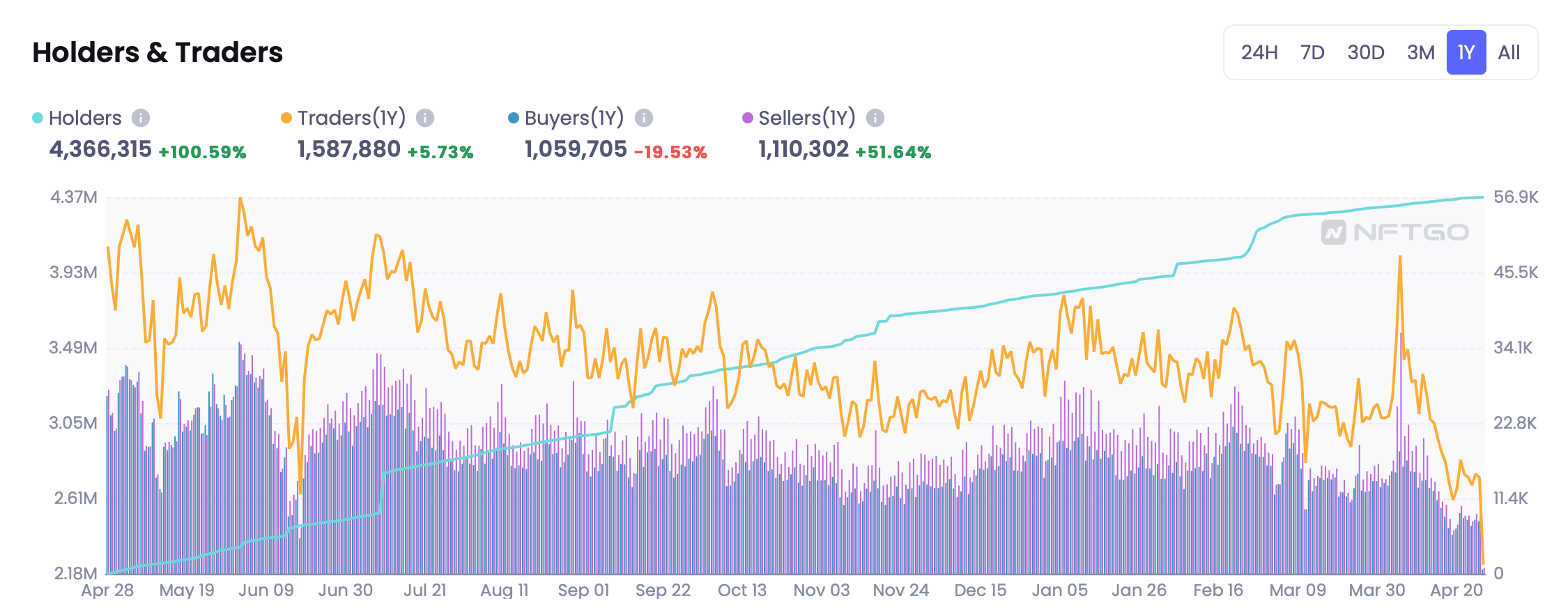
Graph showing the total number of daily buyers, sellers and holders on the NFT market. Source: NFTGo
The turbulent market conditions have been met with various community reactions on Twitter.
For the last year, daily NFT traders ranged from 20-60k.
— Mando (@rektmando) April 26, 2023
In the last few days it dropped to 7k
This market is not functioning atm. pic.twitter.com/akqKuWHmxr
Cointelegraph previously reported that the NFT market experienced a decline on March 12, after the collapse of Silicon Valley Bank caused fear in traders.
Before the bank’s collapse, NFT trading volumes were hovering between $68 million to $74 million on March 10; however, on March 12, they fell to $36 million.
The dip was also accompanied by a 27.9% drop in daily NFT sales count between March 9 and March 11.
According to a March 20 CoinGecko report, the top six NFT marketplaces saw a rise in wash trading in February for the fourth month straight, with a total volume of $580 million.
The report revealed that the market witnessed a 126% increase from the previous month’s volume of $250 million — with the report attributing the overall recovery of the NFT marketplace as the reason for the increase.
Author

Cointelegraph Team
Cointelegraph
We are privileged enough to work with the best and brightest in Bitcoin.