|

Meme coin liquidity hits record high even as bid-ask spread spotlights risk

  • Record liquidity, measured by 1% market depth, suggests ease in executing orders and stable prices.

  • Nevertheless, bid-ask spreads remain elevated, a sign the tokens are still considered relatively risky.
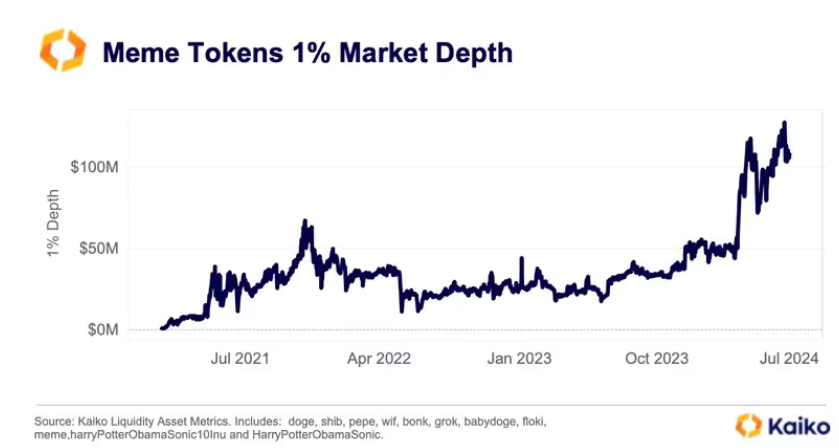
Executing trades in prominent meme coins is easier than ever now that liquidity, as measured by 1% market depth, has surged to record highs, according to data tracked by Paris-based Kaiko.

The combined figure for DOGE, SHIB, PEPE, WIF, BONK, GROK, BABYDOGE, FLOKI, MEME, HarryPotterObamaSonic10Inu and HarryPotterObamaSonic, recently rose to $128 million, the data shows. The figure describes the total value of buy and sell orders within a 1% range of the current market price. The deeper the liquidity – that is, the higher the figure – the easier it is to execute large orders at stable prices.
Chart

Meme tokens 1% market depth. (Kaiko)

Generally, increased liquidity leads to a narrower gap between the highest price a buyer is willing to pay and the lowest a seller is willing to accept, the bid-ask spread. Tighter spreads ensure better trading pricing and reduce the cost of executing trades. Meme coins, however, aren't responding, according to Kaiko, and the bid-ask spreads remain above 2 basis points on most centralized exchanges.

"This suggests that while more market makers are venturing into providing liquidity for these tokens, they are still considered risky due to their high volatility," Kaiko added.

"While part of this increase is related to price appreciations, many small-cap meme tokens such as Dogwifhat (WIF), Memecoin (MEME), or Book of Meme (BOME) have seen significant growth in liquidity in native units, ranging from 200% to 4000%," Kaiko said in a weekly newsletter.

Author

CoinDesk Analysis Team

CoinDesk is the media platform for the next generation of investors exploring how cryptocurrencies and digital assets are contributing to the evolution of the global financial system.


More from CoinDesk Analysis Team
Share:

Markets move fast. We move first.

Orange Juice Newsletter brings you expert driven insights - not headlines. Every day on your inbox.

By subscribing you agree to our Terms and conditions.

Editor's Picks

Avalanche struggles near $12 as Grayscale files updated form for ETF

Avalanche trades close to $12 by press time on Wednesday, extending the nearly 2% drop from the previous day. Grayscale filed an updated form to convert its Avalanche-focused Trust into an ETF with the US Securities and Exchange Commission.

Bitcoin slips below $87,000 as ETF outflows intensify, whale participation declines

Bitcoin price continues to trade around $86,770 on Wednesday, after failing to break above the $90,000 resistance. US-listed spot ETFs record an outflow of $188.64 million on Tuesday, marking the fourth consecutive day of withdrawals.

Michael Selig assumes role as new CFTC Chair, what does this mean for crypto?

Michael Selig has been sworn in to serve as the 16th Chairman of the Commodity Futures Trading Commission. Selig was confirmed by the US Senate to head the commission last week, following his October nomination by the US President Donald Trump.

Crypto.com hires sports trader for event prediction market-making

Crypto.com plans to recruit a quant trader for the sports market-making team to buy and sell financial contracts related to these events. Opponents argue that internal trading desks put operators or their affiliates on the opposite side of customer trades. 

Orange Juice Newsletter – Smart insights by real people. Every day.

A free newsletter highlighting key market trends to help traders stay a step ahead. Daily insights on the most relevant trading topics, compiled by our experts in an easy-to-read format so you never miss an important move.

Bitcoin: Fed delivers, yet fails to impress BTC traders

Bitcoin (BTC) continues de trade within the recent consolidation phase, hovering around $92,000 at the time of writing on Friday, as investors digest the Federal Reserve’s (Fed) cautious December rate cut and its implications for risk assets.