Key Bitcoin metrics to watch out for ahead of next week following market sell-off
- Bitcoin's MVRV moving below its 365-day moving average indicates potential for further decline or start of a bear market.
- BTC short-term holders took in 97% of losses realized during Monday's market crash.
- Stablecoin exchange netflow has risen close to $2 billion in past four days, meaning investors may be buying the dip heavily.
- The Federal Reserve could cut interest rates in September following increasing unemployment and Fed Boston President's interview.

Bitcoin could be set for an interesting week ahead as it struggles to recover from its largest drawdown in the current cycle. This drawdown was sparked by a series of events, including fears of recession, geopolitical tension in the Middle East, and the Japanese yen carry trade.
The metrics below reveal key insights investors need to watch out for as a new week approaches.
Bitcoin metrics that could prove crucial going into next week
Bitcoin's Market Value to Realized Value (MVRV) ratio fell below its 365-day moving average after the market downturn, according to CryptoQuant's data. In previous times, such a move triggered further market declines — the COVID market crash in March, the correction in May 2021, and the beginning of a bear season in November 2021. Hence, investors must be cautious even though the market appears to be seeing a price bounce.
-638588444040490301.png)
Bitcoin MVRV
Bitcoin saw a drawdown of 32% — its largest in the current cycle — as investors realized losses of $1.38 billion — its 13th largest event in history — following the market crash, according to Glassnode analysts. The short-term holders (STH) cohort was the most affected, bearing 97% of the loss. The STH Spent Output Profit Ratio (SOPR) also declined to a three-year low, indicating new investors realized a 10% loss on average — only 70 trading days in Bitcoin's history have seen a lower value.
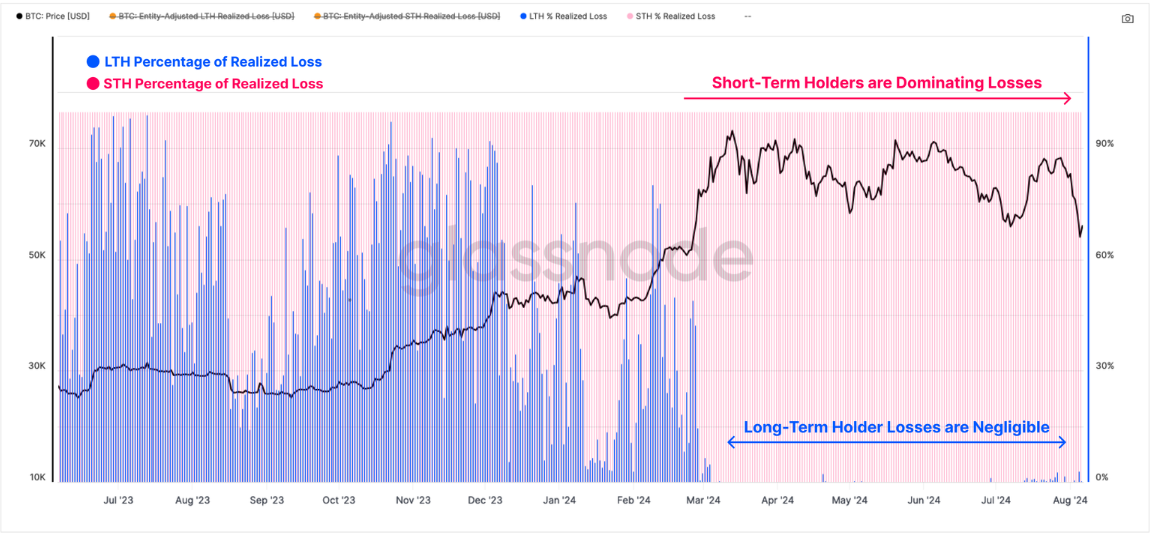
BTC: LTH vs STH Percent Realized Loss
Bitcoin and Ethereum's open interest (OI) declined by $6 billion individually, and their funding rates turned negative, indicating that long traders closed positions heavily while shorts dominated the market. If OI increases and funding rates turn positive for an extended period, it could indicate the potential for a major price reversal.
Exchanges' stablecoin supply on Ethereum has seen close to $2 billion in net inflows since the market crashed on April 5, according to CryptoQuant's data. During the same time, over $1.3 billion was moved from Tether Treasury to exchanges and other addresses as per Lookonchain's data. This suggests investors and institutions are buying the dip heavily, expecting prices to rebound.
 Exchange Netflow (Total) - All Exchanges-638588445079534260.png)
Stablecoin Exchange Netflow
The US lower-than-expected non-farm payroll data last Friday showed that the unemployment rate rose by 4.3%, sparking fears of recession. This is evidenced in reports that computer firm Dell and networking firm Cisco plan to lay off 12,500 and 4,000 employees, respectively. As a result, analysts expect the Federal Reserve to begin cutting interest rates in September.
A lower interest rate environment could raise the prices of risk assets like stocks and crypto. Hence, most crypto community members expect Bitcoin to perform strongly in the coming months if the Fed cuts rates.
The Bank of England, the People's Bank of China, and the European Central Bank have all cut rates in the past few months, and the Fed is expected to follow suit.
The Federal Reserve isn't leading the charge on interest rate cuts this time.
— ecoinometrics (@ecoinometrics) August 9, 2024
The European Central Bank, People's Bank of China, and Bank of England have already made their moves.
This shift marks a significant macro trend that will impact global liquidity. pic.twitter.com/unxaXDJfKO
In an interview with Providence Journal, Fed Boston President Susan Collins said that the Federal Reserve could begin easing rates if inflation continues to slow down. "If the data continue the way that I expect, I do believe that it will be appropriate soon to begin adjusting policy and easing how restrictive the policy is," said Collins.
Author

Michael Ebiekutan
FXStreet
With a deep passion for web3 technology, he's collaborated with industry-leading brands like Mara, ITAK, and FXStreet in delivering groundbreaking reports on web3's transformative potential across diverse sectors. In addition to



