How will regulatory troubles and mandatory KYC impact Binance Coin (BNB) price?

Data shows traders have mixed emotions about BNB’s future given Binance’s regulatory troubles and new mandatory KYC policy.
Binance Coin (BNB) rallied 30% in two weeks, but the fourth largest cryptocurrency by market capitalization seems to be struggling to break the $450 resistance. Coincidently, this is the same top from June 3, which was followed by a 48% correction down to $225.
Given the similarity of the situation when compared to previous instances, investors have reasons to doubt the recent performance, especially as Solana (SOL), a competing smart contract platform, reached an all-time high on August 18.
The move was partially attributed to a recent $70-million crowdfund to support its decentralized exchange (DEX), Mango Markets, and the launch of a well-subscribed NFT project.
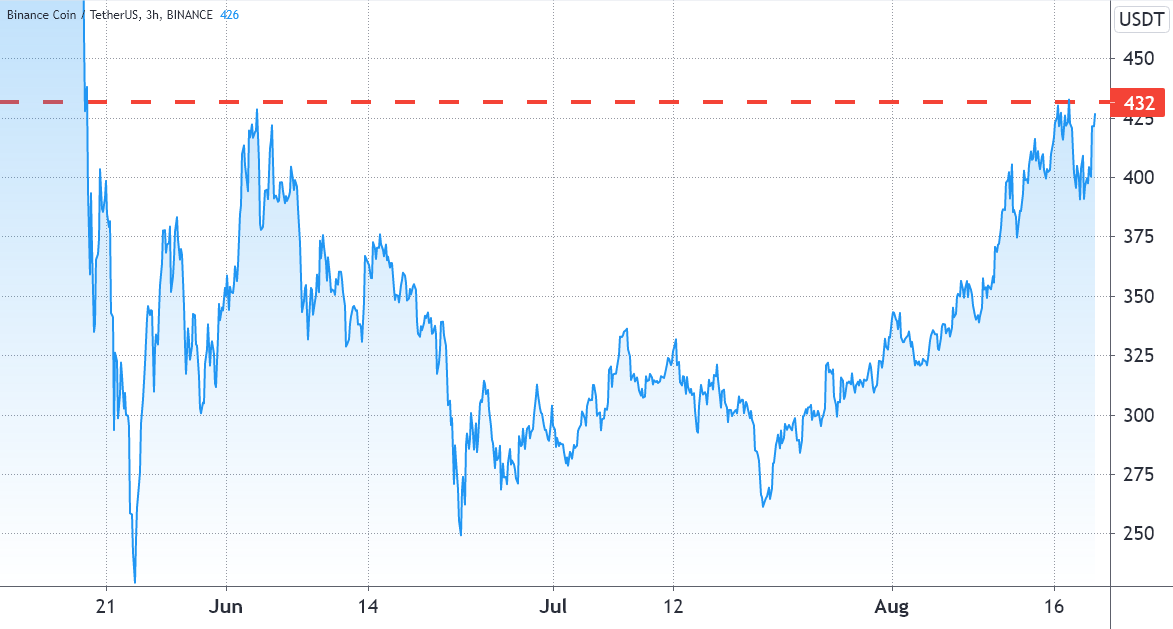
Binance Coin (BNB) price at Binance, in Tether (USDT). Source: TradingView
BNB reacted negatively after the exchange suddenly halted stock tokens trading on July 16, and investors' increased concern that regulatory hurdles would severely impact the exchange's growth.
In late July, the shutdown of derivatives trading for Binance's European and Hong Kong clients added to BNB's woes. On August 18, De Nederlandsche Bank, the Netherlands' Central Bank, issued a warning to Binance after concluding that the exchange offered crypto services to local residents. The authority alleges that the company is not acting in compliance with the country's Anti-Money-Laundering and Anti-Terrorist-Financing Act.
The BNB perpetual contracts premium has vanished
Derivatives data gives good insight into how whales and professional traders are positioned in Binance Coin (BNB).
Even though future contracts longs (buyers) and shorts (sellers) are matched at all times, their leverage may vary. Thus, by gauging the perpetual contracts funding rate, one can determine how bullish or bearish those investors are.
Derivatives exchanges will charge the side demanding more leverage, which is paid to the opposing side. Usually, it is calculated every 8-hours, but some exchanges such as FTX have hourly rates.
In neutral markets, the funding rate tends to vary from 0% to 0.03% on the positive side. This number is equivalent to 0.6% per week and indicates that longs are the ones paying it.
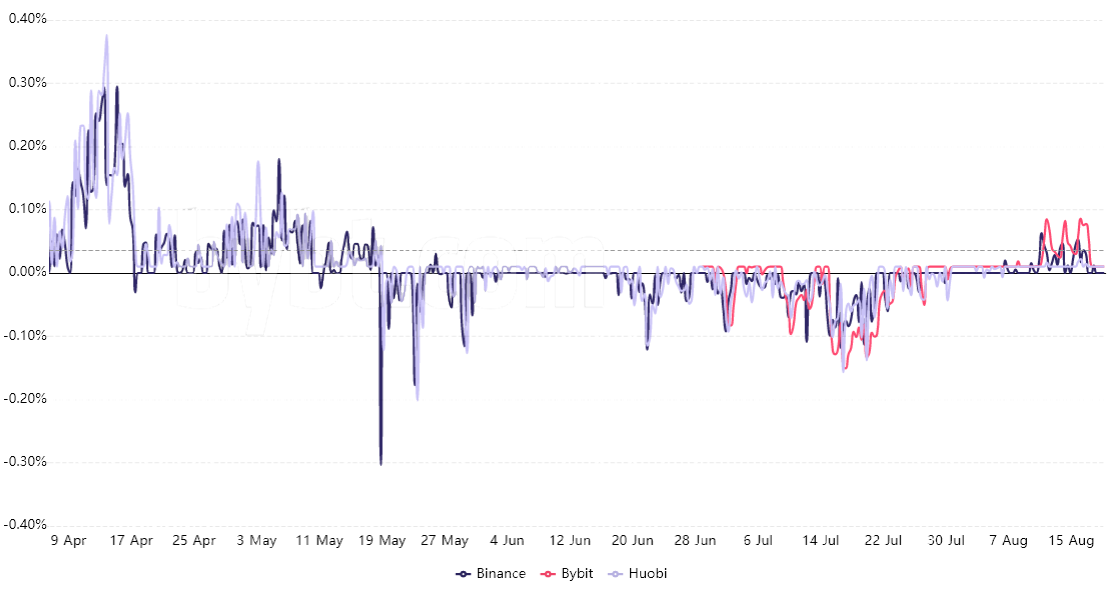
Binance Coin USD/USDT margined futures 8-hour funding rate. Source: Bybt.com
Between Aug. 11 and Aug. 17, there was a slightly bullish 0.10% positive funding rate, but it dissipated over the past few days. Although entirely different from the bearish negative 0.15% indicator seen in late July, the current reading does not transpire confidence from leverage traders.
Professional traders have not turned bullish
To confirm if this data reflects some specific issue regarding the perpetual contracts, let's look at the quarterly futures contracts premium. Retail traders usually avoid the quarterly contracts due to the hassle of calculating the futures premium or manually rolling over positions nearing expiry.
These fixed-date instruments do not have a funding rate adjustment, unlike the perpetual contracts. Therefore, eventual demand imbalances are reflected by a price difference compared to the regular spot markets.
Healthy markets should display a 0.2% to 1% premium in the quarterly contracts, while a negative indicator is a bearish situation known as backwardation.
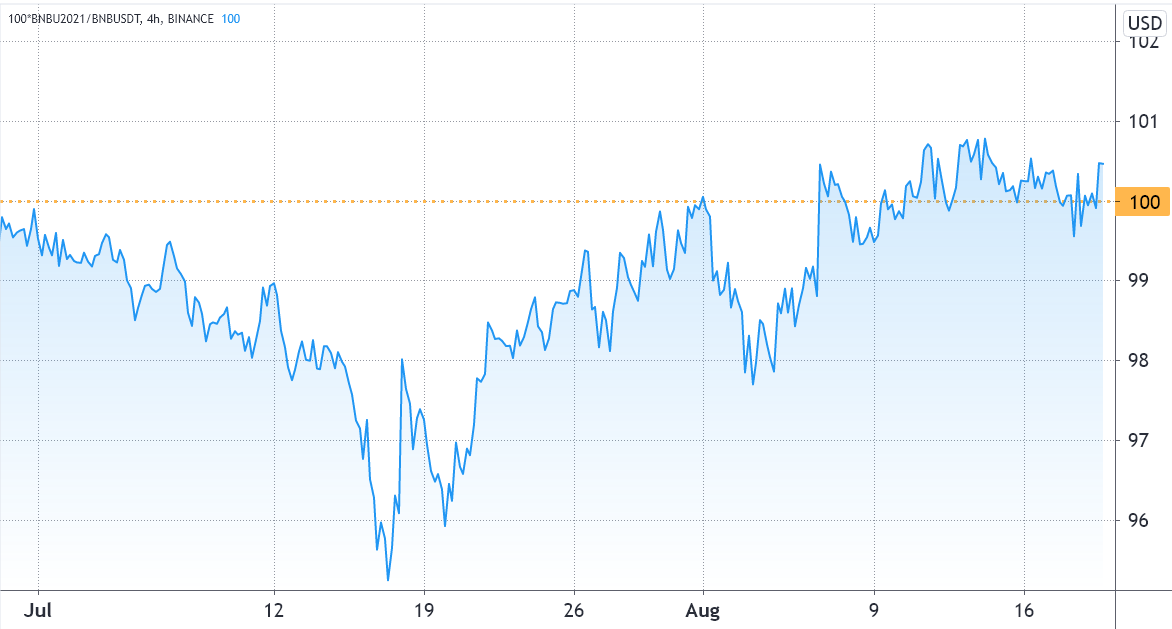
Binance Sept. BNB/USDT futures premium vs. regular spot market. Source: TradingView
The data confirms the mid-July bearishness previously seen on the funding rate, as the Sept. futures contracts displayed a 5% discount. However, the quarterly contract has been neutral over the past few weeks, indicating a neutral-to-bearish sentiment from professional traders.
Derivatives indicators show zero signs of bullishness from investors. It is also clear that retail traders and whales currently have little confidence that the $450 level will be broken in the short term.
Author

Cointelegraph Team
Cointelegraph
We are privileged enough to work with the best and brightest in Bitcoin.