XRP gains momentum supported by mild inflows into ETFs
- XRP logs subtle gains, trading above $1.12 on Thursday as traders increase exposure.
- XRP saw mild capital inflows on Wednesday via ETFs, in line with broader upside momentum.
- XRP’s technical indicators show early signs of recovery as the RSI climbs out of oversold conditions

Ripple (XRP) edges higher at the time of writing on Thursday, trading above $1.12. The cross-border remittance token seeks to erase a persistent downtrend that has weighed on the price since mid-May, as investors navigated geopolitical tensions in the Middle East.
An imminent peace agreement remains elusive as the United States (US) and Iran continue to exchange fire. US President Donald Trump has insisted that Iran is taking too long to sign the peace deal. Following the statement, the US military launched multiple attacks on Iran, describing them as “self-defense.”
Iran’s Islamic Revolutionary Guards Corps (IRGC) launched strikes against US military installations in Kuwait, Bahrain, and Jordan.
XRP ETFs extend inflow streak
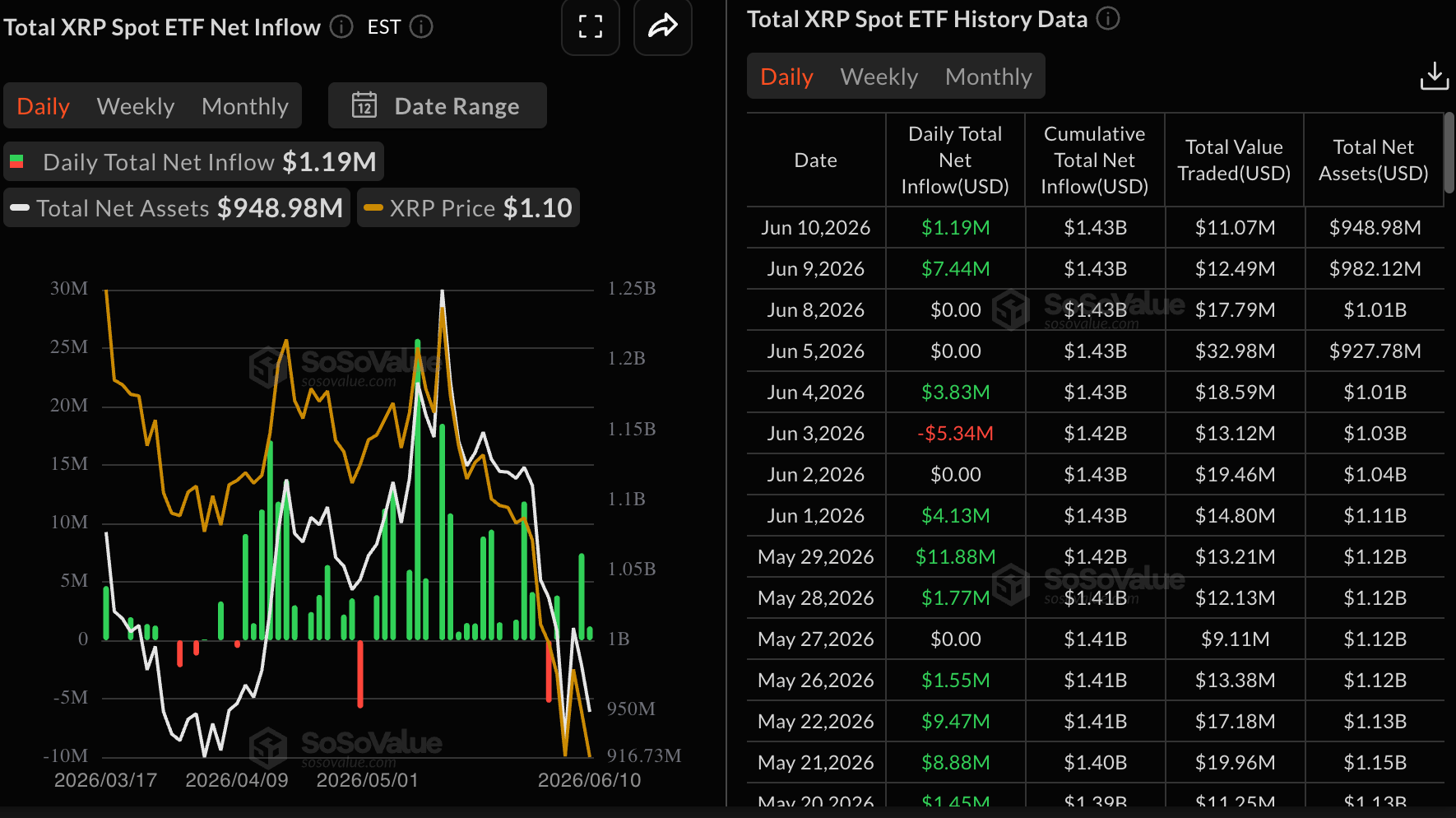
Institutional investors are cautiously increasing their exposure to digital assets, as evidenced by nearly $1.2 million in inflows into spot Exchange-Traded Funds (ETFs) on Wednesday. This follows approximately $7.44 million in inflows on Tuesday, indicating persistent demand for related crypto investment products.
Cumulative inflows now average $1.43 billion, with assets under management totaling $949 million, according to SoSoValue data.
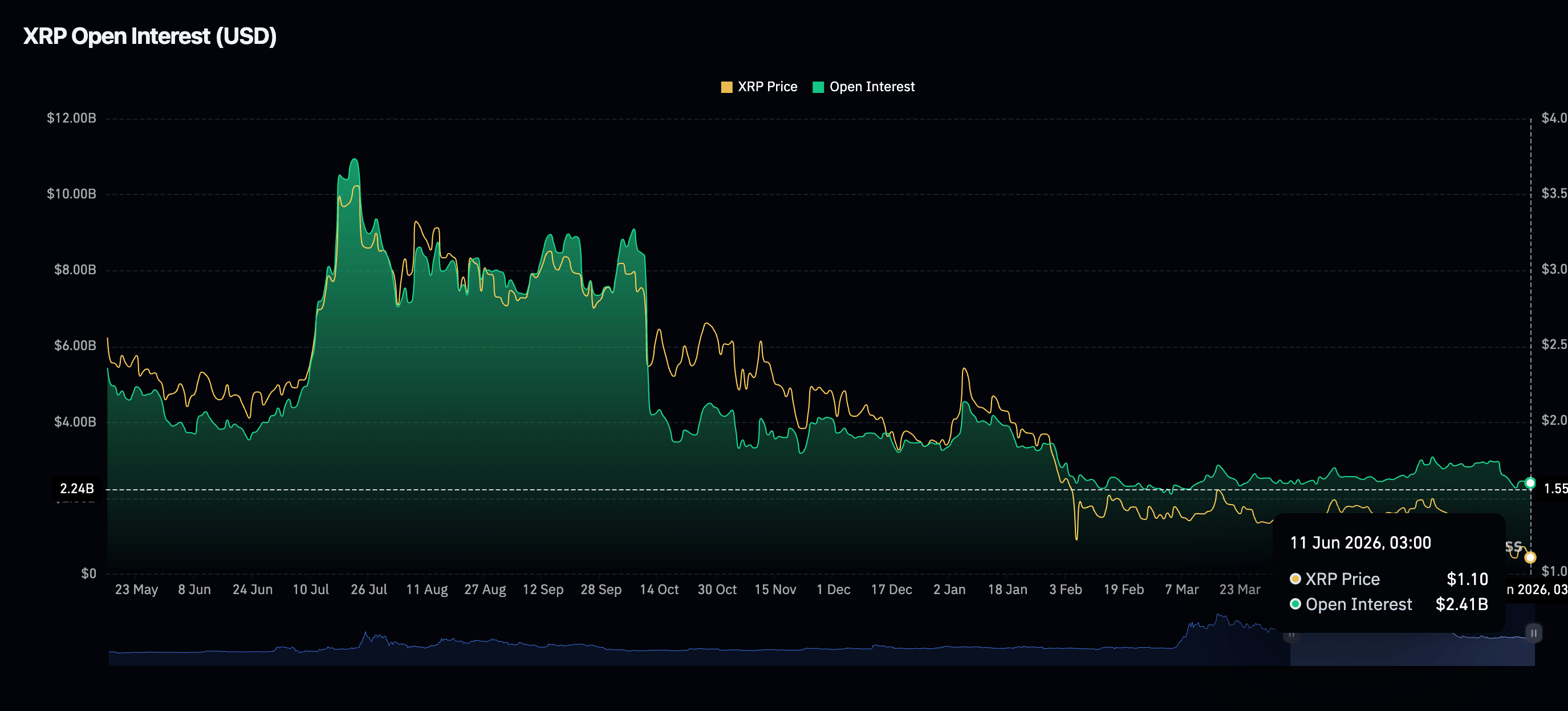
Conversely, retail demand remains on the back foot, with futures Open Interest (OI) steadying at $2.41 billion on Thursday. The OI averaged $2.44 billion on Sunday and was slightly above $3 billion on May 15.
A persistent sell-off in the derivatives market signals diminishing investor confidence in XRP’s ability to sustain its upward trajectory, with market participants reluctant to open new positions.
Price analysis: XRP rebounds as key suppprt holds
XRP trades at $1.12, while holding firmly below the 50-day, 100-day and the 200-day Exponential Moving Averages (EMAs) at $1.30, $1.40 and $1.61, respectively, keeping the broader tone bearish. The latest SuperTrend reading at $1.26 also sits well above spot, reinforcing the view that current price action remains capped, while the Relative Strength Index (RSI ) near 33 on the daily chart hints at weak but not extreme selling pressure as the Moving Average Convergence Divergence (MACD) histogram stays in negative territory.
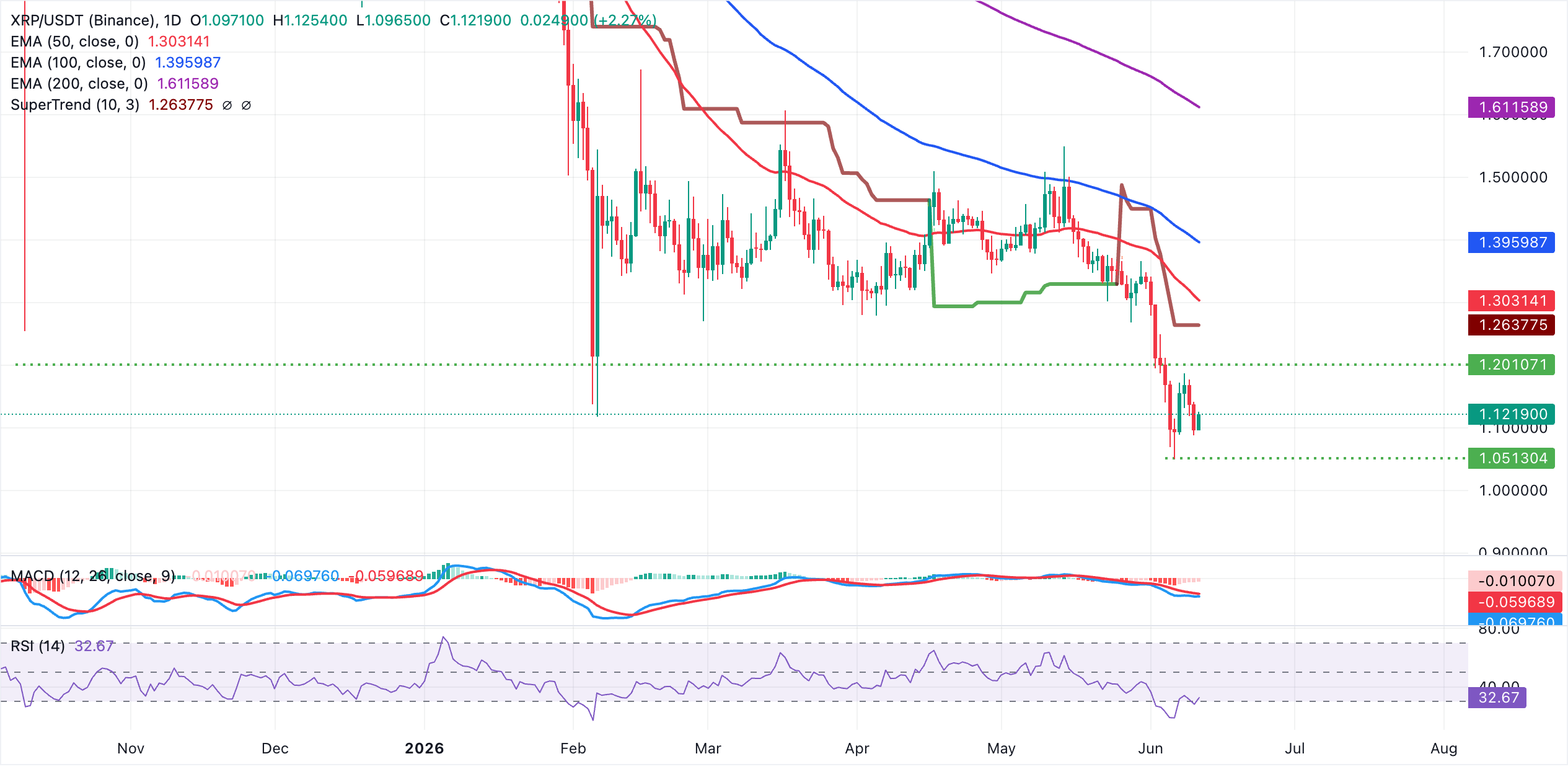
On the topside, initial resistance emerges at the SuperTrend barrier around $1.26, followed by the 50-day EMA at $1.30. A stronger recovery would face subsequent hurdles at the 100-day EMA near $1.40 and the more distant 200-day EMA around $1.61. If rebounds get sold and XRP resumes its decline, bulls will eye support at psychological levels, including $1.05 and $1.00, respectively.
(The technical analysis of this story was written with the help of an AI tool.)
Ripple FAQs
Ripple is a payments company that specializes in cross-border remittance. The company does this by leveraging blockchain technology. RippleNet is a network used for payments transfer created by Ripple Labs Inc. and is open to financial institutions worldwide. The company also leverages the XRP token.
XRP is the native token of the decentralized blockchain XRPLedger. The token is used by Ripple Labs to facilitate transactions on the XRPLedger, helping financial institutions transfer value in a borderless manner. XRP therefore facilitates trustless and instant payments on the XRPLedger chain, helping financial firms save on the cost of transacting worldwide.
XRPLedger is based on a distributed ledger technology and the blockchain using XRP to power transactions. The ledger is different from other blockchains as it has a built-in inflammatory protocol that helps fight spam and distributed denial-of-service (DDOS) attacks. The XRPL is maintained by a peer-to-peer network known as the global XRP Ledger community.
XRP uses the interledger standard. This is a blockchain protocol that aids payments across different networks. For instance, XRP’s blockchain can connect the ledgers of two or more banks. This effectively removes intermediaries and the need for centralization in the system. XRP acts as the native token of the XRPLedger blockchain engineered by Jed McCaleb, Arthur Britto and David Schwartz.
Author

John Isige
FXStreet
John Isige is a seasoned cryptocurrency journalist and markets analyst committed to delivering high-quality, actionable insights tailored to traders, investors, and crypto enthusiasts. He enjoys deep dives into emerging Web3 tren