Ethereum Price Forecast: Staking could be catalyst to drive ETH's price 'more than Pectra upgrade': K33 Research

Ethereum price today: $1,860
- Staking within Ethereum ETFs could be a catalyst to boost ETH's price more than any technical upgrade.
- The SEC acknowledged Fidelity's filing to permit staking in its Ethereum ETF.
- Ethereum could form a critical resistance near $2,000 if it begins consolidation around current prices.
Ethereum (ETH) traded around $1,860 in the Asian session on Thursday as its price remained largely subdued by bearish sentiment weighing on the general crypto market. However, expectations surrounding the potential approval of staking within US spot Ethereum ETFs could lift the top altcoin out of its recent weak performance.
Staking could prove crucial to boost Ethereum's price performance
The SEC acknowledged it has received Fidelity's proposal to allow staking within its spot Ethereum ETF (FETH). However, it's unlikely the agency will decide on the proposal soon, considering it recently postponed deciding on several crypto ETF applications.
The SEC postponed making decisions on Dogecoin, Solana and XRP ETF applications on Tuesday. The ETF Store president Nate Geraci suggested it is due process considering Paul Atkins, Trump's pick to chair the agency, has yet to get Senate approval.
Grayscale and 21Shares have also filed to allow staking within their spot Ethereum ETFs.
Meanwhile, Ethereum's next technical upgrade, Pectra, which will bring several UX improvement features to its blockchain, is getting closer after finalizing on testnets Holesky and Sepolia. Users now await the mainnet upgrade, and many anticipate it could mark a turnaround in ETH's price trajectory, which has severely underperformed Bitcoin and Solana.
"Improved tech does not distract from the overarching theme over the last two years – ETH's underperformance," noted K33 Research analysts in a Wednesday report.
"There are, however, potential bullish catalysts such as the incorporation of staking rewards into US spot ETH ETFs [...] This, more than technical upgrades, could be the necessary trigger for some ETH momentum and enable it to regain favor with market participants," they added.
Standard Chartered analysts have predicted that staking within Ethereum ETFs could drive ETH's price above $14,000 by year-end.
Ethereum Price Forecast: ETH lacks directional bias
Ethereum saw $60.98 million in futures liquidations in the past 24 hours, per Coinglass data. The total amount of long and short liquidations was $34.10 million and $26.88 million, respectively.
ETH appears to lack directional bias as bulls and bears struggle to gain hold of prices since it bounced off the $1,750 support. The top altcoin has to overcome the emerging resistance near $1,960 and surpass a key descending trendline resistance to strengthen the quest to recover $2,200.
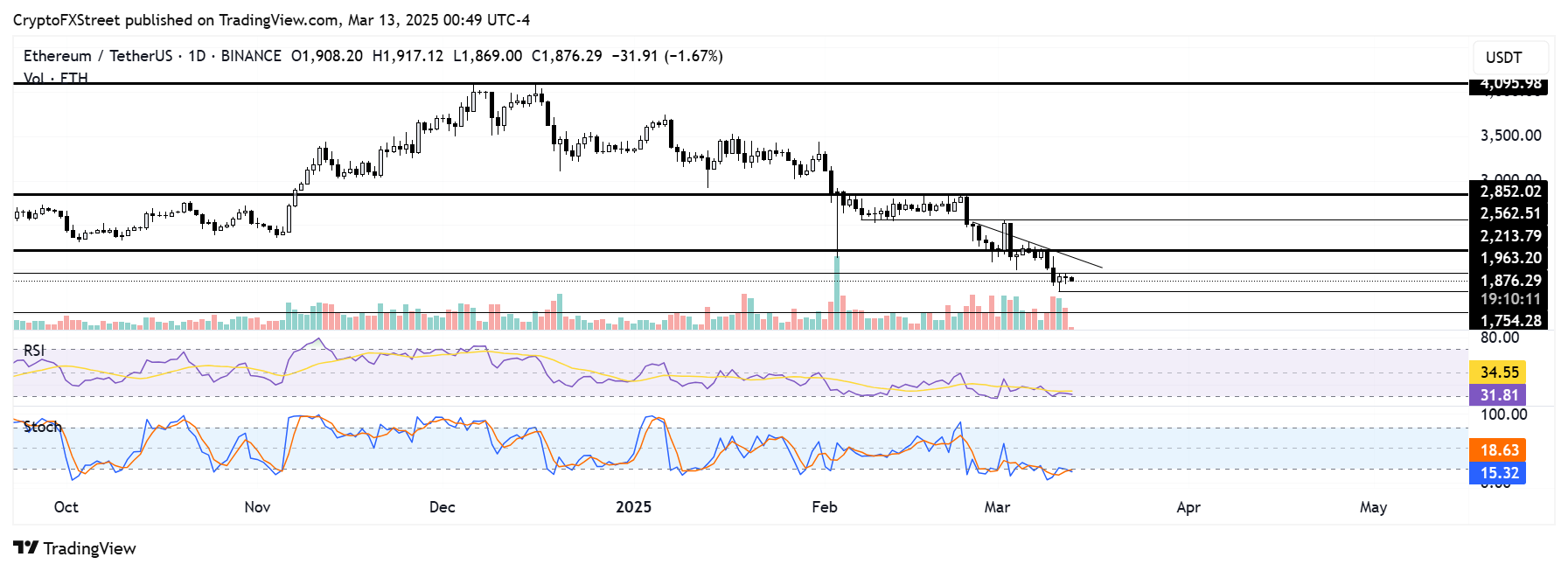
ETH/USDT daily chart
However, a sustained consolidation around $1,900 and $2,000 could establish the range as a key resistance.
The Relative Strength Index (RSI) and Stochastic Oscillator (Stoch) are close to their oversold region, indicating dominant bearish momentum.
A daily candlestick close below $1,500 will invalidate the consolidation thesis and send ETH toward $1,000.
Ethereum development FAQs
After the Dencun upgrade in March 2024, Ethereum users are looking towards the Pectra upgrade slated for early 2025. The upgrade will come in two phases, featuring improved wallet experience, an upgrade to the Ethereum virtual machine (EVM), PeerDAS for scaling L2s, improvement of blob capacity, etc.
Forks are upgrades or changes to the codebase/architecture of a blockchain network. Considering blockchain networks have no central governance, forks are only carried out after developers and validators reach a consensus. Hard forks are substantial permanent changes in a blockchain protocol that create two parallel chains – one with the old rules and the new with the implemented changes. Developers can either upgrade their software to build on the new chain or remain on the old chain as a separate network. During a hard fork, users receive an equivalent amount of their tokens on the new blockchain network 1:1. Soft forks, on the other hand, are subtle changes on a blockchain network that are backwards-compatible, meaning the network still operates as a single entity even when some developers don't implement the new changes.
Famously scribbled by Ethereum co-founder Vitalik Buterin in 22 minutes, Ethereum improvement proposal EIP-7702 is an advanced way of marrying EIP-3074 and ERC-4337 to unlock massive adoption for Ethereum's smart wallet functionality. Slated to go live in the upcoming Pectra upgrade, EIP-7702 will implement an advanced version of account abstraction enabling features like batching that allows users to pay a one-off transaction fee for multiple actions, sponsorship to enable an account pay gas fees for other users and wallet recovery options if users misplace their seed phrase.
Layer 2 is a collective term for protocols that aim to scale Ethereum by processing batches of transactions off the Mainnet. After performing a series of mathematical computations to ensure their validity, these L2s send a compressed version of the transactions back to the Mainnet for final processing. As a result, Layer 2 networks reduce transaction fees and enhance the Mainnet's speed while reaping its security. Think of them like several personal assistants that help their boss to process a series of paperworks. These assistants send a summarised version of the paperworks to the boss who confirms and signs on them.
Layer 3 solutions are application-specific blockchains built upon existing Layer 2 networks to offer high scalability and interoperability. For example, an L3 can focus on tackling privacy, increased scalability, gaming, or some complex functionality while still ultimately deriving security from the Layer 1.
Author

Michael Ebiekutan
FXStreet
With a deep passion for web3 technology, he's collaborated with industry-leading brands like Mara, ITAK, and FXStreet in delivering groundbreaking reports on web3's transformative potential across diverse sectors. In addition to