Ethereum Price Forecast: ETH investors remain indecisive, Vitalik Buterin proposes changes to simplify Ethereum

Ethereum price today: $1,810
- Vitalik Buterin says Beam Chain and RISC-V could make Ethereum as simple as Bitcoin.
- Ethereum ETFs maintained sustained demand, recording $106.75 million in net inflows last week.
- Ethereum's technical outlook indicates indecision among investors following another rejection at the 9-week EMA.
Ether (ETH) saw a 1% decline on Monday following co-founder Vitalik Buterin's suggestion that Ethereum needs to make major tweaks to improve its protocol simplicity.
Beam Chain and RISC-V could boost simplicity in Ethereum's design
In a recent blog post, Buterin stated that Ethereum suffers from security risks and high development expenditure because of several complexities in its design.
According to Buterin, one of Bitcoin's main advantages is its simplicity. "Even a smart high school student is capable of fully wrapping their head around and understanding the Bitcoin protocol," noted Buterin. "A programmer is capable of writing a client as a hobby project."
The post highlights that Ethereum could achieve a similar simple protocol design in five years by simplifying its consensus and execution layers. The Beam Chain is touted as a potential replacement to the consensus layer's current Beacon Chain to enable "a simpler and more robust p2p architecture."
Additionally, he stated the execution layer’s Ethereum Virtual Machine (EVM) has been "over-optimized for specific forms of cryptography that are today becoming less and less relevant, and precompiles that are over-optimized for single use cases."
Buterin reiterated how his proposal of replacing the EVM with RISC-V could result in a 100x gain for the execution layer — far outpacing medium-sized changes to the EVM that can only yield a 1.5x gain. He added how the challenge of backward compatibility from such a transition could be solved through a series of implementations that would ultimately bring "Ethereum consensus to natively understand only RISC-V."
Buterin highlighted how these changes could increase Ethereum's simplicity and unlock several advantages, including improved participation in protocol research, development and governance, low bug risks, and decreased protocol maintenance cost.
Meanwhile, US spot Ethereum exchange-traded funds recorded a second consecutive week of net inflows worth $106.75 million, reflecting sustained demand from traditional investors in the top altcoin, per SoSoValue data.
Ethereum Price Forecast: ETH investors indecisive following rejection at 9-week EMA
Ethereum saw $44.45 million in futures liquidations in the past 24 hours, per Coinglass data. The total amount of long and short liquidations is $35.71 million and $8.74 million, respectively.
After breaking above the upper boundary of a key descending channel last week, ETH posted a doji candlestick on the weekly chart, representing indecision among buyers and sellers. A doji candlestick after an uptrend can lead to a price decline as it indicates buyers failed to maintain the bullish pressure.
The doji candlestick follows a rejection at the 9-week Exponential Moving Average (EMA) — a level that ETH has failed to move above since January.
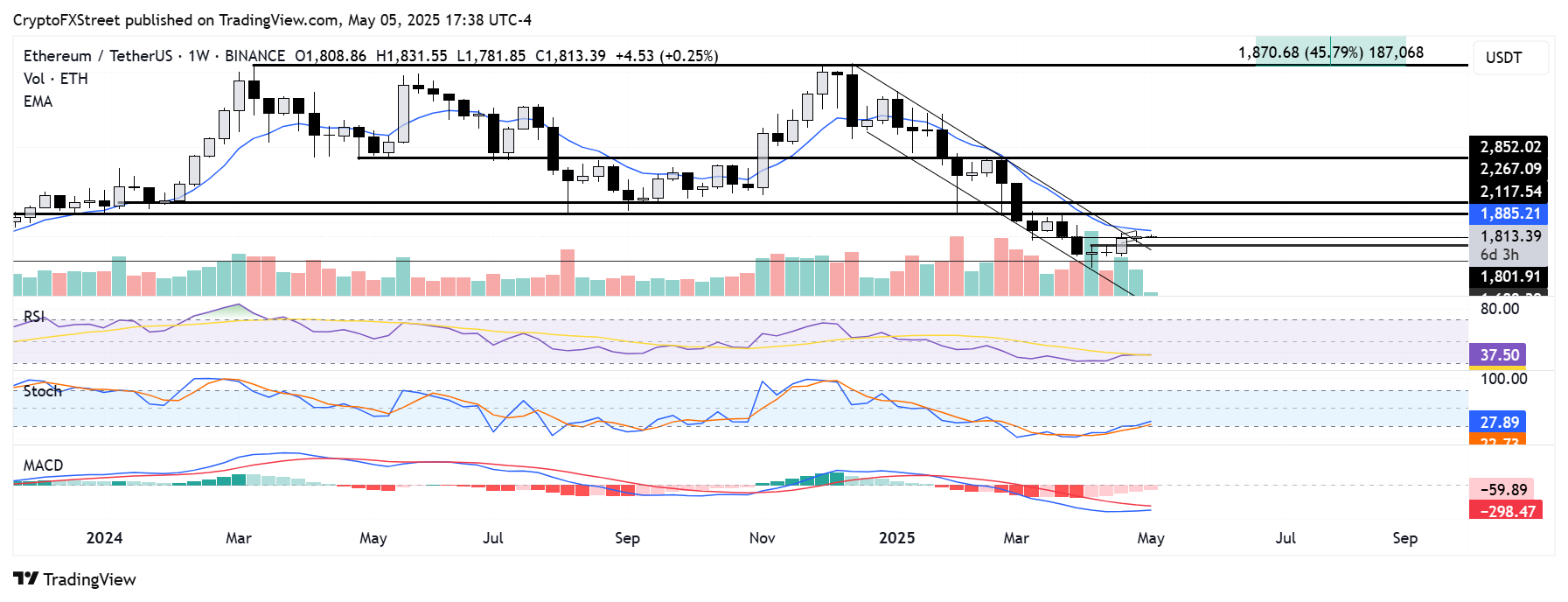
ETH/USDT daily chart
Ethereum is now testing the $1,800 resistance, which stood as a key hurdle throughout April. A decline below this level will confirm a potential brief downtrend with the $1,688, $1,550 and $1,470 as key price support levels to watch.
However, if bulls hold $1,800, ETH could attempt a recovery above the $2,100 key resistance — the lower boundary of ETH's historical largest demand range ($2,055-$2,505), where investors purchased over 69 million ETH, per IntoTheBlock's data.
The Relative Strength Index (RSI) continues to test its yellow moving average line. A move above it and its neutral level could strengthen the bullish momentum. However, a rejection could fuel a bearish pressure.
Meanwhile, the Stochastic Oscillator (Stoch) just retreated from the oversold region for the first time since February, and the Moving Average Convergence Divergence (MACD) has posted consecutive receding red histogram bars, signifying weakening bearish momentum.
Author

Michael Ebiekutan
FXStreet
With a deep passion for web3 technology, he's collaborated with industry-leading brands like Mara, ITAK, and FXStreet in delivering groundbreaking reports on web3's transformative potential across diverse sectors. In addition to