Ethereum classic almost triples, MATIC and UNI surge as July brings relief to crypto market

July has brought relief to the crypto market, with Ethereum classic (ETC), the supposedly dead coin and not-so-similar clone of Ethereum's ether (ETH) token, and other out-of-favor coins like UNI and MATIC leading the recovery in digital assets with at least $1 billion market value.
ETC has added 184% this month, while scaling solution Polygon's MATIC and decentralized exchange Uniswap's UNI have gained 102% and 86% respectively, CoinDesk data show. Industry leader bitcoin (BTC) had added 20% and ether 60% at press time. The total crypto market capitalization has rebounded to $1.14 trillion from last month's $762.82 billion low.
Analysts said coin-specific factors are at play alongside the broader market risk reset.
Ethererum's merge powers ETC rally
"ETC is being driven by speculation that ETH miners will go to ETC and potentially, there could be another hard fork benefitting them," Lucas Outumuro, head of research at IntoTheBlock, said. The driver for the move is Ethereum's impending "merge," combining the network's proof-of-work (PoW) blockchain with a proof-of-stake (PoS) blockchain called the Beacon Chain that has been running since 2020.
After the merge, likely to happen on Sept. 19, Ethereum will start operating as a PoS chain, requiring market participants known as validators to stake, or hold, a minimum number of coins to confirm transactions in return for rewards. In a PoW system miners solve a computational problem to verify transactions.
The merge means Ethereum miners will have to find a new home, most likely Ethereum Classic, which is supposedly the only chain compatible with the Ethereum mining machinery.
"Ethereum's mining network is made up of two types of hardware: ASICs and GPUs," Messari's Sami Kasab said in a research report. "The problem with ASICs is that they can't be repurposed for different applications besides mining ETH. Ethereum Classic is the only other PoW coin that can be mined with an ETH ASIC, since its hashing algorithm is compatible with ETH's algorithm."
Recently, AntPool, the Bitmain-affiliated mining pool, invested $10 million to support the Ethereum Classic ecosystem. Ethereum Classic is a hard-forked version of Ethereum, born from a hack of The DAO, a smart contract operating on the Ethereum blockchain, in 2016.
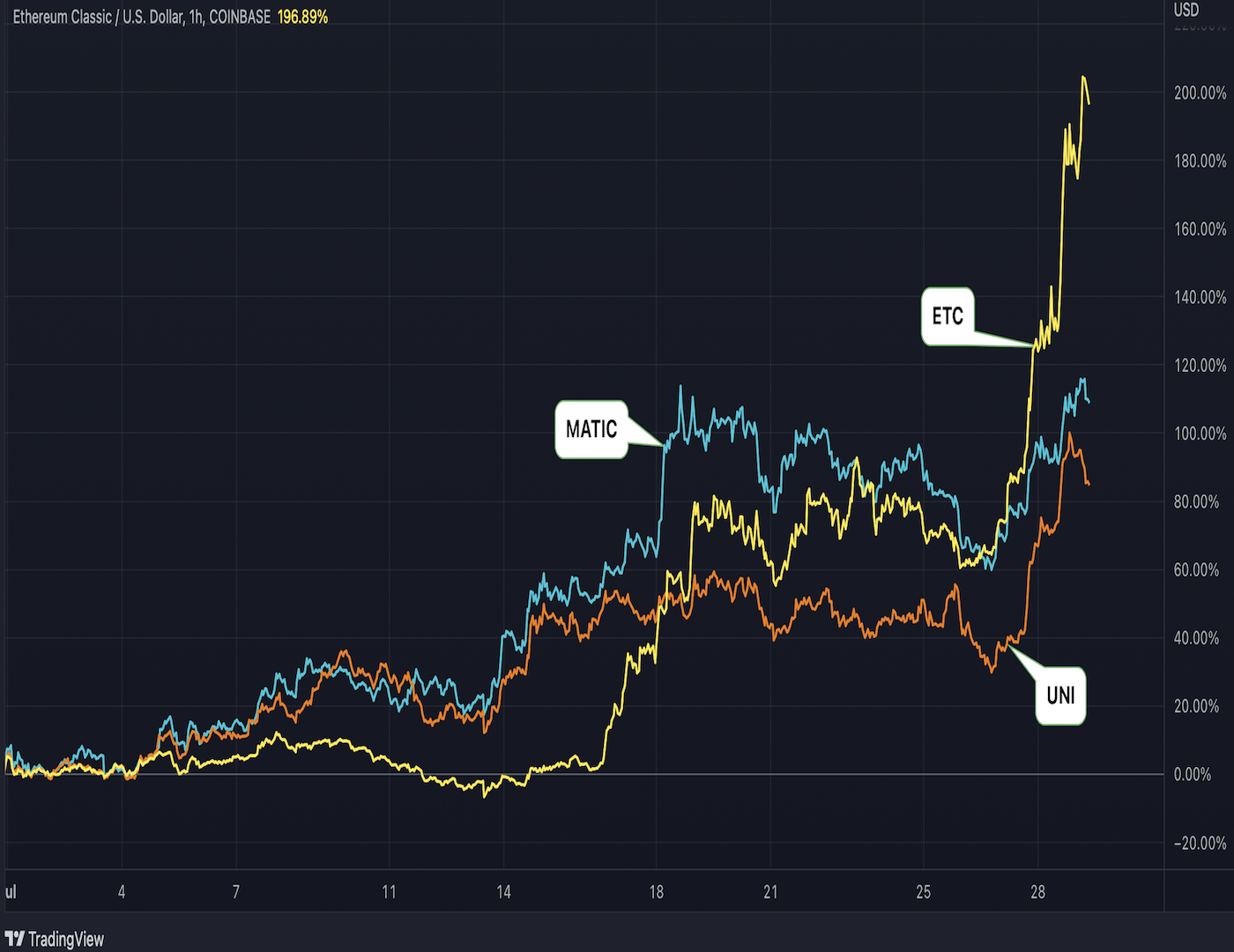
Chart showing performance of ETC, UNI and MATIC in July
ETC's July gain is consistent with a history of rallying around the time of major Ethereum upgrades.
"ETC's April 2021 rally coincided with Ethereum's Berlin upgrade. Similarly, ETC seems to be rallying on the back of expectations related to the merge," Toronto-based crypto platform FRNT Financial said in an email, adding that investors may see ETC as a hedge against potential difficulties in the change.
ETC was priced at a 3 1/2-month high of $45 on major exchanges early today.
Polygon makes the right noise
MATIC seems to be reaping rewards for Polygon's expansion plans and partnership announcements.
The scaling solution earmarked $20 million to help projects migrating to its platform from the Terra blockchain. Disney said earlier this month that Polygon was one of the six companies selected for a business-development accelerator program. Furthermore, Polygon said it was building a zkEVM, or zero-knowledge system, in a bid to slash transaction fees by 90% in comparison with Ethereum.
According to FRNT Financial, the zkEVM plan has added to enthusiasm in the ecosystem.
Polygon facilitates faster and cheaper transactions by running sidechains or tangential networks alongside the main Ethereum blockchain. Scaling refers to increasing the system's throughput, as measured by transactions per second.
MATIC neared $1 early Friday, the highest since May 9.
Uniswap's bullish fee switch
While UNI is not the only decentralized finance (DeFi)-associated token to rally, its outperformance may result from the Uniswap community's decision to approve a "fee switch" proposal that directs a portion of trading fees to the UNI holders.
Once the proposal is implemented, about 10% of trading fees could go to UNI holders, according to Ilan Solot, a partner at crypto hedge fund TagusCapital. Currently, they do not get any share in the protocol's revenue, contrary to SUSHI token and CRV token holders. The entire amount collected from the exchange's 0.3% trading cost goes to liquidity providers.
"UNI holders voted overwhelmingly in favor of the proposal; now it's a question of implementation. It looks like it would be 10% of trading fees, estimated at $20-40K per day for the Treasury. Obviously, this had a positive impact on the UNI token," Solot wrote in Thursday's daily market update.
UNI was changing hands at $8.9 at the time of writing, having touched a 3 1/2-month high of $9.84 on Thursday.
Author

CoinDesk Analysis Team
CoinDesk
CoinDesk is the media platform for the next generation of investors exploring how cryptocurrencies and digital assets are contributing to the evolution of the global financial system.