Does Bitcoin’s beta spike signal danger ahead for crypto investors?

This article is written by Jean-Martial, BeInCrypto French Team Leader
In brief:
- Bitcoin’s increasing correlation and high beta with stock markets mean it now amplifies market volatility.
- Data shows Bitcoin's beta reacts more violently than stocks to market movements.
- Analysts warn that Bitcoin now behaves like a high-risk tech stock.
For years, Bitcoin evangelists claimed the cryptocurrency would protect investors from turmoil in the traditional markets. But a growing body of evidence now suggests the opposite: Bitcoin is becoming more tightly bound to the very stock markets it was supposed to hedge against — and the consequences could be brutal. The key culprit? Beta.
A worrying shift
Data from CME Group show Bitcoin’s correlation with the S&P 500 and Nasdaq‑100 has surged from almost nothing ten years ago to around 0.48 today.
Even more alarming, Bitcoin’s beta — the measure of how violently an asset reacts to market movements — has been hovering at around 1.4 against the Nasdaq and has breached 1 against the S&P 500 several times this year.
Put bluntly, Bitcoin is no longer a hedge — it’s an amplifier. When markets stumble, Bitcoin doesn’t just follow; it plunges.
The numbers don’t lie
An analysis of three‑month rolling beta data paints a disturbing picture: Bitcoin’s beta remains above 1 and shows no sign of coming down.
This means that a modest pullback in equities could turn into a full‑blown crypto bloodbath.
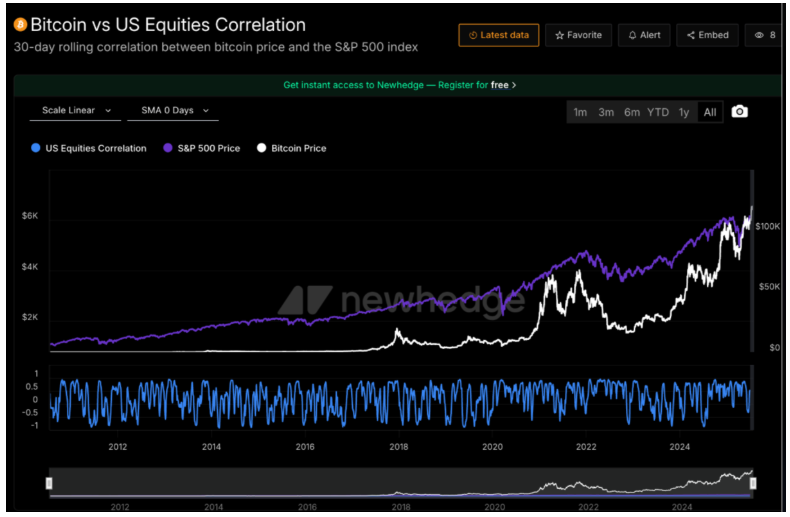
Bitcoin vs US Equities Correlation.
What is beta – And why should you be afraid of it?
Beta measures how much an asset moves relative to the market.
-
Beta of 1: moves in lockstep with the market.
-
Beta above 1: magnifies moves — gains and losses alike.
-
Beta below 1: dampens volatility.
Negative beta: moves opposite to the market.
Bitcoin’s beta is firmly above 1 — which means when markets fall, the crypto damage could be catastrophic.
Analysts are worried
Even seasoned market observers are unsettled by the shift.
Citigroup analysts say “equities now explain 15 per cent of BTC’s price volatility, with beta sitting between 1.4 and 1.5.”
Leah Wald, chief executive of SOL Strategies, is blunt:
“Bitcoin still behaves structurally like a high‑beta risk asset: it tends to outperform during bullish sentiment and underperform when markets de‑risk.”
A recent academic study goes even further, concluding that Bitcoin’s volatility is four times higher than the S&P 500’s at the same risk level — a terrifying prospect if the stock market enters a prolonged downturn.
What it means for you
Investors hoping Bitcoin would protect them in a crisis may instead be walking into a trap.
If the S&P 500 drops 5–10 per cent, Bitcoin could easily crater 15–20 per cent — or worse.
Portfolios heavy on crypto may be doubling down on market risk without even realising it.
With beta this high, Bitcoin looks less like a safe‑haven and more like a leveraged tech stock — without the balance sheet.
A history of pain
This isn’t just theory. Bitcoin has repeatedly demonstrated its tendency to collapse when markets sour:
In March 2020, Bitcoin lost half its value in days as panic swept through markets.
In 2022, it shadowed the Nasdaq into the ground when the Federal Reserve raised rates.
And earlier this year, fresh volatility saw Bitcoin exaggerate every single equity market drop.
The bottom line
Bitcoin’s beta spike is a red flag that can’t be ignored.
Once marketed as “digital gold,” Bitcoin is now a dangerously volatile equity proxy, perfectly poised to turn the next stock‑market wobble into a crypto crash.
Author

BeInCrypto
BeInCrypto
Since 2018, BeInCrypto has grown into a leading global crypto news platform. Through our award-winning journalism and close ties with industry leaders, we deliver trusted insights into Web3, AI, and digital assets.