|

Cosmos community passes proposal to slash ATOM inflation, seeks long-term profitability

  • The Cosmos Hub community has passed the ATOM Production Reduction proposal with 41.1% support. 
  • The maximum inflation of the token will be slashed in half, to 10%.
  • ATOM price is up nearly 6% on the day, yielding 40% monthly gains for holders. 

A Cosmos proposal to reduce ATOM’s inflation rate and improve its security was passed by the Cosmos Hub community. The proposal will reduce the annual interest rate for stakers, in exchange for long term profitability and price growth in ATOM.

Also read: Ethereum whale activity could pave way for ETH price to hit new yearly highs

Cosmos community agrees to slash ATOM inflation in half 

A proposal to reduce ATOM’s inflation rate from 14% to 10% and slash staking yield from 19% to 13.4%, received a go-ahead from the community of voters. The support rate for the proposal os 41.1% and opposition was 31.9%. The community members agreed to slashing inflation for the token to ensure better staking incentives and improve Cosmos network’s security. 

The proposal was inspired by research firm Blockworks’ report that ATOM is overpaying for security. Transitioning to a set supply schedule was suggested to improve security and nearly all validators were at break-even profitability, they agreed at a maximum of 10% inflation. 

Validators were given the option of increasing their commission rate for covering operational expenses. 
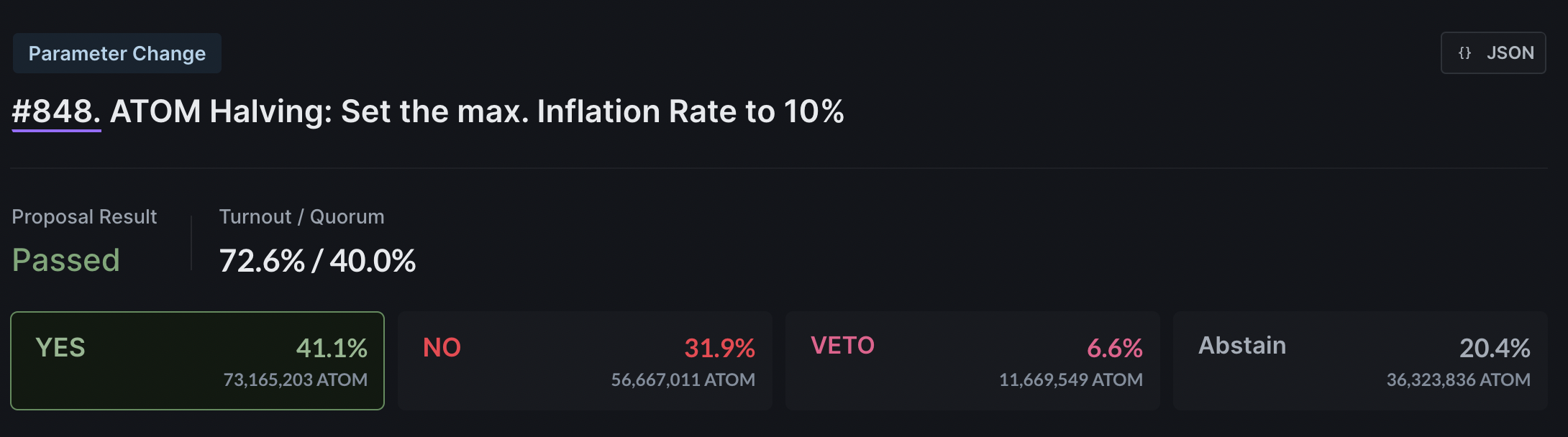
COSMOS proposal

Cosmos proposal to reduce ATOM inflation rate 

With approval on the ATOM halving proposal, the community can now expect higher profitability and likely appreciation of the token’s price in the long term. At the time of writing, ATOM price is $9.9220 on Binance. The token is up 6% on the day and 7.50% on the week. 

In the past month, ATOM holders observed double-digit gains, nearly 40%. 

Author

Ekta Mourya

Ekta Mourya

FXStreet

Ekta Mourya has extensive experience in fundamental and on-chain analysis, particularly focused on impact of macroeconomics and central bank policies on cryptocurrencies.


More from Ekta Mourya
Share:

Editor's Picks

XRP falls toward $1.00 amid muted ETF activity
Ripple (XRP) edges lower toward the short-term $1.05 psychological support level at the time of writing on Wednesday. This marks three consecutive days of losses, undermining investor interest and the broader optimism for a potential deal between the United States (US) and Iran to reopen the Strait of Hormuz.
Swiss-based Taurus gives banks access to Hedera via unified digital asset platform
Taurus, a Switzerland-based digital asset infrastructure provider, announced on Wednesday that it has extended its services, targeting banks and regulated financial institutions on the Hedera (HBAR) network. Meanwhile, HBAR is paring losses, trading above $0.0650 at the time of writing. The token shows signs of stability amid a broader bearish trend.
Crypto markets trade muted, lag risk rally
Whilst hopes for a US-Iran agreement to revive the Strait of Hormuz and renewed AI-trade optimism lifted US equities to all-time highs, major cryptocurrencies remained largely sidelined on Wednesday. Bitcoin and Ether hovered near $64,000 and $1,800, respectively, extending their recent period of consolidation rather than participating in a broader risk rally they would normally follow.
Crypto Today: Bitcoin, Ethereum advance while XRP lags amid US-Iran deal optimism
Bitcoin (BTC) hovers near $64,000 at the time of writing on Wednesday, buoyed by a marginal improvement in crypto sentiment amid growing optimism that the United States (US) and Iran could potentially reach an agreement to open the Strait of Hormuz this week. Ethereum (ETH) mirrors Bitcoin’s neutral-to-bullish outlook, trading toward $1,900.
Bitcoin: Bulls hold the line
Bitcoin (BTC) edges slightly lower, trading at $64,300 at the time of writing on Friday but holding firmly above a key support zone. US-listed spot Bitcoin Exchange Traded Funds (ETFs) support BTC as they continued to attract institutional flows through Thursday, pointing to the fourth consecutive week of net inflows.