BTC/USD: Will 2020 Bring Clear Vision to the Oldest Cryptocurrency?

To simplify, each of the last three years has had a distinct “theme” for the overall cryptoasset markets:
- 2017 was the peak mania/bubble period, especially in the 2nd half of the year.
- 2018 was the year the bubble popped, leading to deflating expectations and prices.
- 2019 was the year of recovery and “green shoots” for future use cases.
As we flip our calendars to 2020, the top question for traders and investors is whether the exciting technological groundwork laid in 2019 will pay dividends for investors, users, and developers.
State of the Crypto Market
Far from the heady, halcyon days of late 2017, the cryptoasset markets are far tamer and more grounded as of writing in December 2019. After peaking above $800B at the start of 2018, the overall market capitalization of all the tokens in circulation has fallen to roughly $200B.
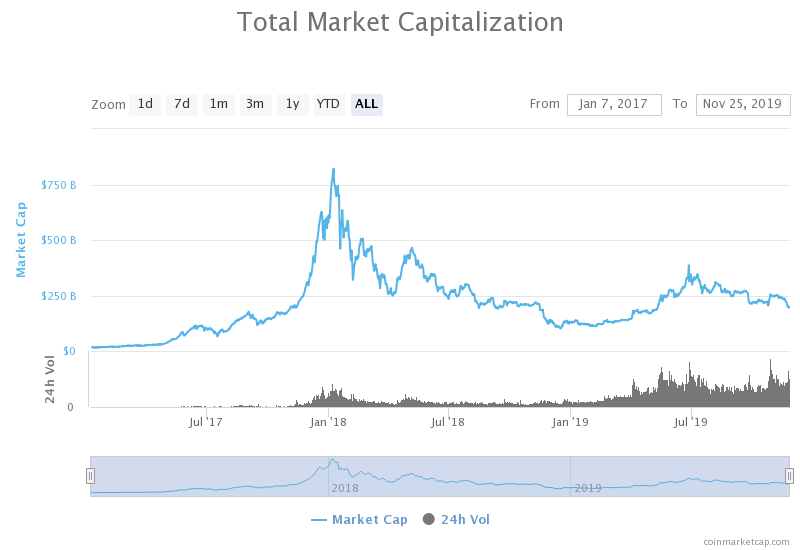
Source: CoinMarketCap
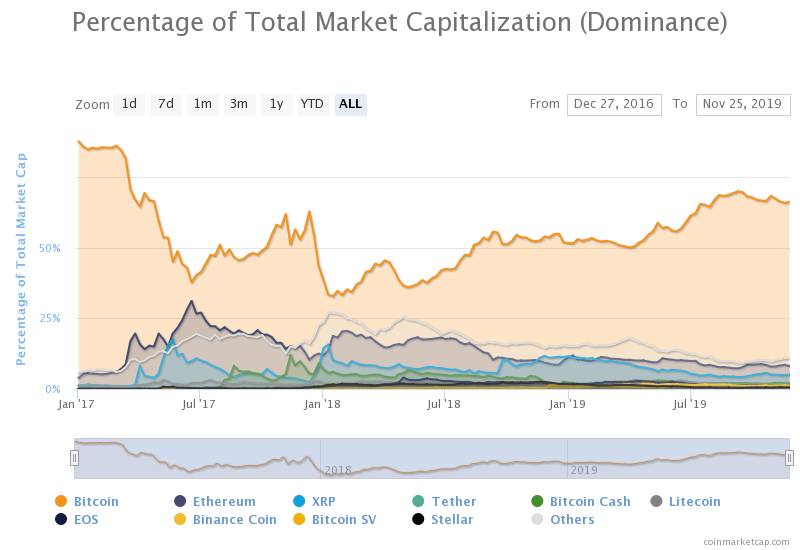
The majority of the “value” lost has come from so-called “altcoins” which include many of the overhyped ICO projects built in Ethereum’s smart contract ecosystem. While Bitcoin has been more than cut in half from its December 2017 peak, it’s fallen less than many competitors, leading to an increase in Bitcoin “dominance” or the portion of overall market value attributable to the original cryptocurrency.
Source: CoinMarketCap
As the chart above shows, Bitcoin now represents about two-thirds of the overall cryptoasset market capitalization, with rivals such as Ethereum, Ripple (XRP), and Bitcoin Cash losing market share. Generally speaking, the above chart can serve as an indicator of so-called “alt seasons”: when Bitcoin’s dominance is trending higher, crypto traders prefer to hold Bitcoin itself, whereas a turn lower in Bitcoin could signal that altcoins are poised to outperform.
Bitcoin’s relative outperformance from 2018-19 is poised to extend further in 2020
Bitcoin is scheduled for a “halving” of its block reward in mid-May, where the reward for successfully “mining” a Bitcoin block (which takes place approximately every 10 minutes) will fall from 12.5 BTC to 6.25 BTC. This will bring Bitcoin’s overall supply inflation rate down from about 3.7% to 1.8%. Historically, Bitcoin has shown a tendency to rally in the wake of previous “halvings,” though it’s difficult to draw any strong conclusions off a sample size of the two occasions.
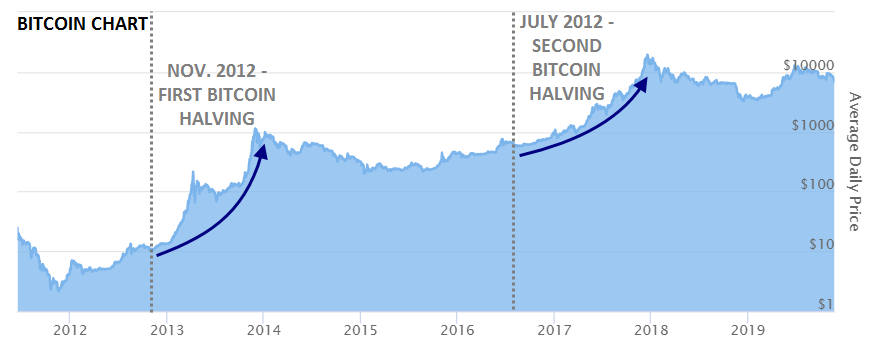
Source: 99Bitcoins, GAIN Capital. Note that this chart uses a logarithmic scale.
Developers continue to work on improvements to Bitcoin’s protocol, with projects like the Lightning Network, for lower-value off-chain transactions, and Taproot, a privacy upgrade which is gaining momentum.
Regulatory policies will play a major role in Bitcoin’s performance in 2020
More than incremental technological improvements though, regulatory policies will play a major role in Bitcoin’s performance in 2020. For Bitcoin bulls, the proverbial “White Whale” is the approval of a Bitcoin ETF (exchange-traded fund) in the US that would make it easier for everyday retail traders to invest in the cryptocurrency. Despite numerous proposals over the last year, US regulators have failed to greenlight a fund yet. If such a fund is approved in 2020, it would be perhaps the biggest possible bullish catalyst for Bitcoin, opening the floodgates for retail and institutional capital to flow into Bitcoin.
Technically speaking, Bitcoin is breaking out of its near-term downtrend off the June peak near $14k. The cryptocurrency recently broke above its 7-week (~50-day) moving average and bulls will now turn their eyes toward the 29-week (~200-day) moving average. Beyond that, bulls may turn their eyes toward the psychologically-significant $10k level, followed by the Q3 highs starting around $12k. On a longer-term basis, the key level of horizontal support to watch will be the Q4 lows near $6400.
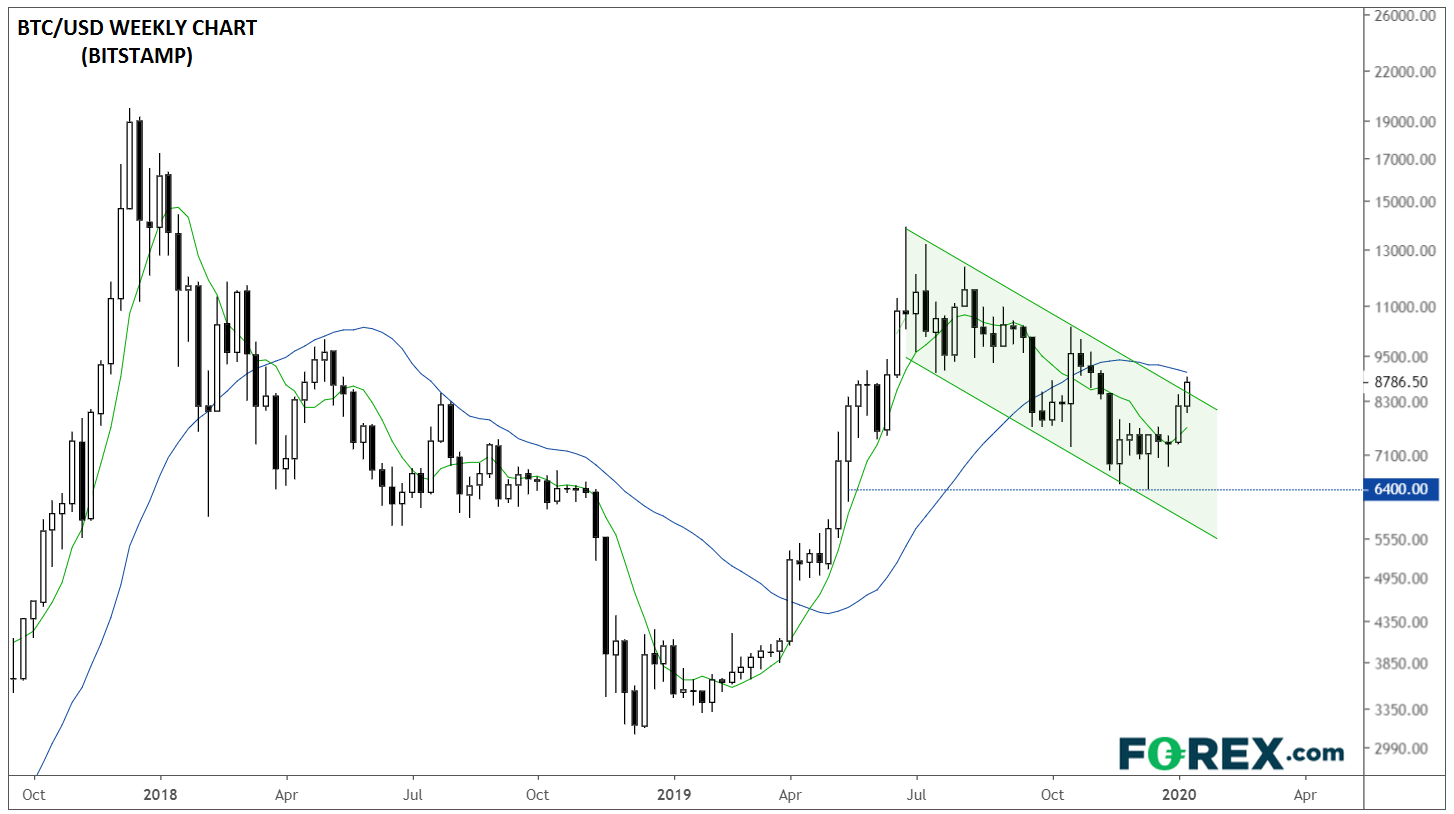
Source: TradingView, GAIN Capital. Note that this chart uses a logarithmic scale.
Author

Matt Weller, CFA, CMT
Faraday Research
Matthew is a former Senior Market Analyst at Forex.com whose research is regularly quoted in The Wall Street Journal, Bloomberg and Reuters. Based in the US, Matthew provides live trading recommendations during US market hours, c