|

Bitcoin's dominance rate runs into familiar resistance, hints at 'altcoin season' ahead

The increase in Bitcoin's (BTC) dominance rate, or the largest cryptocurrency's share of the market, has halted, hinting at the potential outperformance of alternative tokens (altcoins) ahead.

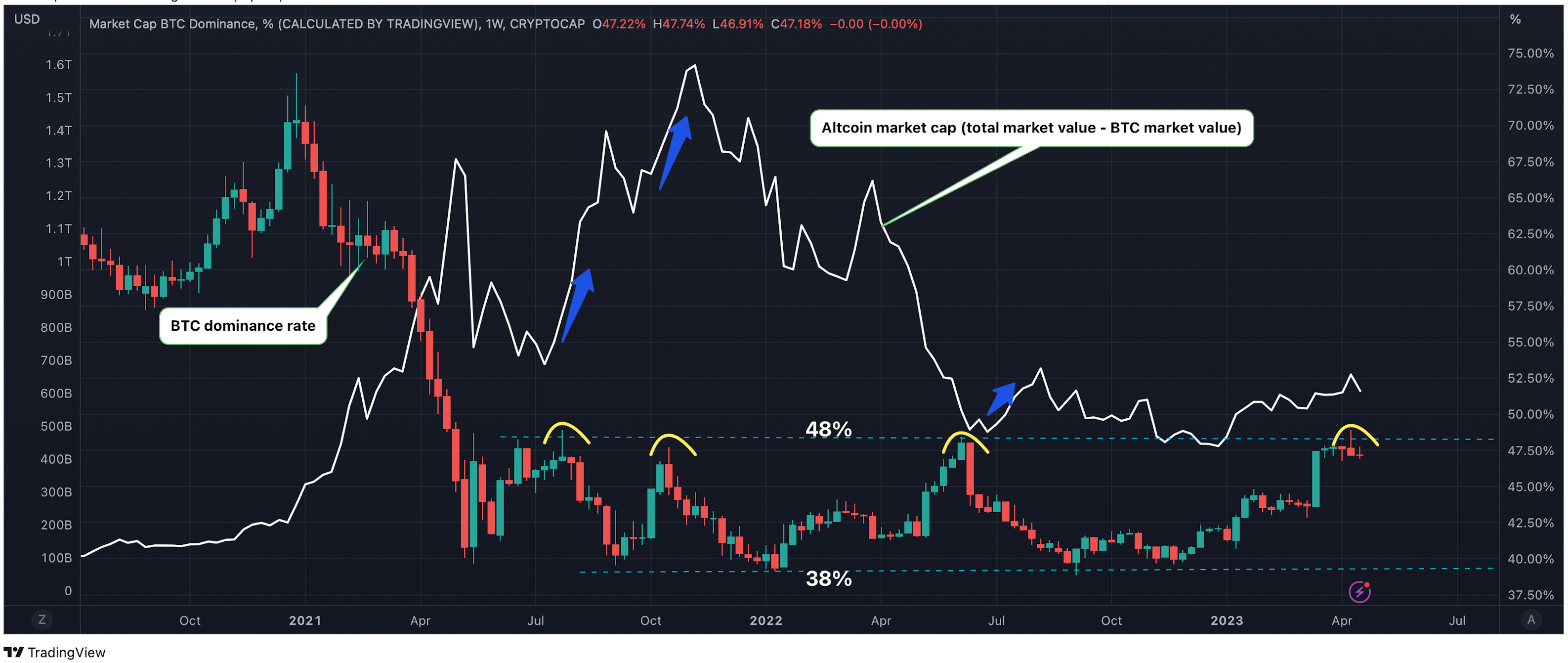
Data from TradingView show the dominance rate rose to 48% from 42% in the first quarter and has struggled to surpass that level so far this month.

The metric has oscillated between 38% and 48% for almost two years, with declines from 46%-48% coinciding with outsized gains in altcoins.

"Bitcoin’s dominance could peak out, this would signal that altcoins would outperform," Markus Thielen, head of research and strategy at crypto services provider Matrixport, said in a note to clients on Thursday.
Chart

BTC dominance rate's previous declines from 48% coincided with the altcoin market boom. (CoinDesk/TradingView) (CoinDesk/TradingView)

The chart shows that the total market cap of altcoins (white line, blue arrows) rose more than 60% to $1.39 trillion in two months after the BTC dominance rate turned lower from 48% in July 2021. Similar bearish turnarounds in the dominance rate in mid-October 2021 and June 2022 also pushed altcoin valuations higher.

History could repeat itself, according to Thielen.

"Bitcoin’s dominance appears to be peaking out at similar levels as in 2022 – accounting for 45/46% of the total crypto market capitalization," Thielen said. "For bitcoin to continue outperforming the rest of the ecosystem would imply that only bitcoin matters, which appears to be unlikely considering the intellectual and financial firepower that is being deployed on other chains."

"Bitcoin benefited from U.S. liquidity but going forward, this could change," he said.

Author

CoinDesk Analysis Team

CoinDesk is the media platform for the next generation of investors exploring how cryptocurrencies and digital assets are contributing to the evolution of the global financial system.

More from CoinDesk Analysis Team
Share:

Markets move fast. We move first.

Orange Juice Newsletter brings you expert driven insights - not headlines. Every day on your inbox.

By subscribing you agree to our Terms and conditions.

Editor's Picks

XRP steadies above $1.90 support as fund inflows and retail demand rise

Ripple (XRP) is stable above support at $1.90 at the time of writing on Monday, after several attempts to break above the $2.00 hurdle failed to materialize last week. Meanwhile, institutional interest in the cross-border remittance token has remained steady.

Cardano struggles to extend gains as retail interest wanes despite Midnight's NIGHT token launch

Cardano ticks higher after a bearish weekend, struggling to extend an upcycle within a descending wedge pattern. On-chain data shows an increase in trading volume and user activity after the Midnight side chain token launch.

Crypto Today: Bitcoin, Ethereum recover as XRP remains supported by ETF inflows

Bitcoin is trending up toward the pivotal $90,000 level at the time of writing on Monday, which marks four consecutive days of gains. Altcoins, including Ethereum and Ripple, are also rebounding above key short-term support levels.

Bitcoin nears $90,000 as recovery hopes clash with institutional outflows

Bitcoin is approaching the $90,000 resistance level at the time of writing on Monday, raising hopes of a short-term recovery. However, the bullish recovery is being challenged by weakening institutional demand, as evidenced by outflows from Spot ETFs.

Orange Juice Newsletter – Smart insights by real people. Every day.

A free newsletter highlighting key market trends to help traders stay a step ahead. Daily insights on the most relevant trading topics, compiled by our experts in an easy-to-read format so you never miss an important move.

Bitcoin: Fed delivers, yet fails to impress BTC traders

Bitcoin (BTC) continues de trade within the recent consolidation phase, hovering around $92,000 at the time of writing on Friday, as investors digest the Federal Reserve’s (Fed) cautious December rate cut and its implications for risk assets.