Bitcoin Weekly Forecast: Binance security breach and hawkish Fed push BTC lower
- Bitcoin fell over 3% this week, trading below $78,000 on Friday and heading for its fourth straight weekly loss.
- A hawkish Fed outlook, along with the Binance exchange security breach, fuels risk aversion and triggers massive long liquidations.
- US-listed spot ETFs are on track to record a two-week inflow streak, with $440.74 million in net inflows through Thursday.

Bitcoin (BTC) continues to weaken this week, down more than 3% and heading for its fourth straight weekly loss. The largest cryptocurrency by market capitalization is facing a bearish outlook, fueled by a hawkish Federal Reserve (Fed) outlook at the October meeting and a reported $6.3 billion hack at Binance, which is driving risk aversion and triggering heavy liquidations.
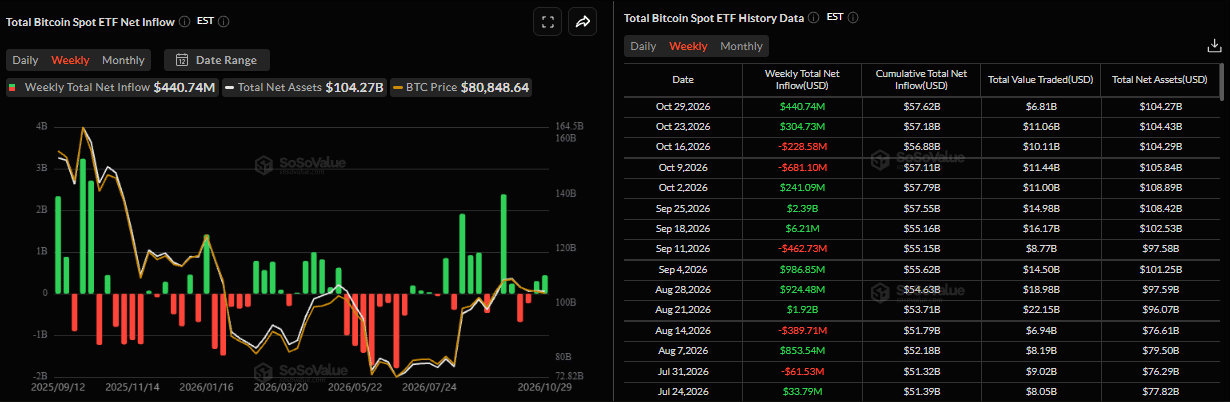
Despite this ongoing correction, spot Bitcoin Exchange Traded Funds (ETFs) remain on track to post a second consecutive week of net inflows, recording $440.74 million through Thursday. However, broader market weakness raises the risk of a deeper correction for the Crypto King.
BTC’s October returns point to a potentially weaker November
Bitcoin is set to close October on a negative note, undermining the market’s “Uptober” narrative and turning it into a “Rektober” month. As of Friday, the Crypto King trades below $78,000 after reaching a low of $76,500 during the early Asian trading session.
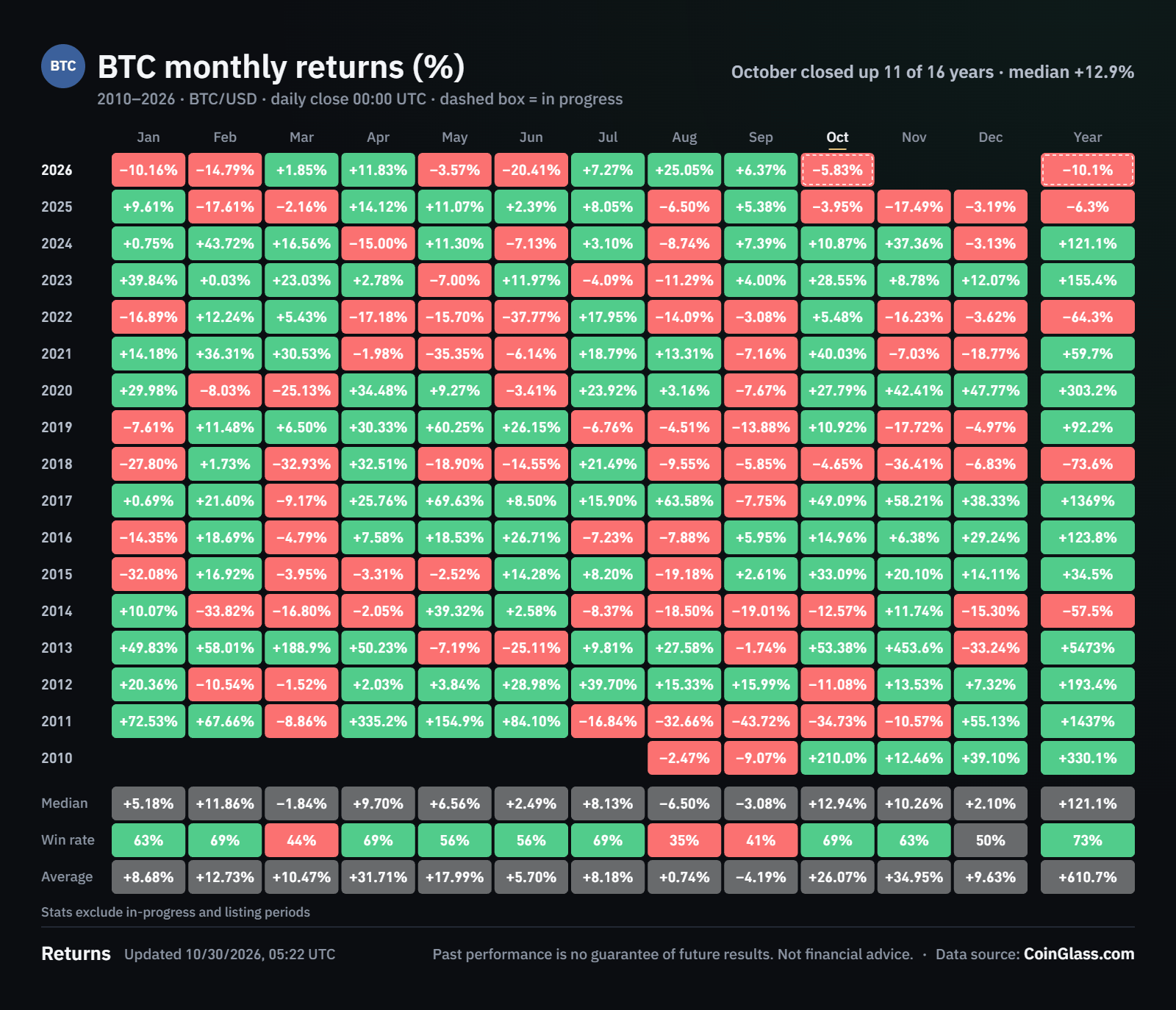
Coinglass BTC monthly returns chart below shows that the largest cryptocurrency has corrected 5.83% so far in October. Historical data shows that when BTC ends October in negative territory, November has also delivered double-digit losses in 3 out of 5 instances. This pattern highlights potential further downside for next month.
In an exclusive interview, Simon-Peter Massabni, Head of Business Development at XS.com, told FXStreet that escalating tensions in the Middle East could tighten global oil supplies, and energy market shocks could be followed by worsening fears of monetary tightening by the Fed. These developments could constrain liquidity in cryptocurrency markets and limit the scope for a sustained recovery.
Against this backdrop, Massabni expects Bitcoin to remain range-bound between $70,000 and $80,000 amid geopolitical uncertainty and fragile investor confidence heading into November.
He added that there are currently no clear signs of a sustainable resumption of the broader uptrend. Any recovery attempts could therefore remain short-lived, with investors likely to take profits quickly amid limited confidence in a broader market rebound.
Binance security breach triggers massive liquidations
The largest centralized cryptocurrency exchange, Binance, suffered a major security breach late Thursday.
“The estimated total impact sits at around $6.3 billion. We have worked with blockchain partners to freeze affected assets, with $3 billion frozen on-chain so far. Binance will cover all losses from the Secure Asset Fund for Users (SAFU) fund and the company’s funds. User funds are safe,” a Binance X post reported.
The company’s initial investigation suggests the security incident may involve a compromised DevOps engineer’s laptop, which allowed an attacker to access a service container and submit unauthorized withdrawal transactions.
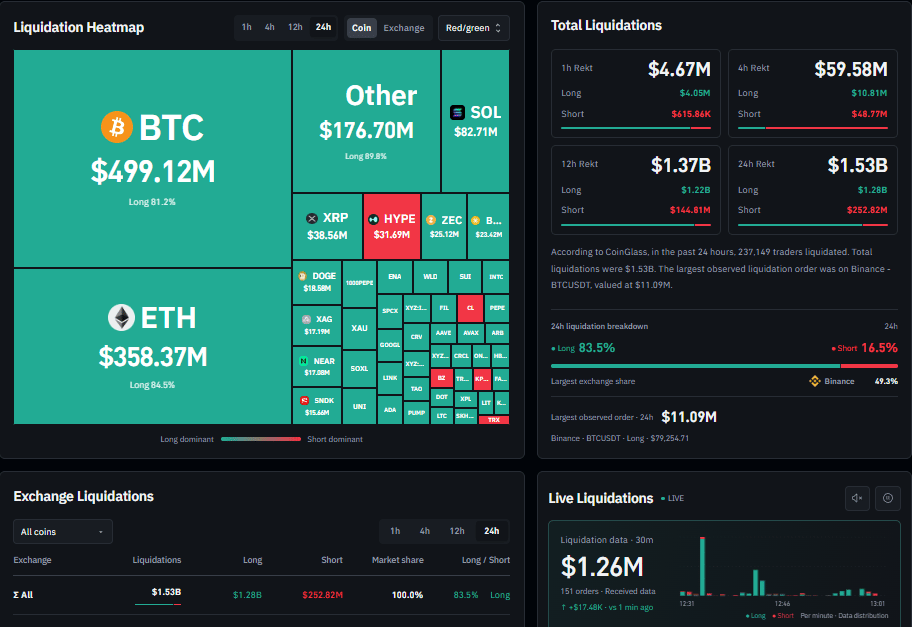
This incident triggered a massive crypto market liquidation. CoinGlass chart below shows that 237,149 traders were liquidated over the past 24 hours, with total liquidations reaching $1.53 billion.
The largest liquidation order was recorded on Binance’s BTCUSDT, worth $11.09 million. These massive liquidations highlight heightened market stress, with forced position closures adding to BTC’s downside pressure this week.
Fed's hawkish outlook caps BTC
On the macroeconomic side, this week’s economic data releases weigh on risky assets such as Bitcoin. The Fed held its interest rates steady at 3.75%-4.00% on Wednesday after its two-day October policy meeting. The decision wasn’t unanimous. Among the two officials who wanted a 25-basis-point (bps) hike were Lisa Cook and Beth Hammack, while Chair Kevin Warsh said the central bank would use the coming flow of information to decide whether further action is needed.
Warsh remarked during his press conference that officials have “made clear our readiness to act as circumstances require, and we have shown our willingness to act.”
“It’s our responsibility to get inflation down (...) That’s the reason the FOMC’s discussion over the last couple of days focused mainly on the price stability side of our remit,” he added.
Meanwhile, market participants had already priced in steady rates, but the hawkish undertone and inflation concerns in forward guidance add to a cautious market backdrop and weigh on risky assets such as cryptos.
Adding to this, US macro data on Thursday pointed to resilient economic growth and persistent price pressures, solidifying bets of an imminent Fed rate hike in December.
The preliminary estimate of third-quarter Gross Domestic Product (GDP) showed US economic growth accelerating to an annualized rate of 3.4%, up from 2.2% in the previous quarter and beating the consensus forecast of 3.2%. Moreover, the US Commerce Department reported that the Personal Consumption Expenditures (PCE) Price Index rose 0.5% in September and was up 3.6% from a year ago. Moreover, the core gauge, which excludes volatile food and energy prices, rose 0.3% and 3.1% on a monthly basis and yearly basis, respectively.
This adds to inflationary concerns stemming from elevated US bond yields and underpins prospects for further Fed tightening, which continues to cap risky assets such as BTC.
Hopes of peace in the Middle East fail to support BTC
Renewed hopes for a diplomatic solution to the Middle East conflict have weighed on the safe-haven US Dollar (USD), but the softer Greenback has done little to ease the bearish pressure on Bitcoin.
In the latest developments, US Vice President JD Vance sent a direct letter to Iran’s Supreme National Security Council secretary, Mohsen Rezaei, in an effort to restart peace negotiations, The Guardian reported on Thursday.
Qatar also presented a new draft proposal to Iran to end the war involving the US and Israel. However, investors remain wary amid escalating hostilities between the Iran-backed Houthi group in Yemen and Saudi Arabia. Furthermore, threats from the US and Israel to restart attacks after the US midterm elections also kept geopolitical risks elevated. Meanwhile, Iran’s navy claimed on Thursday that four oil tankers had struck sea mines in the Strait of Hormuz, adding to concerns over supply disruptions and supporting oil prices.
These developments have kept uncertainty elevated, and concerns over higher oil prices continue to weigh on investor sentiment, limiting any relief for the Crypto King.
Some signs of optimism as ETFs attract fresh inflows
Institutional demand for Bitcoin shows mild signs of a comeback. SoSoValue data show spot ETFs are on track to record a two-week inflow streak, with $440.74 million in net outflows through Thursday after $304.73 million in positive flows last week. If Friday’s inflows continue and intensify, they could cushion falling BTC prices and support a recovery.
On the corporate side, Lookonchain posted on its X account on Monday that Strategy didn’t buy any BTC last week, while Strive bought 6,182 BTC. Strategy’s pause marks a shift in institutional accumulation, with the company stepping back after several weeks of buying while Strive ramps up its purchases. Strive’s continued accumulation could help cushion selling pressure and support BTC.
Bitcoin technical outlook: Fading momentum
The Crypto King is down more than 3% so far this week, trading below $78,000 on Friday and heading into a fourth straight week of correction since early October.
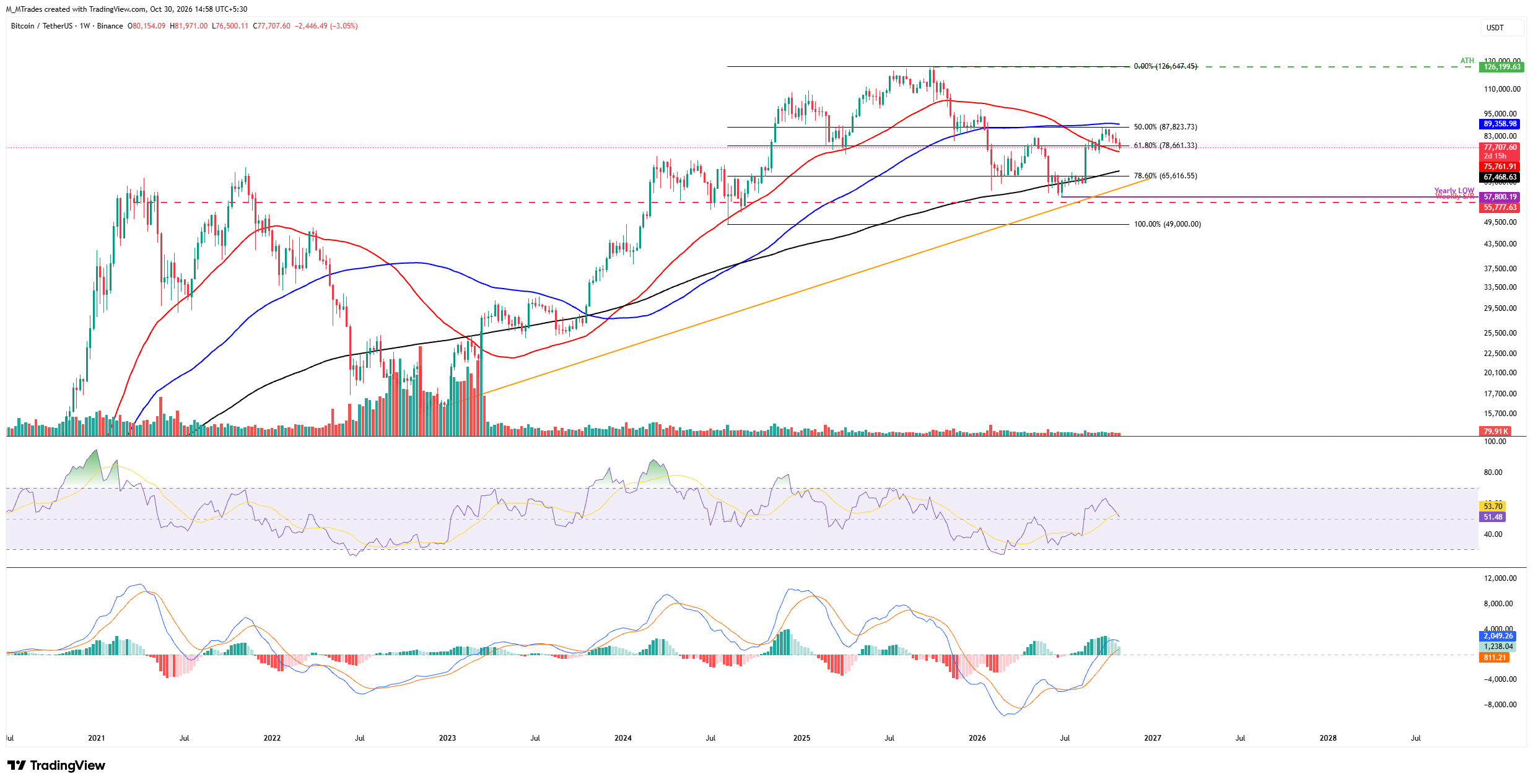
If BTC continues its correction, it could extend losses toward the 50-week Simple Moving Average (SMA) at $75,761. A weekly close below this level could trigger further losses toward the 200-week SMA at $67,468.
The Relative Strength Index (RSI) on the weekly chart stands at 51, close to the neutral 50 level, indicating bullish momentum is cooling. Meanwhile, the Moving Average Convergence Divergence (MACD) histogram remains positive, although its bars are weakening. This suggests broader upside momentum remains intact but is losing strength amid nearby resistance and the ongoing pullback.
On the other hand, if BTC recovers, it could extend the advance toward the 61.8% Fibonacci retracement level of $78,661 (drawn from the August 2024 low of $49,000 to the October 2025 record high of $126,199). If this level holds, BTC could head toward the 50% retracement level of $87,823, then the 100-week SMA at $89,358.
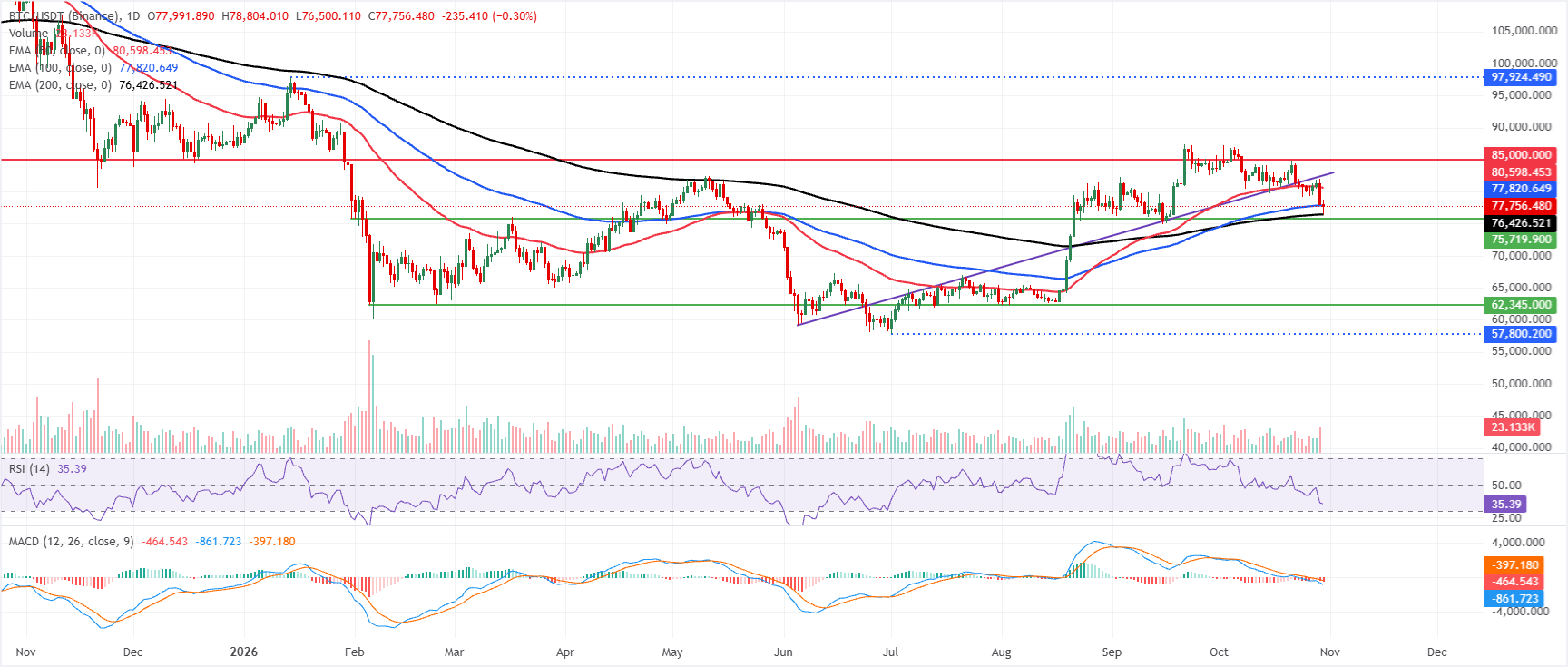
On the daily chart, BTC is maintaining a bearish near-term bias as it holds above the 200-day Exponential Moving Average (EMA) at $76,426 but remains capped by the 100-day EMA at $77,820.
The longer-term trend structure still offers some underlying support via the 200-day EMA, yet BTC trades well beneath the 50-day EMA at $80,598, reinforcing a corrective tone.
The daily RSI at 35 hovers just above oversold territory, while the MACD stays negative and depressed; both momentum indicators hint at persistent downside pressure despite the proximity of long-term support.
On the topside, immediate resistance appears at the 100-day EMA near $77,820, followed by the 50-day EMA around $80,598, with a more significant horizontal barrier at $85,000 likely to cap any stronger rebound if reached.
On the downside, the 200-day EMA at $76,426 acts as the key support level; a decisive break below this floor would open the door to a deeper slide, while holding above it would keep the current pullback framed as a downside correction within the broader bullish structure.
(The technical analysis of this story was written with the help of an AI tool. Know more.)
Bitcoin, altcoins, stablecoins FAQs
Bitcoin is the largest cryptocurrency by market capitalization, a virtual currency designed to serve as money. This form of payment cannot be controlled by any one person, group, or entity, which eliminates the need for third-party participation during financial transactions.
Altcoins are any cryptocurrency apart from Bitcoin, but some also regard Ethereum as a non-altcoin because it is from these two cryptocurrencies that forking happens. If this is true, then Litecoin is the first altcoin, forked from the Bitcoin protocol and, therefore, an “improved” version of it.
Stablecoins are cryptocurrencies designed to have a stable price, with their value backed by a reserve of the asset it represents. To achieve this, the value of any one stablecoin is pegged to a commodity or financial instrument, such as the US Dollar (USD), with its supply regulated by an algorithm or demand. The main goal of stablecoins is to provide an on/off-ramp for investors willing to trade and invest in cryptocurrencies. Stablecoins also allow investors to store value since cryptocurrencies, in general, are subject to volatility.
Bitcoin dominance is the ratio of Bitcoin's market capitalization to the total market capitalization of all cryptocurrencies combined. It provides a clear picture of Bitcoin’s interest among investors. A high BTC dominance typically happens before and during a bull run, in which investors resort to investing in relatively stable and high market capitalization cryptocurrency like Bitcoin. A drop in BTC dominance usually means that investors are moving their capital and/or profits to altcoins in a quest for higher returns, which usually triggers an explosion of altcoin rallies.
Author

Manish Chhetri
FXStreet
Manish Chhetri is a crypto specialist with over four years of experience in the cryptocurrency industry.