Bitcoin nears 60K as tech selloff and tariff risks weigh – Is more downside ahead?
- BTC breaks out of range, sliding towards 60k.
- Trump’s tariff plans hurt risk sentiment.
- The selloff in Software stocks shows no signs of easing.
- More losses could come below 60k.
- BTC technical analysis.

Bitcoin is extending losses, falling to 63k, a two-week low at the time of writing. The largest cryptocurrency trades 4.7% lower over the past 24 hours, around 7% lower over the week, and is down more than 19% in February. This puts Bitcoin on track for its worst monthly performance since June 2022, a year marked by a series of high-profile industry collapses.
The latest leg lower comes amid a broader risk-off mood in financial markets after President Trump announced plans to raise global trade tariffs to 15%, unsettling investors and weighing on growth-sensitive assets. US equities closed roughly 1% lower, while safe-haven gold rose 2.5%. However, even as traditional markets attempt to stabilise — with US futures pointing higher and gold retracing some gains — crypto remains under pressure, highlighting Bitcoin’s heightened sensitivity to growth-sector positioning rather than broad risk sentiment alone.
BTC falls as software stocks continue to decline
In addition to tariff jitters, AI disruption concerns continue to drag on BTC. Bitcoin has behaved less like a defensive hedge and more like a high-beta extension of the technology complex, trading closely alongside the software sector. With investors rotating away from high-duration growth assets amid fears that AI could disrupt traditional business models, both software stocks and crypto have faced sustained selling pressure.
The S&P 500 software sector fell 4.75% yesterday, taking losses over the past month to 22%. Bitcoin’s continued alignment with the software sector suggests that, as long as equity investors remain cautious toward growth stocks, BTC may struggle to stabilise despite pockets of strength elsewhere in markets.
A shift in the broader macro narrative would likely be required for BTC to decouple from software equities and stage a more sustainable recovery. Capital would need to rotate into Bitcoin as a hedge against AI-driven labour-market disruption, currency debasement, or aggressive fiscal stimulus. Such a shift could reduce BTC’s sensitivity to swings in technology sectors and reposition it as a macro hedge rather than a risk proxy.
How low will BTC go?
With few signs of the sell-off easing, the key question remains how much further Bitcoin could fall. Historically, BTC bear phases have tended to exhaust when longer-term moving averages converge into bearish crosses — signals that marked turning points in 2018 and 2022. Currently, the 50-week SMA remains well above the 100-week SMA, suggesting downside risks may not yet be fully priced.
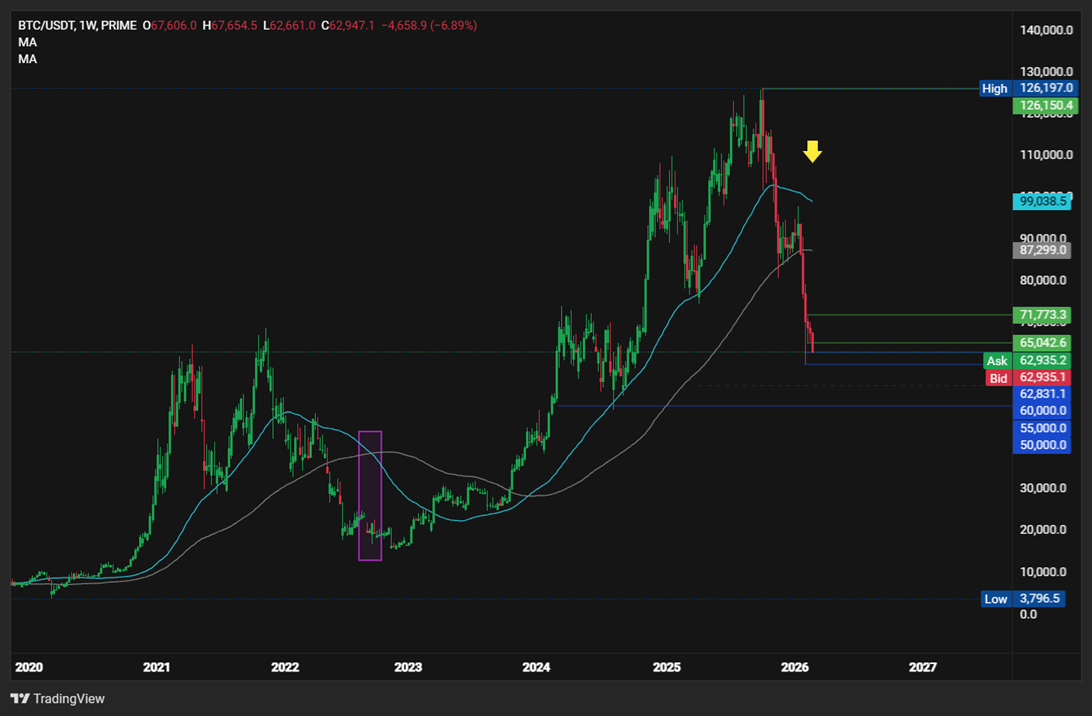
BTC - Technical analysis (daily)
BTC/USDT trades below its long-term falling trendline and beneath both the 200- and 50 SMAs, reinforcing a bearish technical structure. The price failed to reclaim the 20 SMA and broke below its recent consolidation range, pushing under 65k and bringing 60k — the 2026 low — into focus. The RSI is approaching oversold territory.
A sustained break below 60k could open the door to 55k and potentially 50k. On the upside, immediate resistance sits near 65k. A recovery above 71k would create a higher high and shift near-term momentum, bringing 75k into focus ahead of 80k, which aligns with horizontal resistance and the 50 SMA.
-1771939285191-1771939285191.png)
Start trading with PrimeXBT
Author

PrimeXBT Research Team
PrimeXBT
PrimeXBT is a leading Crypto and CFD broker that offers an all-in-one trading platform to buy, sell and store Cryptocurrencies and trade over 100 popular markets, including Crypto Futures, Copy Trading and CFDs on Crypto, Forex, I