Bitcoin falls below $77K as surging global bond yields trigger risk-off
- BTC falls 1.5% to below 77k.
- Hotter US inflation data & rising oil prices lift treasury yields.
- Japanese bond yields rise, raising concerns over the unwinding of the carry trade.
- BTC technical analysis.

Bitcoin is extending losses at the start of the week, falling below 77k as rising US and Japanese bond yields spark a broader risk-off move across global financial markets.
The largest cryptocurrency is down around 1.5% over the past 24 hours and nearly 5% over the past week. Major altcoins are also under pressure, with Ethereum falling 3% on the day and roughly 10% across the past seven sessions.
Bond market repricing hits risk assets
Pressure on crypto is being driven by a sharp repricing across global bond markets.
The US 10-year Treasury yield has climbed to 4.599%, its highest level since mid-2025. Meanwhile, the US 30-year Treasury yield closed above 5.1% on Friday — levels last seen before the 2008 financial crisis.
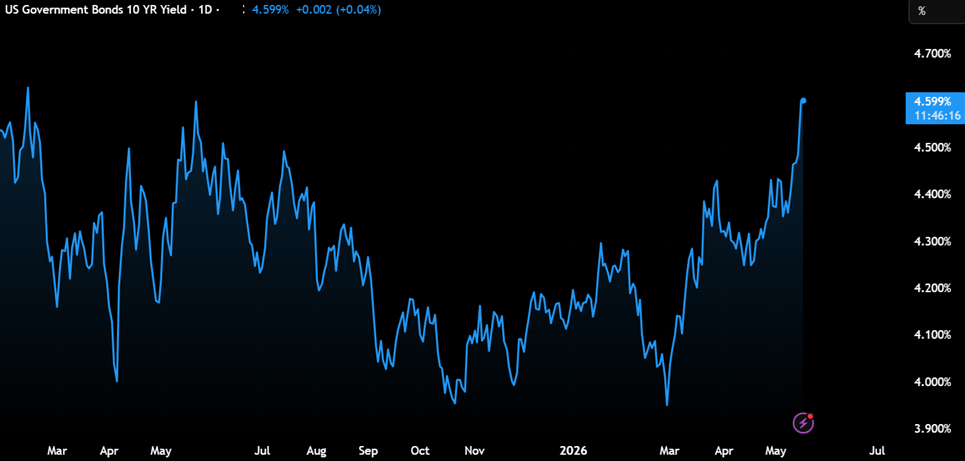
When government bonds offer yields above 5%, speculative assets such as Bitcoin and equities become relatively less attractive, particularly in an environment of rising macro uncertainty.
US equities also weakened, with stocks falling more than 1.2% on Friday while futures are in the red at the start of the new week.
Inflation and geopolitics keep yields elevated
The selloff in treasuries accelerated following stronger-than-expected US inflation data last week. Both core CPI and PPI inflation data surprised to the upside, reinforcing concerns over rising inflation pressures.
At the same time, geopolitical tensions continue to lift oil prices. Oil rallied 10% last week and is rising on Monday amid stalled US–Iran peace talks and with the Strait of Hormuz still closed.
This combination of sticky inflation and elevated oil prices is pushing markets towards a “higher-for-longer” interest rate outlook — a backdrop that typically weighs on risk assets, including crypto.
Why Japan matters for Bitcoin
While rising US yields are significant, developments in Japan may prove equally important.
Japan’s 30-year government bond yield has risen above 4% for the first time since it began trading in 1999. Japanese 20-year yields have also surged to levels last seen in 1996 as markets increasingly expect the Bank of Japan to raise interest rates again in June.
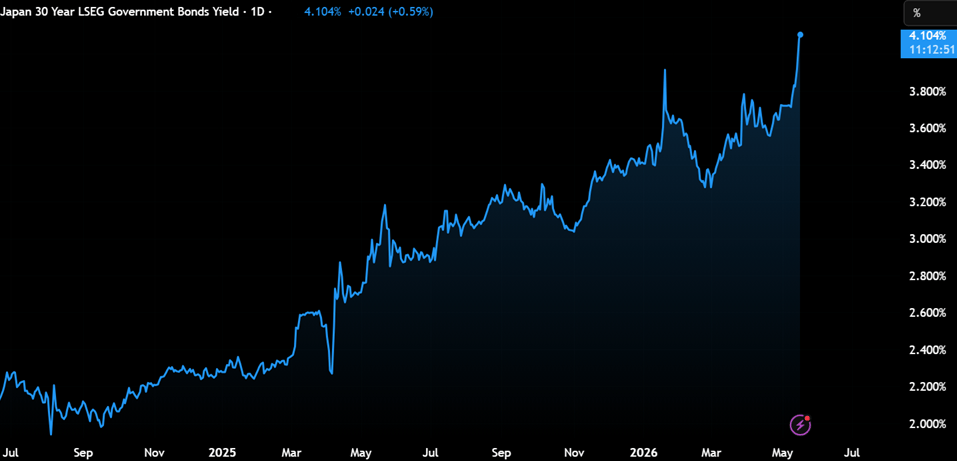
This matters because Japan’s ultra-low interest rate environment has historically supported massive overseas investment into global assets through the so-called carry trade. For decades, investors borrowed cheaply in yen and invested in higher-yielding foreign assets, including more than $1 trillion in US Treasuries as well as in global equities and risk assets.
If Japanese yields continue to rise, investors could increasingly repatriate capital into domestic bonds, triggering an unwinding of the carry trade and draining liquidity from global markets.
That process could become an additional headwind for Bitcoin at a time when crypto is already facing tighter US financial conditions.
Looking ahead
This week, Japanese inflation data and the minutes from the Federal Reserve’s April FOMC meeting will be closely watched for further clues on the outlook for interest rates in both Japan and the US.
At the same time, developments in the Middle East and moves in oil prices are likely to remain key drivers for Bitcoin, given their impact on inflation expectations, Treasury yields, and broader risk sentiment.
Bitcoin technical outlook
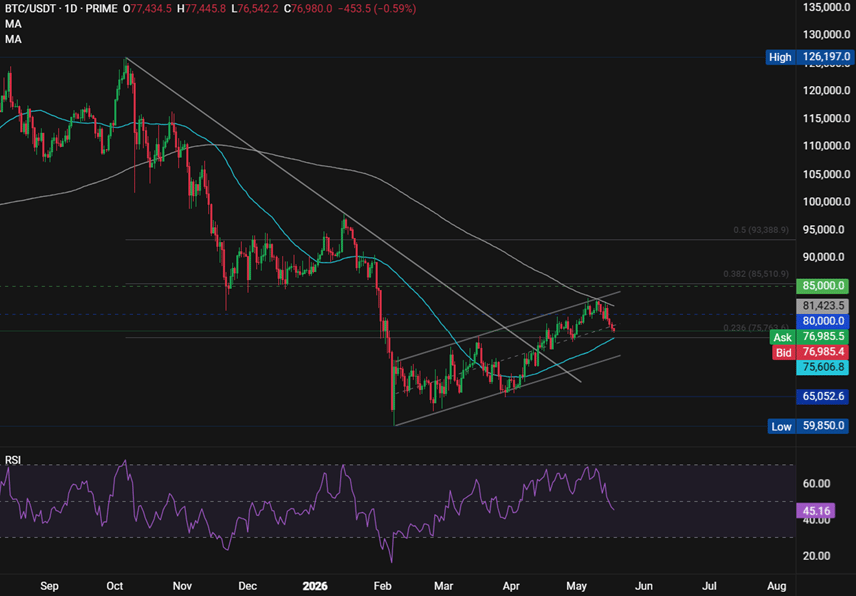
From a technical perspective, Bitcoin continues to trade within the broader rising channel that has been in place since February. However, near-term momentum has weakened following another rejection at the 200-day SMA near 82.5k and the upper boundary of the rising channel.
BTC has now fallen back below 80k and beneath the midpoint of the channel. Combined with an RSI below 50, this suggests sellers are regaining near-term control.
Immediate support sits near 75k, the 23.6% Fibonacci retracement of the 126k high and the $60K and the 50 SMA. A break below here opens the door to 72k, the lower band of the rising channel. Below that, focus shifts towards the 65k April low.
On the upside, bulls would need to reclaim 80k and, more importantly, move above the 200 SMA near 81.6k to gain traction. Above there, resistance is seen at 85k, the 38.2% Fibonacci retracement level.
Start trading with PrimeXBT
Author

PrimeXBT Research Team
PrimeXBT
PrimeXBT is a leading Crypto and CFD broker that offers an all-in-one trading platform to buy, sell and store Cryptocurrencies and trade over 100 popular markets, including Crypto Futures, Copy Trading and CFDs on Crypto, Forex, I