Bitcoin crashes to $110k on whale dump as stagflation fears mount
- Bitcoin slumps from $117K to $110K after a whale sale, triggering $550M in liquidations as weekend liquidity dried up.
- Fed stagflation warnings fuel risk-off sentiment, with BTC treated as a high-beta asset while Ethereum absorbs capital inflows.
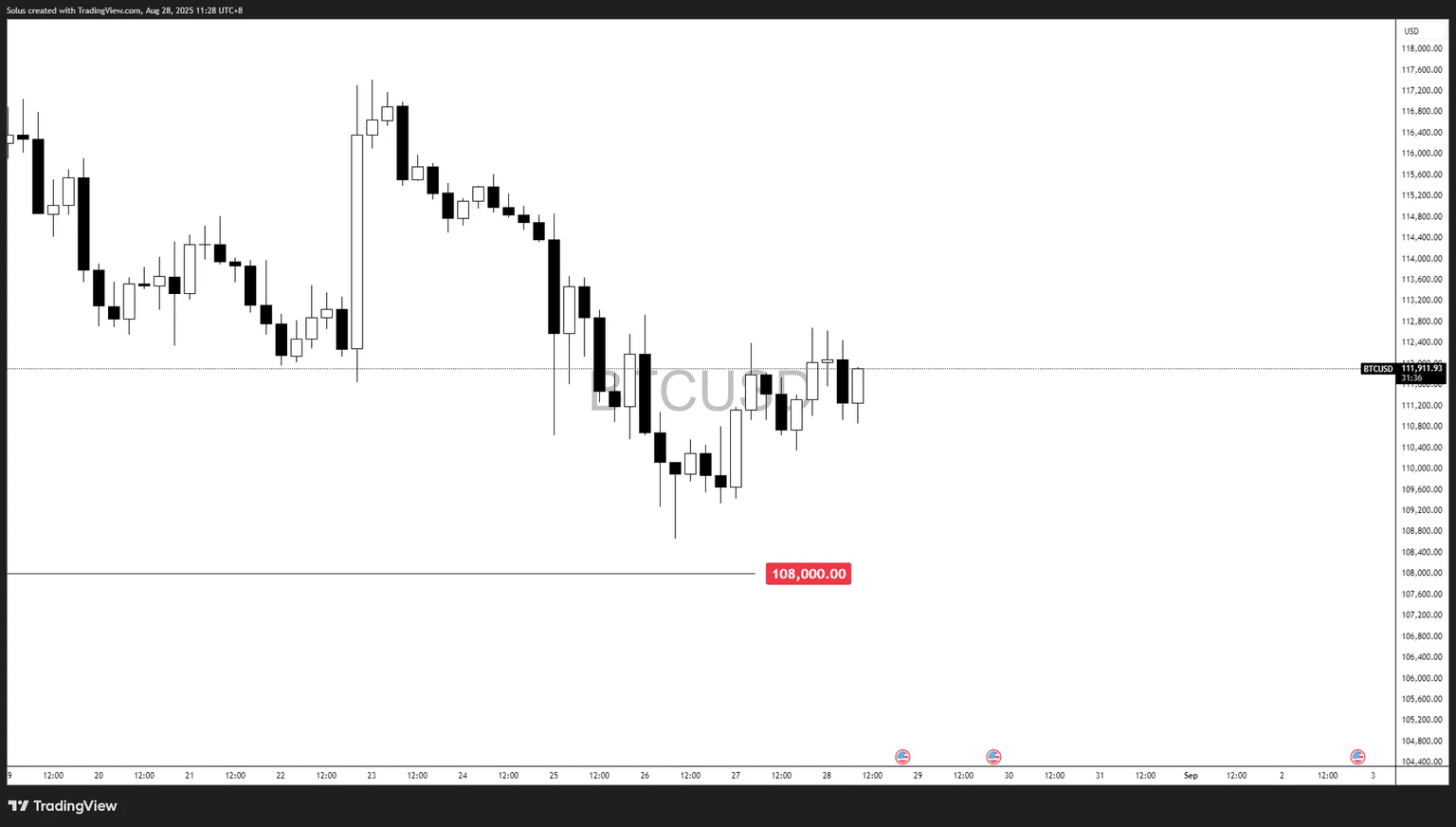
- $108K stands as the decisive battleground, where Bitcoin may either rebound toward $117K or slide further into a risk-off spiral.


Whale pressure meets macro shock
Bitcoin entered the week with fragile footing — and it didn’t take much to spark panic. A whale offloaded nearly 24,000 BTC (~$2.7 billion), causing Bitcoin to collapse from $117,400 to as low as $110,000 in a matter of hours. This move erased more than $550 million in leveraged longs, exposing just how vulnerable liquidity remains when large players strike.
The sharp selloff resembled a classic liquidity sweep, a move often discussed in institutional trading frameworks like SMC, where price aggressively clears positions before seeking equilibrium. The timing — during thin weekend markets — amplified volatility, underscoring how accumulation and distribution cycles can drive exaggerated swings.
Why stagflation hurts Bitcoin

Beyond the whale dump, the macro environment is turning toxic. Market strategists are now warning the Federal Reserve may be forced to accept stagflation — the combination of weak growth and sticky inflation — as its new baseline.
For Bitcoin, this is a double-edged sword:
- In the short term, stagflation fuels risk-off sentiment, where traders dump high-beta assets like BTC and equities alike.
- Policy makers face a dilemma: they can’t cut rates aggressively without reigniting inflation, which removes the liquidity tailwind that historically supported Bitcoin rallies.
- While BTC’s long-term hedge appeal remains, short-term trading is dominated by volatility, requiring traders to lean on price action confirmation rather than blind conviction.
As a result, Bitcoin is currently priced more like a tech stock proxy than a safe-haven hedge, meaning those without a clear risk management plan are the most exposed when volatility spikes.
Ethereum holds its ground

Ethereum (ETH/USD) showed relative strength, trading near $4,427 even as Bitcoin tumbled. Buyers defended the $4,350 support, supported by rotation flows away from BTC.
This resilience reflects Ethereum’s institutional credibility and role as a yield-bearing ecosystem. For traders, this divergence highlights the importance of focusing on key price action levels rather than simply following dominance metrics.
If ETH can hold above $4,350, the path toward $4,700–$4,900 remains open, while BTC must reclaim $113K to stabilize.
Technical outlook: BTC in a compressed consolidation zone

The $108K level remains the key liquidity pocket. Price has tested it but not broken down, creating a “holding pattern” where both bulls and bears are positioning for the next expansion.
- Upside bias: If BTC reclaims momentum above $113K, it would confirm a range breakout and open room toward $116K–$117K, filling inefficiencies left by the prior selloff.
- Downside bias: Failure to hold above $111K, followed by sustained pressure into $108K, risks triggering a liquidity flush with targets at $106K–$103K.
This type of consolidation often precedes an impulsive move, making it critical for traders to lean on liquidity sweep concepts and confirmation models rather than guessing direction.
Bullish scenario: Sweep and higher-low reversal

If Bitcoin dips into $108K and sweeps liquidity, buyers may step in for a relief rally:
- Trigger: Sweep of $108K, reclaiming $111K.
- Targets: First resistance at $113K, then $117K.
- Context: This would mirror a retest confirmation play, where traders wait for structure to be regained before entering.
Another scenario that we could look at: If Bitcoin breaks above $113K, we could see a continuation to the upside reaching until the $115K-$117K level.
Bearish scenario: Failure at resistance and break lower

If BTC attempts a relief bounce but stalls below $113K, it risks confirming distribution. A failed breakout followed by rejection could lead to another leg down, breaking $108K and opening deeper downside liquidity pools.
- Trigger: Rejection under $113K, followed by sustained breakdown below $108K.
- Targets: $106K liquidity first, with extended downside toward $103K.
- Anchor: This would align with a distribution-to-breakdown cycle, a common Smart Money pattern where supply overwhelms demand.
Final take
Bitcoin is no longer in free fall — but it’s far from recovery. The market has entered a compressed consolidation zone between $108K and $113K, where liquidity is building before the next decisive move. This range now acts as the battleground between bulls and bears.
- For bulls, the path is clear: defend $108K-$110K, reclaim $113K, and open the way toward $116K–$117K. This would signal that the whale-driven flush was a liquidity grab rather than the start of a deeper bear leg.
- For bears, the focus is on a breakdown below $108K. If that floor gives way, Bitcoin risks a liquidity-driven cascade into $106K and $103K, confirming the distribution top and reinforcing stagflation-driven risk-off flows.
Ethereum’s relative resilience suggests that capital isn’t leaving crypto entirely, but rather rotating — a sign that Bitcoin is temporarily being treated as the weaker high-beta play.
For traders, the message is simple: the $108K–$113K range is the hinge point. The breakout or breakdown from this zone will dictate whether Bitcoin sees relief toward $117K or sinks deeper into stagflation-fueled downside. In this environment, success won’t come from guessing direction but from trading confirmation after liquidity sweeps and respecting risk parameters.
Author
Jasper Osita
ACY Securities
Jasper has been in the markets since 2019 trading currencies, indices and commodities like Gold. His approach in the market is heavily accompanied by technical analysis, trading Smart Money Concepts (SMC) with fundamentals in mind.