Bhutan govt partners with Binance Pay to launch crypto payments for tourism
- Bhutan government announces partnership with Binance Pay to enable tourists to pay using over 100 cryptocurrencies.
- The Binance Pay integration supports payments via QR codes, helping local vendors to join the global digital economy.
- Bhutan’s crypto-first strategy includes sovereign Bitcoin reserves.

The Royal Government of Bhutan has unveiled the world’s first national crypto-powered tourism payment system through a landmark partnership with Binance Pay and DK Bank.
Bhutan integrates Binance Pay into tourism sector
Led by Prime Minister, Lotay Tshering, Bhutan is set to become the first sovereign country to officially integrate cryptocurrency into its national tourism policy.
In collaboration with Binance Pay and Bhutan’s DK Bank, the initiative enables tourists to make seamless payments using over 100 digital assets across a wide range of services—from visa fees and flight bookings to monument tickets and local roadside purchases.
Crypto payments are automatically converted into Ngultrum (BTN), Bhutan’s fiat currency, ensuring vendors receive price-stable payouts.
According to Binance’s official statement, over 100 Bhutanese businesses have already adopted the platform, many of which are located in rural regions with limited access to credit card infrastructure. The initiative utilizes QR code-based payments, eliminating the need for expensive card terminals and improving financial inclusion at scale.
The system is expected to lower transaction costs for international travelers, ease foreign exchange friction, and allow Bhutanese merchants to tap into global digital finance and the $3 trillion cryptocurrency market.
Bhutan doubles down on crypto economic growth targets
Bhutan’s crypto tourism partnership with Binance is part of a broader national strategy to adopt Cryptocurrencies into the country’s economic strategy.
With a mid-sized GDP of $3.4 billion according to 2025 World bank data, Bhutan has quietly followed in the footsteps of El-Salvador to emerge as one of the nations carrying BTC holdings in treasury.
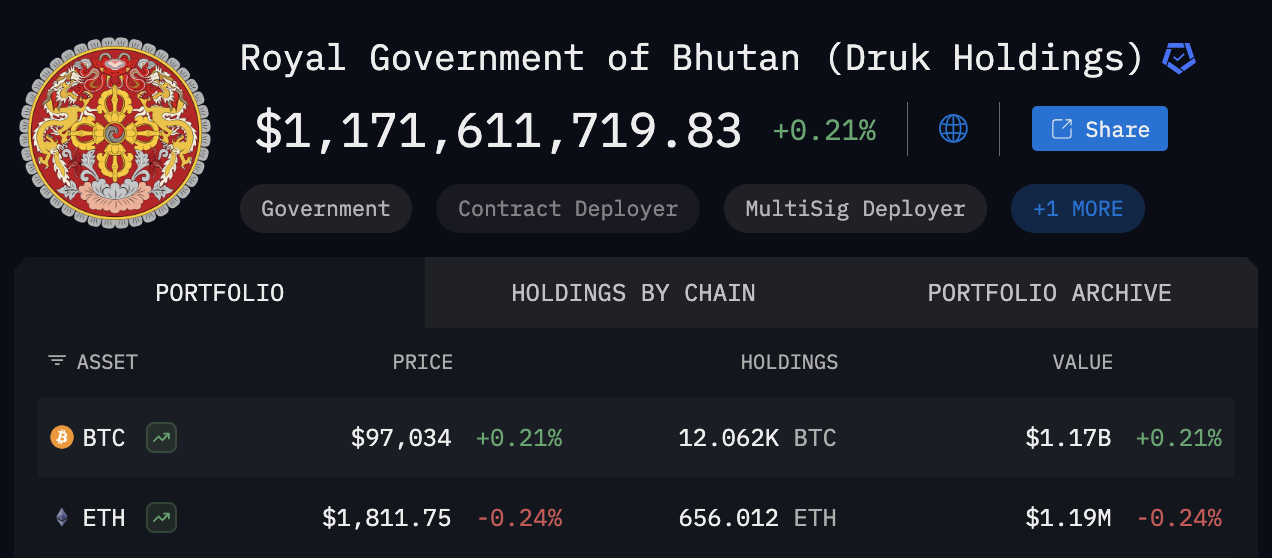
The Royal Government of Bhutan’s cryptocurrency holdings as of May 7 2025 | Source: Arkham
According to data from Arkham Intelligence, the nation now holds $1.2 billion worth of cryptocurrency, the fifth-largest Bitcoin reserve among sovereign states, outpacing even El Salvador.
The Arkham chart above shows that the Royal Government of Bhutan holds 12,000 BTC and just over 659 ETH valued at $1.17 billion and $1.1 million respectively at press time on Wednesday. Notably, majority of Bhutan’s BTC holdings were primarily accumulated through its green Bitcoin mining program powered by abundant hydropower and cool climate conditions in the mountainous Himalaya region.
Local reports also show that Bhutan has previously used digital assets to fund public sector salaries, including for educators, and recently declared that a Special Administrative Region would officially hold Bitcoin, Ethereum, and BNB as part of its strategic treasury.
What’s next?
The Bhutan government aims for the sector to contribute up to 20% of national GDP. Leveraging Binance Pay integration could attract a new wave of crypto-savvy travelers while offering local merchants unprecedented access to global liquidity.
As Bhutan becomes the first mover in national crypto tourism integration, if successful, the model could be adopted by other small, resource-efficient economies seeking to unlock new GDP drivers through cryptocurrencies and decentralized finance.
Notably, the initiative also opens the door to critical regulatory considerations, such as stablecoin settlements, crypto taxation, and the role of banks in local payment transactions, all of which are likely to become subjects of scrutiny across the region in the coming years.
Author

Ibrahim Ajibade
FXStreet
Ibrahim Ajibade is an accomplished Crypto markets Reporter who began his career in commercial banking. He holds a BSc, Economics, from University of Ibadan.