|

Yield Curve Flattens Considerably: Surprising Economic Strength Revisited

Curve Watchers Anonymous is taking a hard look at the yield curve in light of the now odds-on market view of a March rate hike.

Before looking at the chart below, where do you think rates are relative to January 2014? Up, down, or sideways?

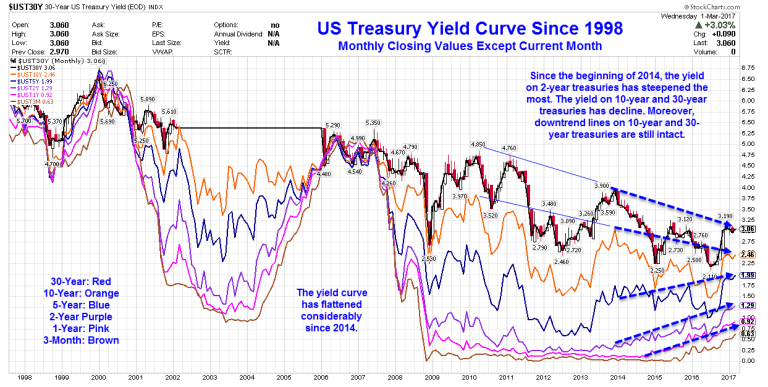
Yield Curve Since 1998
Yield Curve

The chart shows monthly closing values except for the current month.

Change Since January 2014

Duration1-Jan-141-Mar-17Direction
30 Year3.963.06-0.90
10 Year3.042.46-0.58
5 Year1.751.990.24
2 Year0.381.290.91
1 Year0.130.920.79
30 Days0.070.630.56

The 2-30 spread flattened by a whopping 181 basis points in just over two years.

The 2-10 spread flattened by 149 basis points.

A flattening of the yield curve is not good for bank profits. Rising 10-year yields since mid-2016 are not good for mortgages or housing affordability.

Not to worry, despite poor economic reports, Fed governors have stated: “This is a surprisingly strong economy.”

Author

Mike “Mish” Shedlock's

Mike “Mish” Shedlock's

Sitka Pacific Capital Management,Llc

Mike “Mish” Shedlock is a registered investment advisor for SitkaPacific Capital Management.

More from Mike “Mish” Shedlock's
Share:

Editor's Picks

AUD/USD bulls regain control above 0.6950 amid USD retreat

AUD/USD regains traction and extends the previous day's bounce from the weekly low, aiming for 0.7000 in Asia on Friday. The overnight pullback in US bond yields keeps the US Dollar below an 18-month high, which in turn offers some support to the pair. Meanwhile, hawkish RBA expectations also keep the major underpinned.

USD/JPY holds gains near 158.00 after Japan's weak Household Spending data

USD/JPY clings to gains around 158.00 after data showed on Friday that Japan's Household Spending fell for the ninth straight month, undermining the Japanese Yen. Meanwhile, the US Dollar remains depressed as the overnight fall in US bond yields counters a hawkish Fed and geopolitical uncertainties, could cap any downside in the pair.

Gold firms up toward $4,200 as USD pulls back

Gold trades with a positive bias for the second straight day on Friday, though it remains range-bound in the range it has traded in over the past two weeks or so. The overnight decline in US bond yields keeps the US Dollar depressed below an 18-month high, allowing the non-yielding bullion to recover further from a two-month low in a bid to retest the $4,200 level.

Ethereum drops below $2,500 as rising Treasury yields trigger selling pressure​
Ethereum (ETH) fell below $2,500 on Thursday, down nearly 4% and extending losses for a third consecutive day. The decline follows rising Oil prices and US Treasury yields over the past few days. The 10Y Note Yield reached a 24-year high at 5.35%, and the 30Y Note Yield climbed above 5.70% earlier on the day, sparking major distributions in the crypto market.
The inflation illusion: How government formulas shape the data
Every month, the government releases a barrage of economic statistics. Employment, inflation, consumer spending, economic growth, and countless other measurements are presented as objective facts that policymakers, investors, and the public can use to understand the economy. But what happens when the methodology used to produce those numbers changes?
The UK 30-year gilt just hit a 1998 high. Is that good or bad for the British Pound?
The yield on the UK's 30-year government bond, or gilt, went through 6% on October 1 for the first time since early 1998, and on Monday the Pound was at its strongest against the Euro since June 2025. The gilt market's 28-year high is mostly someone else's. Since early May, the 30-year gilt yield has risen about 0.15 of a percentage point and the US 30-year about 0.7.