Yen recovery gathers momentum as BoJ turns hawkish and NFP looms

The Japanese yen has started September on a markedly stronger footing, with the USD/JPY falling sharply as traders reassess the outlook for Bank of Japan monetary policy and the possibility of further official action to support the currency.
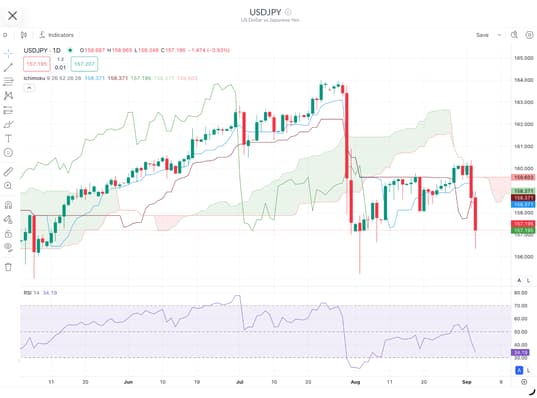
Daily USD/JPY Chart - Source: ActivTrader
The yen surged nearly 1.5% on Thursday to around 156.349 per dollar at its lowet level of the day so far, its strongest level in roughly a month, after gaining about 0.91% in the previous session. The move has revived speculation that Japanese authorities may have intervened in the foreign-exchange market, although the latest price action appears more consistent with a shift in monetary-policy expectations than the abrupt moves normally associated with intervention.
For USD/JPY traders, however, the important question is no longer simply whether Tokyo will intervene. Instead, markets are increasingly asking whether the combination of a potentially faster Bank of Japan tightening cycle, rising Japanese bond yields and the threat of further currency intervention can produce a more durable yen recovery. But the answer also depend on Friday’s US nonfarm payrolls report and its impact on traders’ expectations regarding the Fed’s monetary policy trajectory.
BoJ expectations are becoming increasingly hawkish
The most immediate catalyst for the yen’s recovery has been a change in expectations surrounding the BoJ.
Board member Hajime Takata delivered an unusually hawkish message this week, arguing that the central bank should adjust interest rates "nimbly" rather than follow a predetermined schedule of roughly two increases per year. Takata, who was the sole dissenter when the BoJ kept rates unchanged in July, said Japan had entered a turning point in which policymakers needed to respond more flexibly to developments in inflation and the economy.
What does it mean for FX markets?
A September rate increase is already close to fully priced into markets. The bigger potential shift concerns what happens afterwards. If the BoJ moves from a gradual tightening cycle towards a meeting-by-meeting approach, investors could begin pricing a significantly higher terminal rate than previously anticipated.
Reuters has reported that the BoJ could raise rates as soon as its September 18 meeting and that policymakers are considering a faster pace of tightening thereafter. That would represent a fundamental change for the yen.
For years, the currency has been weighed down by the enormous interest-rate differential between Japan and the United States. Even with the BoJ gradually exiting its ultra-loose monetary policy, Japanese rates have remained far below US rates, encouraging investors to borrow yen and invest in higher-yielding assets elsewhere. A faster BoJ hiking cycle would begin to challenge that carry-trade dynamic.
Japanese bond yields add another layer of support
The yen’s recovery is also occurring against the backdrop of a dramatic rise in Japanese government bond yields.
Japan’s benchmark 10-year yield reached 3% this week for the first time since 1996. The move reflects a combination of stronger inflation expectations, concerns over Japan’s fiscal position and growing speculation that the BoJ will need to raise interest rates more quickly. Higher domestic yields can make Japanese assets more attractive relative to overseas alternatives. This is particularly relevant because Japanese institutional investors have historically allocated substantial amounts of capital to foreign bonds and other overseas assets.
Recent data already indicate that this flow could be changing. Japanese investors sold a net ¥3 trillion of overseas debt through August 22, according to Reuters, as higher domestic yields and currency-hedging costs encouraged greater interest in Japanese bonds. For the USD/JPY par, this creates a potentially powerful second channel of yen support. It is no longer solely about what the BoJ does with its policy rate; the entire Japanese yield curve and associated capital flows are becoming increasingly relevant.
Intervention remains a major risk for Dollar bulls
Monetary policy is not the only reason traders should be cautious about betting aggressively against the yen.
Japan and the United States carried out a rare joint yen-buying intervention on July 31 after the currency had fallen towards 164 per dollar. The operation initially provided support but failed to generate a lasting reversal, with the yen subsequently returning towards the 160 level. This time, however, the threat of intervention could be more effective if it is combined with a hawkish BoJ.
Japanese Finance Minister Satsuki Katayama and US Treasury Secretary Scott Bessent have agreed to continue coordinating to ensure orderly yen movements. Bessent has also indicated that he expects the Japanese government and BoJ to take measures that contribute to a stronger currency.
That does not mean another intervention is imminent. Bessent recently described yen movements as relatively contained rather than disorderly, suggesting that the threshold for another coordinated operation has not necessarily been reached. Nevertheless, the intervention risk changes the risk-reward equation around the USD/JPY. If the Forex pair were to return rapidly towards the 160 area, traders would need to consider not only technical resistance but also the possibility of verbal or actual official intervention.
The US side of the equation is equally important
Despite the yen’s improving fundamentals, USD/JPY remains highly sensitive to US monetary policy.
This makes Friday’s nonfarm payrolls report the next major test for the recent yen recovery. Analysts are forecasting an increase of approximately 56,000 jobs in August, following July’s unexpected 23,000 decline, while the unemployment rate is expected to remain at 4.1%.
The latest US labour-market indicators have not been particularly encouraging. Private payrolls increased by only 38,000 in August, below expectations of around 48,000. The ADP report showed that gains in education and healthcare were partly offset by job losses in manufacturing and professional and business services. The JOLTS report has also pointed towards a lower-hiring, lower-turnover labour market. Job openings increased slightly to 7.3 million in July, but the hiring rate declined to 3.2% from 3.4% in June.
Markets are currently pricing a significant probability of another Fed rate increase in September, but a weak NFP could undermine those expectations. Conversely, a stronger-than-expected employment report would reinforce the argument for maintaining or increasing US rates, widening the yield advantage of the dollar over the yen.
Stay up to date with what's moving and shaking on the world's markets and never miss another important headline again! Check ActivTrades daily news and analyses here.
Author

Carolane de Palmas
ActivTrades
Carolane graduated with a Masters in Corporate Finance & Financial Markets and got the AMF Certification (Financial Markets Regulator in France). Afterward, she became an independent trader, investing mostly in European and American stocks/indices.