|

XAU/USD outlook: Gold bounces from new 2026 low on profit-taking / reaction on Trump's comments
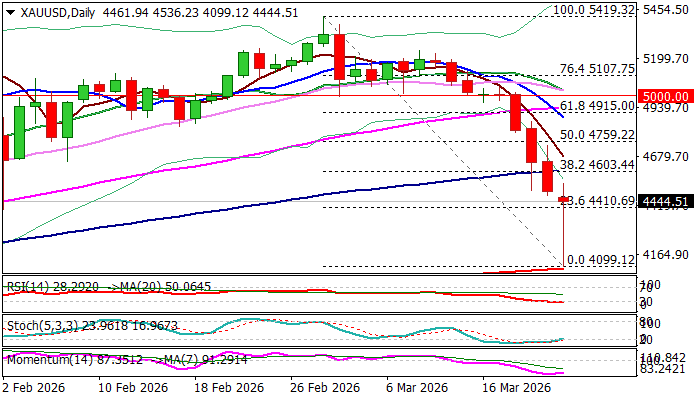
Gold hit the lowest this year ($4100) after falling nearly 8% in the Asian session on Monday.

Persisting negative sentiment, which drove the price for 10% drop last week (the biggest weekly loss in decades) was additionally boosted by growing expectations of rate hikes as strong rise on oil prices fuels inflation in its domino-effect to global economies that keeps major central banks on high alert and makes the metal less attractive for investors.

Gold price fell about 20% from its all-time high of Jan 29 ($5598) and is on track for a record monthly loss in March.

Near term action shows bounce from the session low, where ascending 200DMA provided solid support, with oversold daily studies contributing to profit taking that lifted the price over $4 so far.

But the main driver of gold’s latest jump was the comment from President Trump about postponing military strikes on Iranian infrastructure which boosted optimism about potential de-escalation of the conflict that put the whole region in fire and threatening of huge consequences on global economy.

Recovery eyes key barrier at $4600 (Fibo 38.2% of $5419/$4100 / 100 DMA), violation of which would generate fresh bullish signal and expose net targets at $4759 (50% retracement) and $4800 (round figure).

However, developments on the fundamental side will remain as dominant factor and will be closely watched for fresh direction signal.


Res: 4536; 4600; 4684; 4759

Sup: 4410; 4343; 4223; 4163
Author

Slobodan Drvenica

Slobodan Drvenica

Windsor Brokers

Industry veteran with over 22 years’ experience, Slobodan Drvenica joined Windsor Brokers in 1995 when he was an active trader for more than 10 years, managing the trading desk and own account departments.


More from Slobodan Drvenica
Share:

Editor's Picks

AUD/USD flirts with 0.7000, lowest since early August amid bullish USD

AUD/USD hits a fresh low since early August during the Asian session on Friday and looks vulnerable near 0.7000 after breaking below the 200-day SMA overnight. Against the backdrop of the hawkish Fed, a two-day rally in oil prices revives inflation fears and continues to push US bond yields to multi-year highs. Adding to this, geopolitical risks lift the US Dollar to a two-month high, overshadowing RBA rate hike bets and weighing on the pair.

USD/JPY pulls back from three-week high after failing near 159.00

USD/JPY edges lower during the Asian session on Friday, stalling its recent strong move to a three-week high of 159.00 as Japanese Yen bears turn cautious amid intervention fears. Meanwhile, the US Dollar retains a strong bullish undertone as the Fed's hawkish outlook and oil-driven inflation fears continue to push US bond yields to multi-year peaks. Furthermore, the BoJ's dovish rate hike last week might cap JPY and support spot prices.

Gold treads water below $4,300

Gold grabs some buying attention and advances marginally at the end of the week, partially retracing the weekly decline, although it is still navigating below the key $4,300 mark per troy ounce. The fresh selling bias on the Greenback and the modest decline in US Treasury yields appear to support the humble advance in the precious metal.

Crypto Today: Bitcoin and Ethereum edge lower, XRP extends recovery as macro headwinds weigh

The broader cryptocurrency market is consolidating on Friday, with Bitcoin paring losses slightly above $84,000. Ethereum declines in tandem with BTC. Ripple (XRP), meanwhile, paints a different picture.


Fed vs BoJ: Both hiked. The market only believes one of them – and the chart shows which
The Federal Reserve (Fed) and the Bank of Japan (BoJ) have just done something remarkably similar. Both central banks raised interest rates by 25 basis points (bps) last week, both are confronting inflation risks, and both signal that future decisions will depend on incoming economic data.
Fed vs BoJ: Both hiked. The market only believes one of them – and the chart shows which

The Fed and the BoJ have just done something remarkably similar. Both central banks raised interest rates by 25 bps last week, both are confronting inflation risks, and both signal that future decisions will depend on incoming economic data.













